
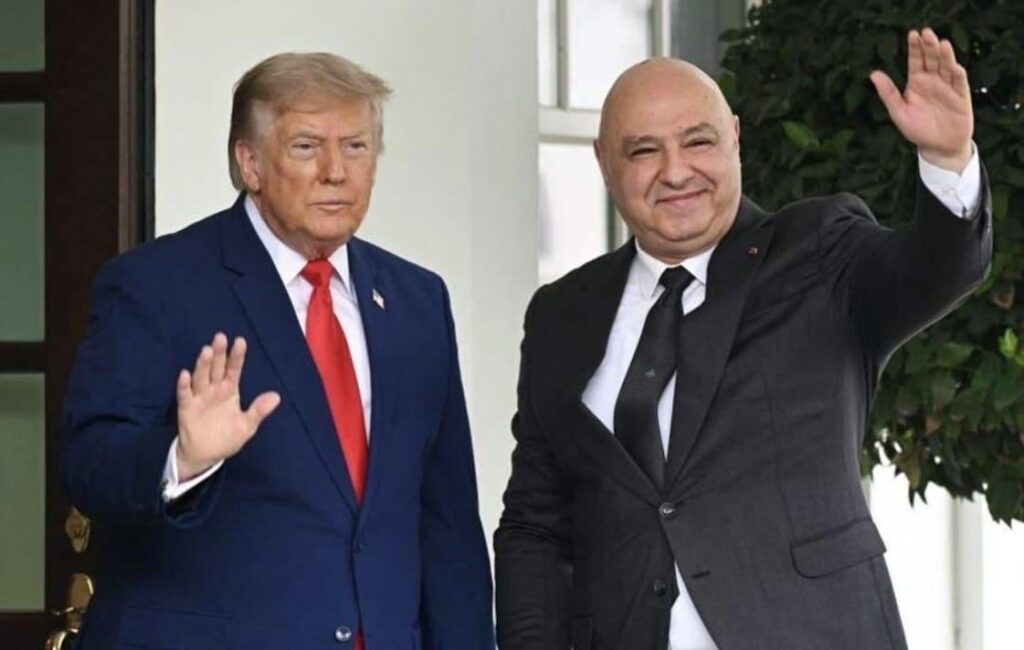
Image: from Shada Omar شدا عمر X @Shadaomar
By Open Chronicle News Desk with Agencies
U.S. President Donald Trump welcomed Lebanese President Joseph Aoun to the White House on Tuesday for high-level talks focused on strengthening Lebanon’s security, expanding military cooperation and advancing efforts to stabilize the region.
The meeting comes at a critical moment for Lebanon as Beirut seeks greater international support to reinforce state institutions, implement a U.S.-backed security framework in southern Lebanon and secure the withdrawal of Israeli forces from remaining occupied areas.
US President Donald Trump welcomed Lebanese President Joseph Aoun to the White House for talks centred on Hezbollah's disarmament and Israel's withdrawal from southern Lebanon.
Aoun's visit marks the first by a Lebanese head of state to the White House in nearly two decades.… pic.twitter.com/pACoQtMm43
— India Today Global (@ITGGlobal) July 21, 2026
Security and military cooperation at the forefront
During the discussions, the two leaders reviewed the security situation in Lebanon and explored ways to deepen cooperation between the United States and the Lebanese Armed Forces (LAF).
President Aoun emphasized Lebanon’s commitment to extending the authority of the state throughout its territory, particularly in the south, where the Lebanese Army has been deploying under a U.S.-mediated framework designed to replace armed non-state actors with state security institutions.
The United States has long been one of the principal supporters of the Lebanese military, providing training, equipment and financial assistance aimed at strengthening the country’s official security forces.
#USA #LEBANON #WashingtonDC #DC
🔴 WASHINGTON DC : Pres. TRUMP AND LEBANESE Pres. AOUN MET IN WHITE HOUSE
White House talks put Lebanon’s security and economic RESET in Focus.
Pres. Aoun said: “I've been looking forward to this visit for a long time — meeting such a great… pic.twitter.com/5ofb8gpLuL
— LW World News (@LW_WorldNews) July 21, 2026
Implementing the framework agreement
A major topic of the meeting was the implementation of the recently negotiated framework agreement intended to consolidate the ceasefire between Lebanon and Israel.
The agreement includes the gradual deployment of the Lebanese Army into areas previously affected by conflict, alongside phased Israeli withdrawals from parts of southern Lebanon under international monitoring.
President Aoun reportedly presented Washington with proposals intended to reinforce Lebanese sovereignty while addressing the future status of Hezbollah’s military capabilities through state-led mechanisms and political dialogue.
Reconstruction and economic support
Beyond security issues, the leaders also discussed Lebanon’s urgent economic and reconstruction needs.
Large areas of southern Lebanon continue to require rebuilding following months of fighting, while the country remains mired in one of the world’s most severe financial crises.
According to reports, Lebanese officials sought expanded U.S. assistance for reconstruction projects, humanitarian relief and continued international financial support as part of broader efforts to stabilize the country.
Regional stability
The White House meeting also addressed wider regional developments, including tensions involving Israel, Iran and armed groups operating across the Middle East.
Trump reiterated U.S. support for a stable and sovereign Lebanon while emphasizing the importance of preventing renewed conflict along the Israeli-Lebanese border.
President Aoun stressed that long-term stability depends upon strengthening state institutions, preserving Lebanon’s sovereignty and reducing the risk of further military escalation.
A significant diplomatic milestone
The visit marks the first official White House meeting by a Lebanese president in nearly two decades, highlighting renewed diplomatic engagement between Washington and Beirut.
Observers view the talks as an important step in shaping the next phase of U.S.-Lebanon relations, particularly regarding security cooperation, regional diplomacy and support for Lebanese state institutions.
While many of the proposals discussed will require continued negotiations and coordination with regional partners, both governments presented the meeting as an opportunity to strengthen bilateral ties and pursue greater stability across the Eastern Mediterranean.