
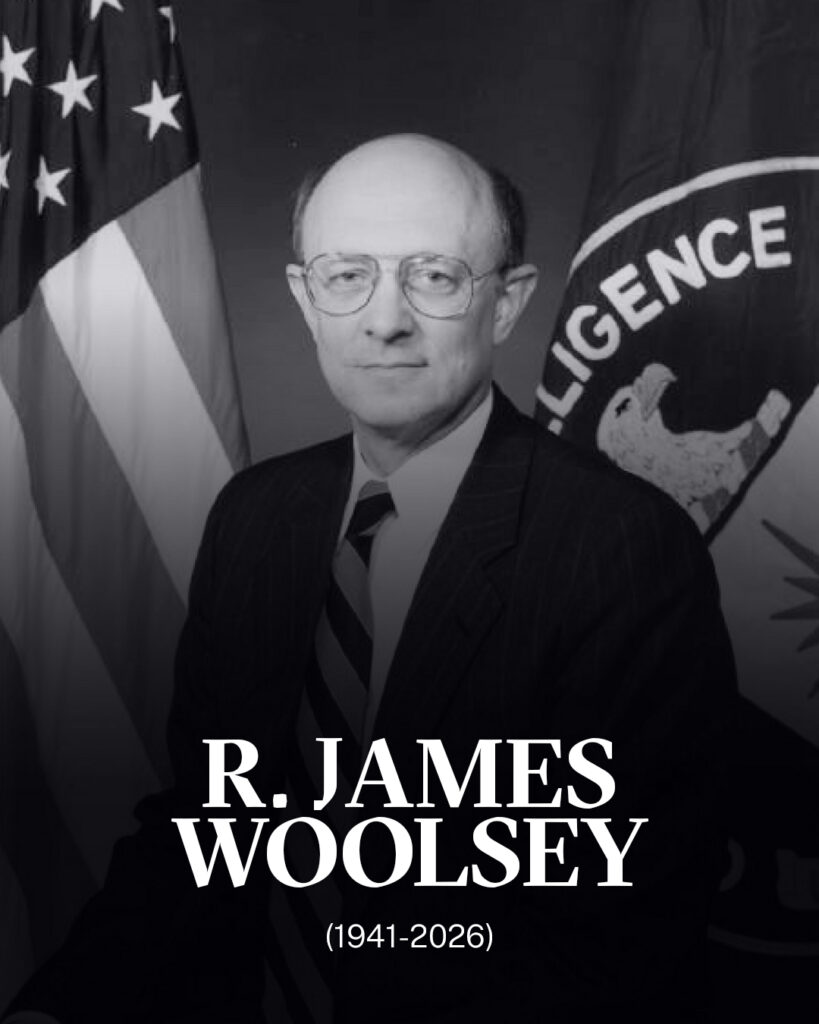
Image: from CIA X @CIA
By Open Chronicle News Desk with Agencies
R. James Woolsey, the former Director of the Central Intelligence Agency (CIA) who helped steer U.S. intelligence through the uncertain years following the end of the Cold War, has died at the age of 84.
Woolsey passed away on Tuesday at his home in Washington, D.C., after suffering a stroke, according to his wife, Conchita Sarnoff Woolsey. She also revealed that he had experienced declining health linked to Havana syndrome, the mysterious condition that has affected hundreds of American diplomats, intelligence officers and government personnel stationed overseas.
His death marks the passing of one of the most influential national security figures of the post-Cold War era, a man who served Democratic and Republican administrations while remaining an outspoken advocate for strong American intelligence capabilities.
Leading the CIA in a changing world
Woolsey became Director of Central Intelligence in 1993, during the first administration of President Bill Clinton, at a time when the United States was reassessing its global intelligence priorities after the collapse of the Soviet Union.
Many policymakers believed the end of the Cold War had significantly reduced the threats facing the United States. Woolsey, however, warned against such optimism.
During his Senate confirmation hearing, he delivered one of the most memorable assessments of the new strategic environment.
“Yes, we have slain a large dragon. But we live now in a jungle filled with a bewildering variety of poisonous snakes.”
With those words, Woolsey argued that although the Soviet Union had disappeared, the United States still faced growing dangers from international terrorism, North Korea, the proliferation of weapons of mass destruction and transnational organised crime.
His warning would later be viewed by many analysts as remarkably prescient.
The Aldrich Ames espionage scandal
Woolsey’s tenure was dominated by one of the most damaging intelligence failures in CIA history.
In 1994, veteran CIA officer Aldrich Ames was arrested after admitting he had spied for the Soviet Union and later Russia for nearly a decade, compromising numerous intelligence operations and exposing American assets.
The scandal severely damaged the agency’s reputation and prompted widespread calls for accountability.
Woolsey formally reprimanded 11 current and former CIA officials but declined to dismiss any personnel, arguing that those most responsible had already retired and that the failures reflected systemic weaknesses rather than the actions of a single individual.
Difficult relationship with President Clinton
Although appointed by President Clinton, Woolsey later acknowledged that his relationship with the White House was often distant.
He frequently remarked that he had only a handful of face-to-face meetings with the president during his nearly two years leading the CIA.
Years later, Woolsey joked that the pilot who crashed a small aircraft onto the White House lawn in 1994 “was me trying to get an appointment to see President Clinton.”
The humorous remark became one of the most frequently quoted anecdotes illustrating the limited interaction between the CIA director and the president during that period.
A lifetime in national security
Before becoming CIA director, Woolsey built a distinguished career in defence and strategic affairs.
He served as Under Secretary of the Navy during the administration of President Jimmy Carter and later participated in strategic arms negotiations under Presidents Ronald Reagan and George H. W. Bush.
Throughout his career, he became known as a respected national security expert whose views often transcended party politics.
Although registered as a Democrat for much of his public life, Woolsey developed a reputation for advocating robust defence policies that frequently aligned with conservative foreign policy positions.
Continued influence after government service
Following his departure from the CIA in 1995, Woolsey remained active in public policy and international affairs.
He practiced law, worked as a consultant and continued to write and speak on intelligence, defence and energy security issues.
In 2016, he briefly served as a senior adviser to Donald Trump’s presidential transition team before leaving shortly before the inauguration.
Even outside government, Woolsey remained a prominent voice in debates over counterterrorism, intelligence reform and national security.
Academic achievements
Woolsey combined his public service with an impressive academic background.
He graduated from Stanford University, earned a prestigious Rhodes Scholarship to study at the University of Oxford, and later received his law degree from Yale Law School.
Colleagues often described him as an intellectual strategist whose ability to analyse complex geopolitical issues made him one of Washington’s most respected security thinkers.
Legacy
James Woolsey’s career spanned more than four decades of American defence and intelligence policy, covering the Cold War, nuclear arms negotiations and the emergence of new global security threats.
His early warnings that the United States faced a more fragmented and unpredictable security environment after the Cold War proved influential in shaping strategic thinking within the intelligence community.
As Director of Central Intelligence, he led the agency through one of the most consequential transitional periods in modern intelligence history, while continuing throughout his life to argue that effective intelligence gathering remained indispensable to protecting the United States.
He is survived by his wife, Conchita Sarnoff Woolsey, three sons from his first marriage, two stepchildren, and ten grandchildren.