
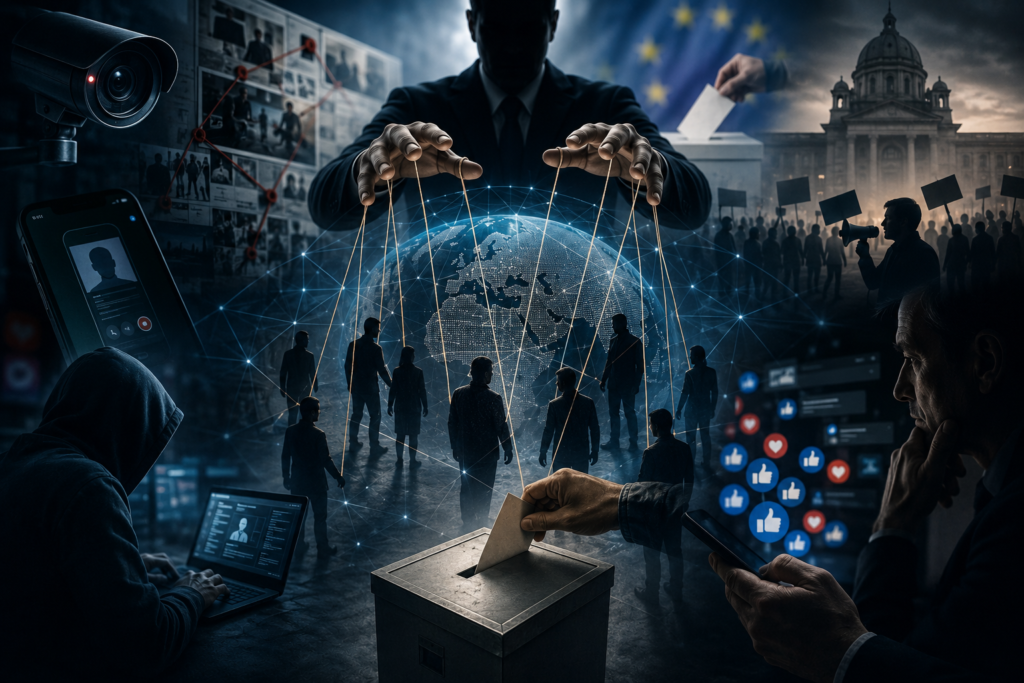
Image Credentials: Image Title: Spies at the Ballot Box: How Private Intelligence Firms Are Reshaping Election Interference. Source: (chatgpt.com) Date: July 2026. Attribution: This image was created using AI-generated imagery (chatgpt.com) by Open Chronicle and does not depict a real-world scene.
By Open Chronicle News Desk with Agencies
Election interference is no longer solely the domain of nation states and intelligence agencies. Increasingly, intelligence tradecraft is being offered as a commercial service, creating a global market where private firms, former spies and digital influence specialists provide sophisticated operations capable of shaping political narratives, undermining public confidence and influencing democratic processes.
Recent investigations across Europe suggest that Israeli-origin private intelligence companies have become recurring actors in this expanding ecosystem, employing techniques that blend human intelligence, cyber capabilities, fabricated online identities and coordinated information campaigns.
While the companies involved deny wrongdoing or insist they operate within legal commercial boundaries, intelligence agencies and investigators argue that these activities represent a growing challenge to democratic sovereignty.
Slovenia raises alarm over foreign influence
The issue came into sharp focus ahead of Slovenia’s parliamentary election in March 2026.
In the weeks leading up to the vote, professionally produced videos alleging corruption involving figures connected to the governing coalition appeared online at strategically timed moments.
Following the election, Slovenia’s Intelligence and Security Agency (SOVA) confirmed that it had identified foreign influence operations surrounding the campaign.
According to official statements, investigators uncovered evidence of activities conducted by what authorities described as a foreign para-intelligence organisation, including documented contacts between representatives linked to Black Cube, an Israeli-origin private intelligence firm, and Slovenian entities.
Evidence reportedly placed three identified individuals at locations connected to the country’s main opposition party.
The opposition leader acknowledged meeting one adviser associated with Black Cube but denied any improper conduct related to the election.
Black Cube rejected suggestions that it had participated in political interference, stating that it provides services exclusively to corporate clients involved in litigation, arbitration and white-collar investigations.
Regardless of who commissioned the operation, Slovenian authorities argue the episode demonstrated how private intelligence capabilities can now be deployed inside established European democracies.
Beyond traditional election interference
Unlike conventional state-sponsored propaganda, modern influence operations often lack clear government attribution.
Instead, investigators describe an increasingly complex marketplace where former intelligence officers, private security firms, political consultants, digital influence specialists and local intermediaries cooperate through commercially contracted operations.
These campaigns combine multiple disciplines, including:
- Human intelligence collection.
- Cyber capabilities.
- Fabricated online identities.
- Coordinated social media amplification.
- Narrative manipulation.
- Reputation attacks.
Rather than directly changing election results, specialists say the primary objective is to undermine confidence in institutions, media organisations and the broader democratic process.
The Hungarian example
One of the best-documented cases emerged in Hungary.
According to LinkedIn, Black Cube created an extensive network of fake professional profiles between 2020 and the country’s 2022 parliamentary election.
Using fictitious employment opportunities, the network contacted journalists and civil society activists critical of Prime Minister Viktor Orbán.
Individuals who agreed to participate in online interviews were secretly recorded during video calls.
Selected excerpts later appeared in pro-government media, where they were used in efforts to discredit independent journalists and non-governmental organisations.
LinkedIn attributed the operation to Black Cube, removed the fake accounts and deleted the firm’s company page for violating platform policies.
Black Cube denied conducting cyber operations, maintaining that its work remains confined to commercial litigation support.
France investigates BlackCore
French authorities have meanwhile focused attention on another Israeli-linked company, BlackCore.
In June 2026, France’s digital security agency Viginum reported technical findings connecting BlackCore to suspected online influence campaigns during the country’s local elections.
Investigators alleged that deceptive websites and coordinated social media accounts spread false accusations targeting candidates from La France Insoumise, accompanied by organised online amplification.
According to French officials, similar techniques appeared during elections or political campaigns in Scotland, New York, Angola and Togo.
French authorities requested assistance from Israel in identifying those responsible for commissioning the campaigns, although the clients remain publicly unidentified.
BlackCore describes itself as a technology and influence company specialising in strategic communications and narrative development.
Team Jorge and the private influence industry
Public attention toward the commercial intelligence sector intensified in 2023, when the collaborative investigation by Forbidden Stories and The Guardian exposed the activities of Team Jorge, a group led by Israeli businessman Tal Hanan.
Undercover recordings showed Hanan presenting what he described as a full-service election influence operation capable of:
- Hacking email and messaging accounts.
- Operating large automated disinformation networks.
- Conducting covert sabotage campaigns.
- Manipulating online narratives.
- Deploying fabricated digital identities.
The investigation included demonstrations involving political communications linked to elections in Kenya, while leaked documents referred to previous work connected to Nigeria and numerous other countries.
Hanan rejected allegations of wrongdoing, describing Team Jorge’s activities as legitimate commercial services.
Although investigators have not verified every claim made by the group, the reporting illustrated the breadth of capabilities now available on the private market.
Public trust becomes the target
Security experts increasingly argue that these operations are designed less to persuade voters than to weaken confidence in democratic institutions themselves.
Journalists become targets of covert recording.
Civil society organisations face coordinated smear campaigns.
Political parties confront professionally orchestrated leaks and reputation attacks.
The cumulative effect is to create uncertainty over what information can be trusted and whether democratic processes remain fair.
Unlike traditional espionage, commercial influence operations are more difficult for governments to deter because responsibility is fragmented across private companies, subcontractors and anonymous clients.
This creates significant legal and diplomatic challenges for democratic governments attempting to investigate foreign influence.
Democracies face a new challenge
Analysts argue that many Western democracies continue to focus election security primarily on protecting voting systems from cyberattacks.
While safeguarding ballots remains essential, experts increasingly warn that the broader information environment has become equally important.
Protecting elections now requires greater transparency surrounding:
- Foreign political consultancy.
- Private intelligence contracting.
- Digital influence campaigns.
- Coordinated inauthentic online behaviour.
- Cross-border information operations.
Several governments are already considering stronger disclosure requirements for political consulting firms and expanded powers for independent authorities to investigate covert influence campaigns during election periods.
A growing global marketplace
The emergence of commercially available intelligence services has fundamentally altered the landscape of election security.
Instead of relying exclusively on state intelligence agencies, political actors may now access sophisticated influence capabilities through private contractors operating across international borders.
Whether the objective is collecting compromising information, amplifying damaging narratives or undermining confidence in democratic institutions, investigators increasingly view these services as part of an expanding global marketplace for political influence.
As governments seek to adapt their legal and security frameworks, the central challenge extends beyond protecting the act of voting itself. Preserving democracy increasingly depends on safeguarding the public trust that gives elections their legitimacy in the first place.