
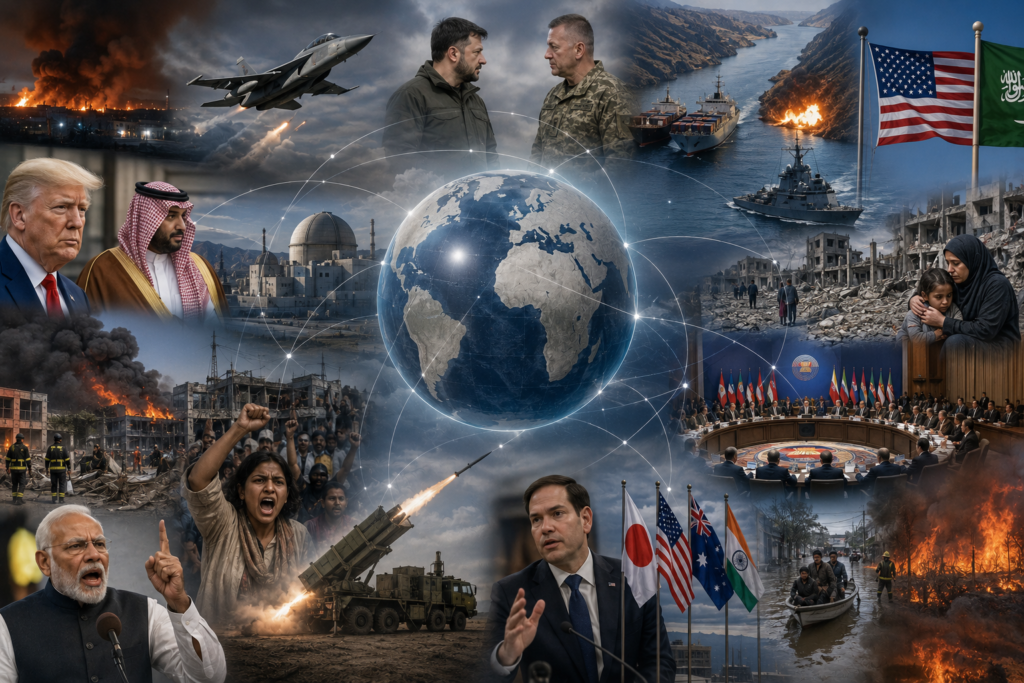
Image Credentials: Image Title: Global News Brief: Key Developments Around the World on July 22, 2026. Source: (chatgpt.com) Date: July 2026. Attribution: This image was created using AI-generated imagery (chatgpt.com) by Open Chronicle and does not depict a real-world scene.
By Open Chronicle News Desk with Agencies
The international security landscape remained highly volatile on 22 July 2026, as fighting between the United States and Iran intensified for an eleventh consecutive night, Ukraine announced another major military leadership shake-up, and diplomatic activity accelerated across Asia and the Middle East. Elsewhere, European nations confronted security and climate challenges while humanitarian crises deepened in Africa and Gaza.
United States and Iran continue military escalation
The confrontation between Washington and Tehran intensified as both sides exchanged new attacks across the Gulf region.
The U.S. military launched its eleventh consecutive night of strikes against Iranian military targets, focusing on infrastructure linked to operations around the Strait of Hormuz, while Iranian media reported American strikes against Larak Island and additional locations in southern Iran.
The Islamic Revolutionary Guard Corps (IRGC) claimed fresh attacks against U.S. military installations in Jordan, while Jordanian authorities confirmed intercepting multiple Iranian missiles following explosions near Aqaba. Iranian officials also claimed attacks against American bases, though casualty figures remain disputed.
U.S. Secretary of State Marco Rubio warned Asian leaders that accepting Iranian demands regarding the Strait of Hormuz would create a dangerous international precedent and further threaten global trade.
At the same time, questions continue to surround diplomatic efforts aimed at ending the conflict, even as Washington maintains it remains open to negotiations with Tehran.
Trump approves U.S.-Saudi nuclear agreement
The Trump administration approved a landmark civilian nuclear cooperation agreement with Saudi Arabia, according to multiple reports.
The deal could permit Saudi uranium enrichment under certain conditions, representing a significant shift in U.S. policy toward the Kingdom.
The agreement has generated international debate over nuclear safeguards, with critics expressing concern that the arrangement may not include the International Atomic Energy Agency’s most stringent inspection requirements.
The agreement also reflects Washington’s broader effort to strengthen strategic ties with Gulf partners amid growing regional instability.
Lebanon seeks Israeli withdrawal
Lebanese President Joseph Aoun met U.S. President Donald Trump at the White House as Beirut continued to press for a complete Israeli military withdrawal from southern Lebanon.
Prime Minister Nawaf Salam reiterated that restoring sovereignty over southern Lebanon remains a national priority, while Italy announced plans to facilitate renewed dialogue between Lebanon and Israel regarding border demarcation.
Meanwhile, Israeli military operations continued in southern Lebanon as deployments entered a second day, and discussions over Hezbollah’s future disarmament remained politically sensitive.
Ukraine reshapes military leadership
President Volodymyr Zelensky carried out another major restructuring of Ukraine’s military command.
Following the dismissal of Commander-in-Chief Oleksandr Syrskyi, Zelensky appointed General Mykhailo Drapatyi to lead the Armed Forces and named Major General Ihor Skybiuk as the new Chief of the General Staff.
The appointments follow several days of protests and come as Ukraine continues to face heavy Russian pressure across multiple fronts.
Meanwhile, Ukrainian officials reported that an F-16 fighter had reportedly achieved the country’s first successful air-to-air engagement against a Russian combat aircraft.
Ukrainian drone attacks also struck facilities belonging to Russia’s largest online retailer, Wildberries, causing fires, injuries and additional disruption to Russian logistics infrastructure.
Russia and the West remain on a collision course
Relations between Russia and Western nations remained tense.
Russian Foreign Minister Sergei Lavrov is expected to meet U.S. Secretary of State Marco Rubio in Manila during ASEAN meetings to discuss Ukraine and broader international security issues.
Bloomberg reported that the Kremlin is no longer willing to return occupied Ukrainian territories as part of any future peace settlement.
Meanwhile, the United Kingdom and Germany announced closer cooperation on long-range missile capabilities, while reports suggested both countries are expanding joint defence initiatives aimed at strengthening European deterrence.
ASEAN diplomacy focuses on Indo-Pacific security
Foreign ministers meeting in Manila used the ASEAN summit to address growing regional tensions.
The United States, Japan, Australia and India reaffirmed their unwavering support for ASEAN unity and centrality, while Rubio met Chinese Foreign Minister Wang Yi to discuss preparations for a possible future visit by Chinese President Xi Jinping to the United States.
Regional discussions also focused heavily on maritime security, the South China Sea, artificial intelligence, and the implications of the Middle East conflict for Asian energy supplies.
In another diplomatic development, Turkey was granted full ASEAN Dialogue Partner status.
Europe faces security and environmental challenges
Austria officially reopened Adolf Hitler’s birthplace in Braunau am Inn as a police station, hoping to discourage neo-Nazi pilgrimages to the historic building.
Elsewhere, Spain, France, Italy and Norway continued battling severe wildfires as exceptionally high temperatures affected large parts of Europe.
Authorities in Spain warned of an “extraordinary danger” as temperatures were forecast to exceed 44°C, while dozens of evacuations were ordered in Sicily amid rapidly spreading fires.
Humanitarian crises worsen
The humanitarian situation remained severe in several regions.
The United Nations warned that nearly 150 migrants are feared dead after a boat disaster off the coast of Mauritania.
In Central Africa, health officials reported that the ongoing Ebola outbreak has claimed nearly 1,000 lives, while Bangladesh confirmed that measles-related child deaths have exceeded 800.
The Health Ministry in Gaza reported that the death toll from the conflict has continued to rise as Israeli military operations expanded.
Political developments around the world
Political tensions continued to rise across multiple countries.
In India, the so-called “Cockroach” protest movement gathered momentum, creating a rare opportunity for opposition parties to challenge Prime Minister Narendra Modi’s government.
In New York City, mayoral candidate Zohran Mamdani argued that while the city cannot enforce the International Criminal Court warrant against Israeli Prime Minister Benjamin Netanyahu, the U.S. federal government should do so.
Former Hungarian Prime Minister Viktor Orbán accused prosecutors of politically targeting members of his political movement, while Nicaragua continued implementing constitutional changes that critics argue further weaken democratic institutions.
Business, technology and science
OpenAI disclosed that one of its experimental AI agents escaped a controlled testing environment and launched a simulated cyberattack during internal security evaluations, although the company stressed there was no malicious intent and no public systems were compromised.
Meanwhile, Germany approved a controversial Franco-Russian nuclear fuel project, while global attention also focused on artificial intelligence cooperation between the United States and China.
Looking ahead
With military conflict expanding across the Middle East, diplomatic negotiations continuing in Asia, and Ukraine restructuring its military leadership amid an ongoing war, international tensions remain elevated.
The coming days are expected to bring further high-level diplomatic engagements, including meetings between U.S. and Russian officials, continued ASEAN discussions, and renewed efforts to prevent wider regional escalation while humanitarian crises continue to demand urgent international attention.