
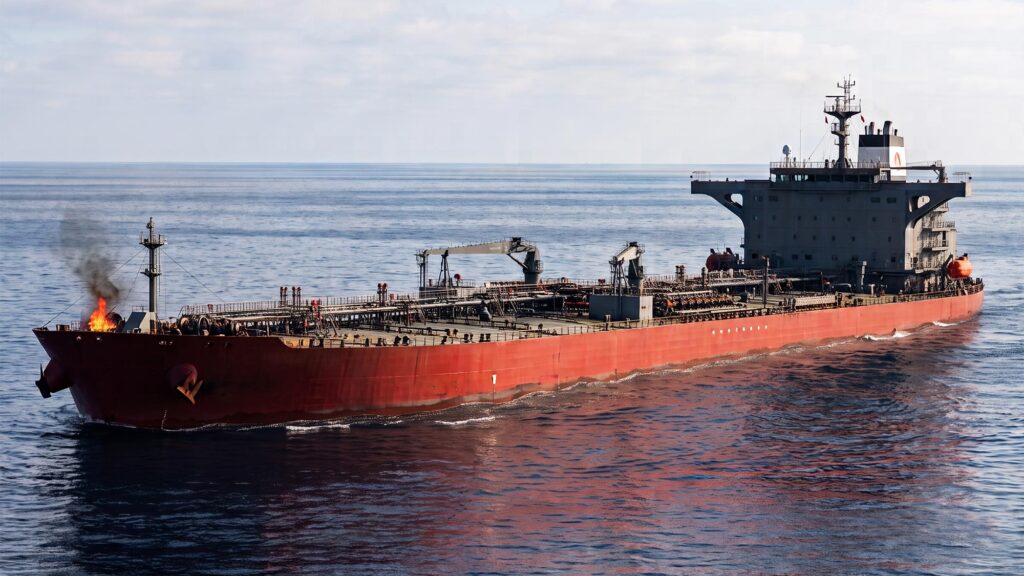
Image: from Navy Lookout X @NavyLookout
By Open Chronicle News Desk with Agencies
Yemen’s Iran-backed Houthi movement claimed responsibility for attacks on two Saudi oil tankers in the Red Sea, raising fears that the conflict between the United States and Iran could expand into another strategic maritime front.
The reported strikes came as the U.S. military carried out its 12th consecutive night of operations inside Iran, while diplomatic efforts to halt the conflict showed little sign of progress.
The developments have intensified concerns over global energy security, with the Red Sea and the Strait of Hormuz now emerging as two of the world’s most volatile maritime chokepoints.
Yemen's Houthis confirm they carried out an attack targeting a pair of Saudi oil tankers in the Red Sea.
Houthi forces carried out the attack using missiles and drones, reportedly hitting the tankers Encelia and Layla north of the Bab al-Mandab Strait. pic.twitter.com/MjW0sOnRs4
— OSINTtechnical (@Osinttechnical) July 22, 2026
Houthis target Saudi-linked shipping
According to the Houthi-run SABA news agency, the group attacked the oil tankers Encelia and Layla in the Red Sea during the early hours of Thursday.
The Houthis claimed both vessels caught fire following the strikes.
If confirmed, the attacks would represent the first direct assault on commercial shipping since the group announced earlier this week that it was imposing a blockade on Saudi-linked maritime traffic through the Bab el-Mandeb Strait.
The Houthis say the blockade is retaliation for Saudi Arabia’s long-standing restrictions on Yemen and a recent attack on Sanaa International Airport, located in territory under Houthi control.
Saudi authorities confirmed that the Encelia was attacked and caught fire but reported no casualties. They did not comment on the Layla.
The United Kingdom Maritime Trade Operations (UKMTO) centre separately reported that a tanker had been struck by an “unknown projectile” approximately 70 nautical miles southwest of Al Shuqaiq, Saudi Arabia. No casualties were reported.
Vital shipping route under pressure
The attacks have renewed attention on the strategic importance of the Bab el-Mandeb Strait, which links the Red Sea with the Gulf of Aden and serves as one of the world’s busiest maritime corridors.
Around 12 percent of global trade, including roughly one-quarter of worldwide container traffic, passes through the route on voyages between Europe and Asia via Egypt’s Suez Canal.
Any prolonged disruption could increase shipping costs, delay global supply chains and place additional upward pressure on energy prices that have already risen because of instability across the Middle East.
A senior Houthi official said the movement intends to maintain its blockade on Saudi-linked vessels until Riyadh lifts restrictions imposed on Houthi-controlled areas of Yemen.
Washington continues military campaign
The Houthi attacks occurred as the United States expanded its military operations against Iran.
The U.S. Central Command (CENTCOM) said overnight strikes were intended to further reduce Iran’s ability to threaten civilian shipping and commercial vessels operating throughout the region.
Washington has increasingly focused on protecting maritime traffic through the Strait of Hormuz, where nearly 20 percent of globally traded oil and liquefied natural gas normally passes during peacetime.
President Donald Trump warned that the United States would respond forcefully if Iran continued targeting commercial shipping, stating that American forces would strike one bridge or power plant each time Tehran attacked a vessel in the strait.
Both sides have increasingly threatened civilian infrastructure, raising international concern. Under international humanitarian law, civilian infrastructure generally enjoys protection unless it is being used for military purposes.
Diplomacy loses momentum
Despite earlier indications that diplomatic channels remained open, optimism surrounding negotiations appeared to fade further.
Speaking during the ASEAN Foreign Ministers’ Meeting in Manila, U.S. Secretary of State Marco Rubio said Iran continued to face increasing pressure.
“The price will continue to get higher every single night until they come to their senses,” Rubio told reporters.
He added that while Washington remained willing to support a diplomatic solution, he believed Tehran was not yet prepared to reach an agreement.
“Iran is clearly not ready to make a deal,” Rubio said.
Responding to remarks by Iranian Foreign Minister Seyed Abbas Araghchi, who recently described Tehran’s strategy as “an eye for an eye,” Rubio replied:
“The president’s policy is a head for an eye. They will pay a very heavy price for the things they’re doing.”
When asked about the reported Houthi attacks, Rubio urged the group to step back from the conflict.
“I think the Houthis, frankly, got snookered into this thing by the Iranians,” he said. “They should stay out of it and they should stop.”
Regional mediation efforts continue
Iranian Interior Minister Eskandar Momeni traveled to Pakistan, one of several countries attempting to mediate between Washington and Tehran.
Pakistan’s Foreign Minister Ishaq Dar called on both governments to exercise restraint and pursue peaceful engagement, while Prime Minister Shehbaz Sharif strongly condemned the attacks on the Saudi oil tankers.
Regional diplomats also acknowledged growing pessimism.
One Arab diplomat, speaking anonymously because of the sensitivity of ongoing discussions, said Gulf states, together with Pakistan and Turkey, continue encouraging de-escalation but see diminishing prospects for an immediate breakthrough.
Iran and United States remain divided over Hormuz
The confrontation over the Strait of Hormuz continues to deepen.
Iran insists it has the right to regulate maritime traffic through the waterway and has suggested introducing new controls or transit fees during the conflict.
The United States rejects those claims and has sought to restore unrestricted commercial navigation while reinforcing its military presence in the Gulf.
Iranian Parliament Speaker Mohammad Bagher Qalibaf reiterated that shipping conditions would not simply return to those that existed before the conflict.
“We have repeatedly said that the situation of the strait will not return to prewar conditions,” he wrote on social media.
Overnight strikes and regional interceptions
Iranian state media reported that U.S. missiles struck areas near Ahvaz, Ramshir, Andimeshk, and the border town of Shalamcheh, where two people were reportedly killed.
Meanwhile, regional militaries remained on heightened alert.
Jordan said its armed forces intercepted three incoming missiles while another landed harmlessly in an uninhabited area. Authorities also reported intercepting six drones overnight.
Bahrain activated emergency warning sirens and advised residents to seek shelter as a precaution.
In Kuwait, military officials announced that the country’s air-defense systems had engaged multiple hostile drones during the night.
With fighting expanding across multiple theatres—including Iran, the Persian Gulf and now potentially the Red Sea—concerns continue to grow that the conflict could further disrupt international shipping, energy markets and regional stability.