
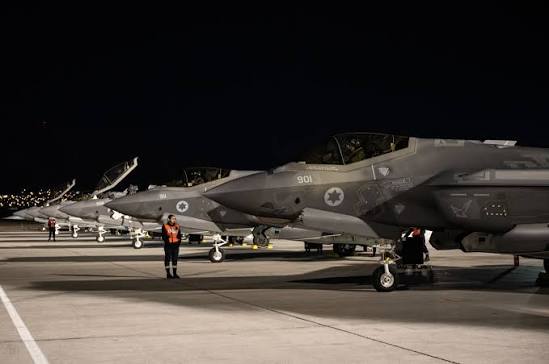
Image: from Mossad Commentary X @MOSSADil
By Open Chronicle News Desk with Agencies
Israel has signaled that it is preparing for the possibility of renewed military action against Iran, with senior government and defense officials warning that the security situation could deteriorate rapidly in the coming days as the confrontation between Washington and Tehran continues.
Prime Minister Benjamin Netanyahu is expected to convene Israel’s Security Cabinet on Friday to assess the country’s military preparedness amid concerns that the regional conflict could intensify over the weekend.
The meeting comes as Israel raises its alert level while monitoring developments between the United States and Iran, whose exchanges of military strikes have heightened fears of a broader regional war.
Security Cabinet to assess preparedness
According to Israel’s public broadcaster KAN, the Security Cabinet will review Israel’s readiness and possible responses should the security situation worsen.
Israeli media reported that the country’s defense establishment has already increased operational preparedness, reflecting concerns that hostilities could quickly expand beyond the current U.S.-Iran confrontation.
Although officials have not announced any decision to launch military operations, they have emphasized that Israel is prepared to respond if necessary.
Defense officials warn Iran
During security consultations, Defense Minister Israel Katz said Israel remained ready for every possible scenario.
According to remarks reported by Yedioth Ahronoth, Katz warned that Iran would suffer a “devastating blow” if it attacked Israel.
Energy Minister Eli Cohen echoed those comments, stressing that the regional situation requires heightened vigilance.
“We see what is happening in the region. The United States is attacking Tehran, and Iran is attacking countries in the region. This requires vigilance and raising the level of alert,” Cohen said during an interview with Army Radio.
He added that Israel possesses extensive intelligence capabilities and offensive military options.
“If Iran acts against Israel, we will respond forcefully. We have significant intelligence and offensive capabilities.”
Intelligence assessments point to possible escalation
Israeli media also cited assessments from Western intelligence specialists suggesting that Tehran could attempt to broaden the conflict by drawing Israel more directly into the ongoing confrontation.
According to those assessments, Iranian leaders may believe differences exist between Washington and Jerusalem regarding the management of the crisis and could seek to exploit those perceived divisions.
Analysts continue to monitor whether Iran might choose to expand the geographic scope of the conflict through additional attacks against Israeli or U.S. interests.
Speculation over possible Israeli strike
Public speculation intensified after Likud Member of Parliament Moshe Saada told Israel’s Channel 14 that Israel could be preparing to launch military action against Iran, possibly within days.
His remarks quickly attracted attention but were later downplayed by senior officials.
Sources within Netanyahu’s Likud party emphasized that Saada had not participated in recent high-level security consultations and described his comments as personal analysis rather than information based on official government briefings.
According to Israeli media, the Prime Minister’s Office expressed dissatisfaction with the public remarks, seeking to avoid speculation over potential military operations.
Washington seen as key decision-maker
Despite increasingly forceful rhetoric from Israeli officials, government sources indicated that the direction of events will largely depend on decisions taken in Washington.
An unnamed Israeli official told Yedioth Ahronoth that U.S. President Donald Trump remains central to developments expected over the coming days.
According to the official, the United States continues pursuing a dual-track approach by maintaining military pressure on Iran while simultaneously seeking to encourage Tehran to return to negotiations.
The official added that Israel is not expected to initiate military action unless it is directly attacked, although Washington could later request Israeli support or operational participation depending on how the situation evolves.
Ceasefire breakdown fuels instability
Regional tensions have steadily increased since President Trump announced on 8 July that the ceasefire framework established under the 18 June U.S.-Iran memorandum of understanding was no longer in effect.
Since then, both countries have exchanged military strikes.
The United States has carried out operations against targets inside Iran, while Tehran says it has responded by attacking American military facilities and equipment across several countries in the region.
The renewed confrontation has also affected international commerce, disrupting shipping through the Strait of Hormuz, increasing uncertainty in global energy markets and prompting temporary airspace closures in parts of the Middle East.
Region remains on edge
Although no immediate Israeli military action has been announced, the combination of heightened military readiness, increasingly confrontational rhetoric and continuing U.S.-Iran hostilities has reinforced concerns that the conflict could widen further.
With Israel closely monitoring developments and Washington continuing to balance military pressure with diplomatic efforts, regional governments remain on alert for any event that could trigger a broader confrontation involving additional states.