
By Open Chronicle
For decades, stranded pygmy sperm whales have offered scientists rare opportunities to study one of the least understood mammals on Earth. Living far from coastlines and spending much of their lives in deep ocean waters, these elusive cetaceans remain largely hidden from researchers.
Now, an investigation into whales that stranded along the southeastern coast of the United States has uncovered an unexpected scientific mystery: three previously unknown bacterial species living inside the animals’ stomachs, raising new questions about marine health, host evolution and the hidden microbial ecosystems that exist within ocean mammals.
A hidden microbial world
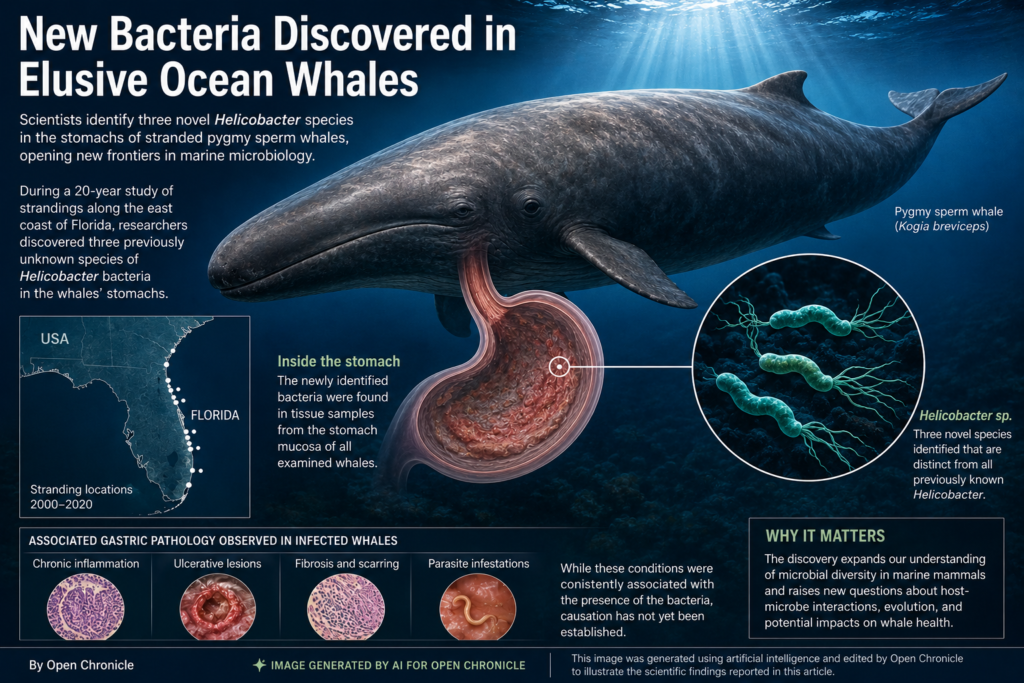
The discovery emerged from an analysis of pygmy sperm whales (Kogia breviceps) that stranded between 2000 and 2020. Researchers examined gastric tissue samples searching for microorganisms belonging to the genus Helicobacter, a group of spiral-shaped bacteria best known for including Helicobacter pylori, the pathogen responsible for most human stomach ulcers and an established risk factor for gastric cancer.
Instead of finding familiar bacterial strains, scientists identified three entirely new Helicobacter taxa previously unknown to science.
The findings considerably expand the known diversity of the genus and suggest that marine mammals may harbour specialized bacterial communities that have evolved independently over long evolutionary timescales.
More than harmless passengers?
The newly discovered bacteria were not found in isolation.
Every infected whale exhibited significant gastrointestinal abnormalities, including chronic inflammation of the stomach lining, ulcerative lesions, fibrosis, tissue scarring and heavy parasite infestations. Although these pathological changes were consistently associated with the presence of the bacteria, researchers emphasize that the study does not establish a direct causal relationship.
In pathology, correlation alone is insufficient to demonstrate disease causation. Additional investigations will be required to determine whether the bacteria actively contribute to gastric disease, exploit already damaged tissue, or simply coexist with other infectious or environmental stressors.
That distinction is critical, because members of the Helicobacter genus display remarkably diverse biological behaviour. While some species are highly pathogenic, others appear to coexist relatively harmlessly with their hosts.
Why Helicobacter matters
The genus Helicobacter has become one of the most intensively studied bacterial groups in medicine.
Its best-known representative, H. pylori, transformed gastroenterology after scientists demonstrated that stomach ulcers were caused by bacterial infection rather than stress or excess stomach acid alone. The discovery fundamentally changed ulcer treatment and earned the 2005 Nobel Prize in Physiology or Medicine.
Finding multiple previously unknown relatives of these bacteria inside deep ocean whales suggests that the evolutionary history of Helicobacter may be considerably broader than previously recognised.
Marine environments may represent an overlooked reservoir of bacterial diversity, containing lineages that evolved separately from terrestrial species over millions of years.
The challenge of studying pygmy sperm whales
Unlike larger whales that are frequently observed during migration, pygmy sperm whales are among the most cryptic cetaceans on the planet.
They spend much of their lives in deep offshore waters, surface only briefly, and rarely approach vessels. Consequently, much of what scientists know about their biology comes from stranded individuals recovered after death.
Although unfortunate, strandings provide unique scientific opportunities to investigate anatomy, pathology, toxicology, genetics and microbial ecology that would otherwise remain inaccessible.
The twenty-year collection of tissue samples used in this study demonstrates the scientific value of long-term wildlife monitoring programs and systematic post-mortem examinations.
A growing field: marine microbiomes
The discovery also contributes to one of biology’s fastest-growing research areas, the study of microbiomes.
Every multicellular organism hosts vast microbial communities that influence digestion, immune function, metabolism and disease susceptibility. While human microbiome research has expanded rapidly over the past two decades, comparatively little is known about the microbial ecosystems inhabiting marine mammals.
Understanding these microbial communities could improve veterinary medicine for stranded animals, reveal new evolutionary relationships between hosts and microorganisms, and provide insights into how changing ocean conditions influence wildlife health.
Questions that remain unanswered
The research opens far more questions than it answers.
Scientists still do not know how widespread these newly discovered bacteria are among pygmy sperm whales, whether they occur in other cetacean species, how they are transmitted between animals, or whether they play beneficial, neutral, or harmful biological roles.
Future genomic sequencing and comparative microbiological studies may reveal whether these bacteria possess virulence genes similar to those found in pathogenic human Helicobacter species or represent entirely different evolutionary adaptations to life within marine mammals.
What is already clear is that the oceans continue to conceal extraordinary biological diversity, not only in the animals themselves but also within the microscopic organisms that live alongside them. Even after decades of marine research, some of the most important discoveries remain invisible to the naked eye.
Research publication
Journal: Journal of Wildlife Diseases
Article: Novel Gastric Helicobacter Species in Stranded Pygmy Sperm Whales (Kogia breviceps) on the East Coast of Florida, USA
Authors: Wendy Marks, Jessy Castellanos Gell, Steven B. Tillis, Nicole Pegg, David Rotstein, Sushan Han, James F. X. Wellehan, April Childress, Steve Burton and Annie Page
Source
This article is based on research materials provided by Florida Atlantic University. The original source material may have been edited for clarity, style and length.