
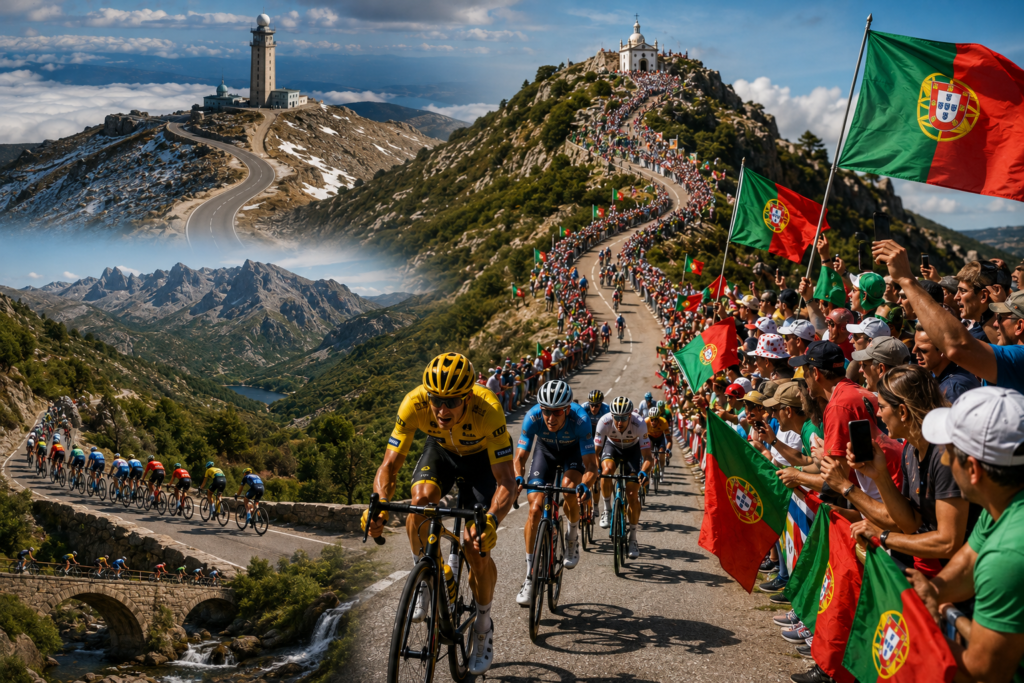
Image Credentials: Image Title: Legendary Climbs of the Volta a Portugal: The Mountains That Shaped a Nation’s Greatest Race. Source: (chatgpt.com) Date: July 2026. Attribution: This image was created using AI-generated imagery (chatgpt.com) by Open Chronicle and does not depict a real-world scene.
By Open Chronicle History Desk
Every great cycling race has its defining mountains. The Tour de France has Alpe d’Huez and Mont Ventoux. The Giro d’Italia has the Stelvio and Mortirolo. For the Volta a Portugal, the race has been forged by the demanding roads that climb into Portugal’s highest mountains, where champions have been crowned, dreams have been broken, and some of the country’s greatest sporting moments have unfolded.
From the windswept summit of Torre to the legendary ramps of Senhora da Graça, these climbs have become as famous as the riders who conquered them.

Volta a Portugal 2026
Follow every stage of the Volta a Portugal 2026 with race reports,
classifications, teams, riders, route information and daily coverage
of Portugal’s greatest cycling race.
Torre: Portugal’s rooftop
Standing at 1,993 metres above sea level, Torre, in the Serra da Estrela, is the highest point reached by any road in mainland Portugal.
Whenever the Volta finishes at Torre, the general classification is almost always transformed.
The climb is long rather than brutally steep, gradually wearing riders down over more than 25 kilometres as the road rises through forests before emerging onto the exposed granite plateau near the summit.
Changing weather conditions frequently add another challenge. Riders have climbed Torre under intense summer heat, thick mountain fog and even snow flurries during unusually cold editions.
Winning at Torre has long been regarded as one of the greatest achievements in Portuguese cycling.
Senhora da Graça: The climb of legends
If Torre is Portugal’s highest climb, Senhora da Graça is undoubtedly its most iconic.
Located above Mondim de Basto, Monte Farinha rises dramatically from the surrounding valleys before finishing beside the famous hilltop sanctuary.
The final kilometres are relentless.
Steep gradients, narrow roads and thousands of passionate spectators lining every corner create one of the most electric atmospheres in Portuguese sport.
It is a climb perfectly suited to explosive attacks.
Some of the Volta’s most memorable victories have been decided here, with riders launching decisive accelerations on the final ramps while rivals struggle to respond.
For many fans, no image better represents the Volta a Portugal than cyclists climbing towards Senhora da Graça beneath a sea of Portuguese flags.
Serra da Estrela: The race’s greatest natural challenge
The Serra da Estrela is more than a single climb.
Portugal’s largest mountain range has shaped the Volta for decades, providing multiple ascents that reward endurance, tactical intelligence and climbing ability.
Roads leading to Penhas da Saúde, Torre and surrounding peaks have repeatedly separated the strongest contenders from the rest of the peloton.
Altitude, changing weather and long gradients mean that riders rarely attack too early.
Instead, victories are often decided through careful pacing before explosive accelerations near the summit.
Montejunto: Where attacks begin
Located northwest of Lisbon, Serra de Montejunto has frequently appeared during the opening week of the Volta.
Although lower than Portugal’s great mountain passes, its steep slopes have often encouraged aggressive racing before the peloton reaches the country’s highest mountains.
For puncheurs and all-rounders, Montejunto has provided opportunities to gain valuable seconds and wear down rivals before the decisive stages.
Alto da Senhora da Assunção and northern classics
Northern Portugal has contributed several demanding finishes over the years.
Climbs such as Senhora da Assunção, Sameiro, Santa Luzia and roads through the Gerês region have repeatedly produced spectacular racing.
While they may not reach the altitude of Serra da Estrela, their steep gradients and technical descents have often rewarded courageous attackers willing to take risks.
More than mountains
The legendary climbs of the Volta are about more than gradients and altitude.
Every ascent tells a story.
Supporters gather hours before the riders arrive, filling the roadside with flags, music and cheers. Families picnic beside the route, local villages celebrate the race’s arrival and thousands of spectators create an atmosphere unlike any other sporting event in Portugal.
For the cyclists, reaching the summit means more than surviving another climb.
It is an opportunity to write their names into the history of the race.
The climbs that decide champions
Across almost a century, these mountains have shaped the careers of countless champions.
From Joaquim Agostinho and Marco Chagas to modern winners of the Volta, success has often depended on mastering Portugal’s toughest roads.
Many editions have remained undecided until the final ascent of Senhora da Graça, while finishes at Torre have repeatedly produced unforgettable displays of climbing strength.
As the Volta approaches its centenary in 2027, these legendary mountains remain the soul of the race.
They continue to test every generation of riders and remind cycling fans that while bicycles, equipment and tactics may evolve, one challenge remains unchanged: to conquer Portugal’s greatest climbs.