
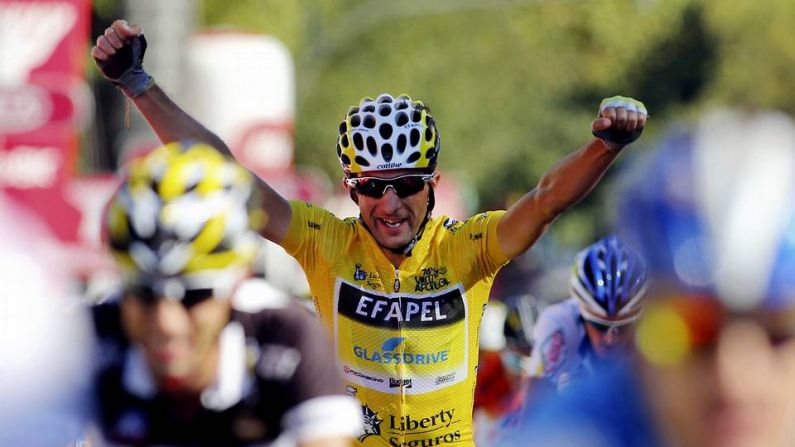
Image: from Aleix Serra X @chiodi17
By Open Chronicle History Desk
Across nearly a century of racing, the Volta a Portugal has created a statistical history as dramatic as the competition itself. Its records tell the story of dominant champions, relentless stage hunters, remarkable longevity and editions shaped by speed, endurance and changing generations.
From David Blanco’s five overall victories to the extraordinary consistency of Cândido Barbosa, the race’s milestones reveal how difficult it is not only to win the Volta, but to remain competitive across years and decades.
David Blanco leads the all-time winners
Spanish rider David Blanco remains the most successful overall champion in the history of the Volta a Portugal.
He won five editions:
- 2006
- 2008
- 2009
- 2010
- 2012
His fifth victory, achieved at the age of 37, also placed him among the oldest riders ever to win the race.
Behind Blanco stands Portuguese legend Marco Chagas, who claimed four titles in 1982, 1983, 1985 and 1986.
Joaquim Agostinho and Alves Barbosa follow with three victories each. Agostinho won three consecutive editions between 1970 and 1972, while Barbosa triumphed in 1951, 1956 and 1958.
Several riders have won twice, including Gustavo César Veloso, Orlando Rodrigues, Joaquim Gomes, Ribeiro da Silva, José Martins, José Maria Nicolau, Alfredo Trindade, José Albuquerque, Dias dos Santos and Artem Nych.
Alves Barbosa holds the stage-win record
The most prolific stage winner in Volta history is Alves Barbosa, with an extraordinary 30 victories.
That total places him ahead of another Portuguese crowd favourite, Cândido Barbosa, who won 25 stages and accumulated an exceptional 96 stage top-ten finishes.
The leading stage winners include:
- Alves Barbosa — 30
- Cândido Barbosa — 25
- Joaquim Agostinho — 24
- Fernando Moreira — 23
- Ildefonso Rodrigues — 22
- Marco Chagas — 21
- Leonel Miranda — 20
- José Maria Nicolau — 20
- João Lourenço — 19
- Alexandre Ruas — 16
These totals show that many of the race’s greatest champions were also frequent stage winners, although Cândido Barbosa built his legend without ever winning the final general classification.
Cândido Barbosa’s unmatched consistency
Cândido Barbosa holds the record for the most stage top-ten finishes, with 96.
His career combined sprinting strength, durability and consistency across fifteen starts between 1996 and 2010.
He also collected:
- 25 stage victories
- 16 second places
- 14 third places
- Seven final general-classification top tens
- A best overall result of second
His record illustrates why he remains one of the most popular riders in the history of Portuguese cycling.
Venceslau Fernandes: a record of longevity
No rider started and completed the Volta more often than Venceslau Fernandes.
He entered the race 22 times between 1965 and 1991 and completed all 22 editions.
Behind him are:
- Joaquim Adrego Pereira Andrade — 21 starts, 21 finishes
- Rui Sousa — 19 starts, 19 finishes
- Virgílio Martins dos Santos — 18 starts, 18 finishes
- Célio Sousa Alves — 18 starts, 18 finishes
- Alejandro Marque — 18 starts, 18 finishes
Finishing the Volta repeatedly requires exceptional physical resilience, especially across an era when stages were often longer and road conditions more demanding than those faced by modern riders.
The youngest overall champion
Alves Barbosa was only 19 years and 254 days old when he won the 1951 Volta, making him the youngest overall champion in the history of the race.
The next youngest winners were José Pacheco and Ribeiro da Silva, both aged 20 years and 186 days when they claimed their respective titles.
Other champions who won before turning 22 included Manuel Zeferino, Américo Silva, Joaquim Leão, Mário Silva and José Albuquerque.
The oldest overall champion
At the opposite end of the age spectrum, Venceslau Fernandes became the oldest Volta winner when he captured the 1984 edition at 39 years and 132 days.
David Blanco occupies several positions among the oldest winners because of his repeated success late in his career. His 2012 title came at 37 years and 176 days.
Gustavo César Veloso was 35 when he won in 2015, while Polish rider Zenon Jaskuła was also 35 when he claimed victory in 1997.
Youngest and oldest stage winners
The youngest recorded stage winner is Joaquim Moreira, who was only 18 years and 219 days old when he won Stage 15 from Évora to Alcains in 1969.
Several other riders won stages while still aged 18, including Carlos Manuel Francisco dos Santos, João Centeio, Dinis Alves, Alberto Carvalho and Joaquim Fonseca.
The oldest stage winner is again Venceslau Fernandes, who won the 1988 stage from Águeda to Marinha Grande at 43 years and 99 days.
Rui Sousa ranks second after winning in Fafe in 2017 at the age of 41, while Gustavo César Veloso won the 2020 Lisbon time trial at 40 years and 250 days.
Rui Sousa leads the general-classification top tens
The rider with the most final top-ten results is Rui Sousa, who finished among the ten best riders on 12 occasions.
Joaquim Gomes follows with 11, while Venceslau Fernandes recorded ten.
Other notably consistent contenders include:
- Firmino Bernardino — 9
- Marco Chagas — 9
- Manuel Zeferino — 8
- Manuel Cunha — 8
- Joaquim Andrade — 8
- António Carvalho — 7
- Joni Brandão — 7
- Vítor Gamito — 7
- Cândido Barbosa — 7
- David Blanco — 7
The fastest stages
The fastest stage in the race’s recorded history came in 1984, when the 160-kilometre route from Mangualde to Covilhã was completed at an average speed of 53.23 kilometres per hour.
The second-fastest was the 1998 stage from Póvoa de Varzim to Porto, raced at 50.48 kilometres per hour.
Remarkably, the 2010 stage from Idanha-a-Nova to Torre averaged 48.7 kilometres per hour despite finishing on one of the most demanding climbs in Portugal.
Among stages with more than 2,000 metres of climbing, the fastest was the 2024 route from Felgueiras to Paredes, completed at an average of 43.915 kilometres per hour.
Portugal dominates the national honours
Portuguese riders account for the overwhelming majority of overall victories.
According to the official-results dataset, the leading nations are:
- Portugal — 59 victories
- Spain — 12
- Russia — 3
- Italy — 2
- Switzerland — 2
Denmark, Uruguay, Brazil, Poland, Great Britain and Belgium have each produced one overall winner.
Spain’s total reflects the major influence of riders such as David Blanco, Gustavo César Veloso, Xavier Tondo and David Bernabéu.
Lisbon is the most visited location
No place is more closely connected to the history of the Volta than Lisbon.
The Portuguese capital has appeared in 67 editions, hosting 51 departures and 91 arrivals.
Other frequently visited locations include:
- Senhora da Graça — 47 editions
- Castelo Branco — 46
- Viseu — 45
- Porto — 43
- Guarda — 41
- Évora — 39
- Loulé — 36
- Tavira — 32
- Beja — 32
The statistics also underline the symbolic importance of the race’s greatest mountains. Senhora da Graça has hosted 47 finishes, while Torre has appeared in 27 editions and recorded 28 arrivals.
Mountain and points classifications
The secondary classifications have also produced their own specialists.
Recent winners of the King of the Mountains classification include Hugo Nunes, Luis Ángel Maté, César Fonte, Frederico Figueiredo, Bruno Silva, Luís Gomes, Raúl Alarcón, Amaro Antunes and Rui Sousa.
In the points classification, German Nicolás Tivani won in both 2024 and 2025. Other recent winners include Daniel Babor, Scott McGill, Rafael Reis, Daniel Mestre, Vicente García de Mateos and Gustavo César Veloso.
These classifications recognise riders whose influence on the race extends beyond the final yellow jersey.
New teams continue the story
The Volta continues to attract new teams from Portugal and abroad.
The latest debutants listed for 2026 include:
- APS Pro Cycling by Team Cadence Cyclery
- Localiza Meoo / Swift Pro Cycling
- Óbidos Cycling Team
Their arrival follows recent debuts by Team Skyline, Petrolike, Project Echelon Racing, Illes Balears Arabay Cycling, Global 6 Cycling, Trinity Racing and Equipo Kern Pharma.
Each new team adds another chapter to the international history of the race.
Records that define the Volta
The statistics of the Volta a Portugal reveal many different forms of greatness.
David Blanco represents overall dominance. Alves Barbosa stands for repeated stage success. Cândido Barbosa embodies consistency and popularity. Venceslau Fernandes demonstrates extraordinary longevity, while riders such as Joaquim Agostinho and Marco Chagas combined victories with lasting national influence.
As the race approaches its centenary, these records offer more than a list of numbers. They preserve the achievements of the riders who conquered Portugal’s roads and helped transform the Volta into one of the country’s most important sporting traditions.