
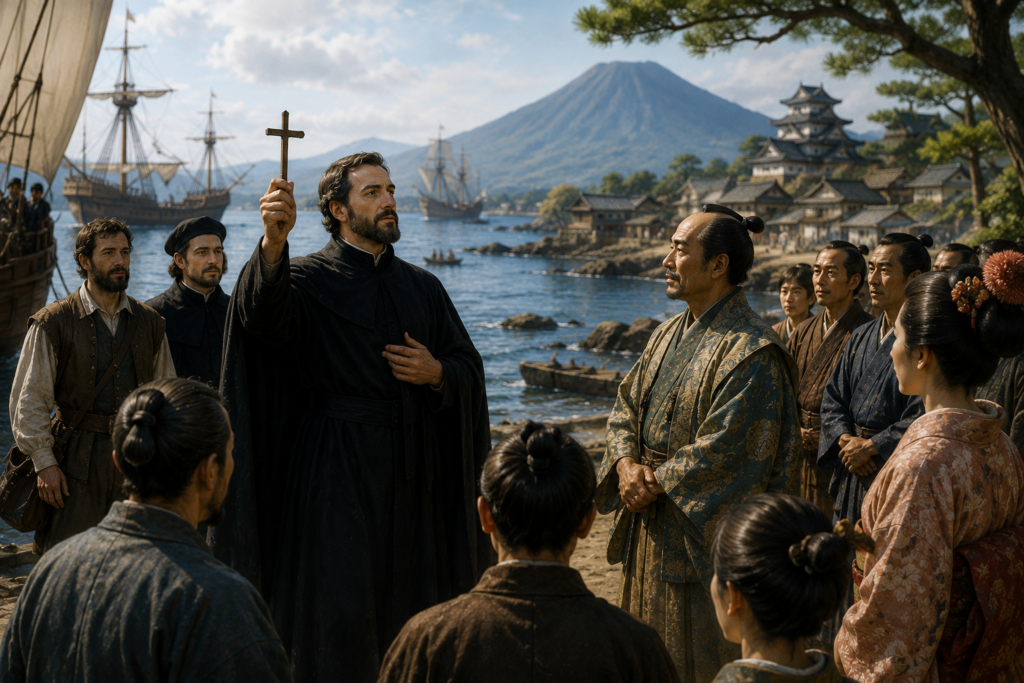
Image Credentials: Image Title: Today in History, July 27: Jesuit Missionary Francis Xavier Arrives in Japan, Introducing Christianity. Source: (chatgpt.com) Date: July 2026. Attribution: This image was created using AI-generated imagery (chatgpt.com) by Open Chronicle and does not depict a real-world scene.
By Open Chronicle
15 August 1549
On 15 August 1549, the Jesuit missionary Francis Xavier arrived in Kagoshima, southern Japan, becoming the first Christian missionary to establish a lasting Catholic mission in the country. His arrival marked the beginning of Christianity’s introduction to Japan and opened a remarkable period of religious, cultural and commercial exchange between Europe and East Asia.
Francis Xavier was one of the founding members of the Society of Jesus, or Jesuit Order, established by Ignatius of Loyola in 1540. Born in the Kingdom of Navarre in 1506, Xavier quickly became one of the Catholic Church’s most energetic missionaries, travelling thousands of kilometres throughout Asia in an effort to spread Christianity.
Before reaching Japan, Xavier had already carried out missionary work in Portuguese India, present-day Sri Lanka, Southeast Asia and the Maluku Islands. During his travels, he met a Japanese convert known as Anjirō, who described his homeland as a sophisticated society with a highly educated population interested in philosophy, ethics and religion. Inspired by these accounts, Xavier decided to bring Christianity to Japan.
After a difficult voyage from Malacca aboard a Portuguese vessel, Xavier landed at Kagoshima on the island of Kyushu on 15 August 1549. He was accompanied by fellow Jesuits Cosme de Torres and Juan Fernández, together with Anjirō, who served as interpreter and guide.
Japan during the mid-sixteenth century was experiencing the Sengoku period, often called the “Age of Warring States.” Political authority was fragmented among powerful regional lords, or daimyō, who frequently fought for territory and influence. This decentralised political landscape created both opportunities and challenges for foreign missionaries, who often depended on the support of individual rulers.
Initially, Xavier was welcomed in Kagoshima, partly because Anjirō’s local connections eased introductions with the ruling Shimazu clan. The missionaries began learning the Japanese language, studying local customs and attempting to explain Christian beliefs in terms that Japanese audiences could understand.
Xavier quickly recognised that successful missionary work required adapting to Japanese culture. Rather than presenting Christianity solely through European customs, he sought to engage with educated Buddhist monks and scholars in theological discussion. Although language barriers and cultural differences sometimes produced misunderstandings, he admired the intellectual curiosity and discipline of the Japanese people.
During the following two years, Xavier travelled to several important centres, including Hirado, Yamaguchi and Bungo. In Yamaguchi, one of western Japan’s principal cultural cities, he received permission to preach from the local daimyō after presenting gifts and letters from Portuguese authorities. His respectful approach helped establish the first Christian communities in the country.
Despite these successes, progress remained gradual. Buddhism and Shintoism were deeply rooted in Japanese society, and many people viewed the new religion with caution. Nevertheless, a small but growing number of converts embraced Christianity, attracted by its teachings as well as by the expanding commercial connections with Portuguese traders.
Although Francis Xavier left Japan in 1551 after just over two years, he believed the country offered exceptional potential for future missionary work. His reports encouraged additional Jesuits to continue the mission, including Alessandro Valignano and other influential figures who expanded Christian education and church organisation throughout Japan.
By the late sixteenth century, Christianity had spread rapidly. Historians estimate that as many as 300,000 Japanese converts and hundreds of churches existed before official persecution began. Several powerful daimyō accepted baptism, while European trade flourished alongside missionary activity.
However, growing concerns over foreign influence eventually led Japanese rulers to restrict Christianity. Beginning with Toyotomi Hideyoshi and later intensified under the Tokugawa shogunate, Christianity was outlawed, missionaries were expelled, and many believers suffered persecution. Thousands of Japanese Christians were executed or forced to practise their faith in secret during the following centuries.
Despite these hardships, hidden Christian communities, known as Kakure Kirishitan, preserved elements of their faith until religious freedom was restored in the nineteenth century after Japan reopened to the outside world.
Francis Xavier himself never returned to Japan. Hoping to continue his missionary work in China, he died in 1552 on Shangchuan Island off the Chinese coast. He was later canonised by the Catholic Church and is widely regarded as one of history’s greatest Christian missionaries.
Today, Xavier’s arrival in Japan is remembered as a landmark in the history of cultural exchange between Europe and East Asia. His mission marked the beginning of Christianity in Japan and opened new channels of dialogue, trade, and intellectual contact that influenced both Japanese society and the wider history of global exploration and religion.