
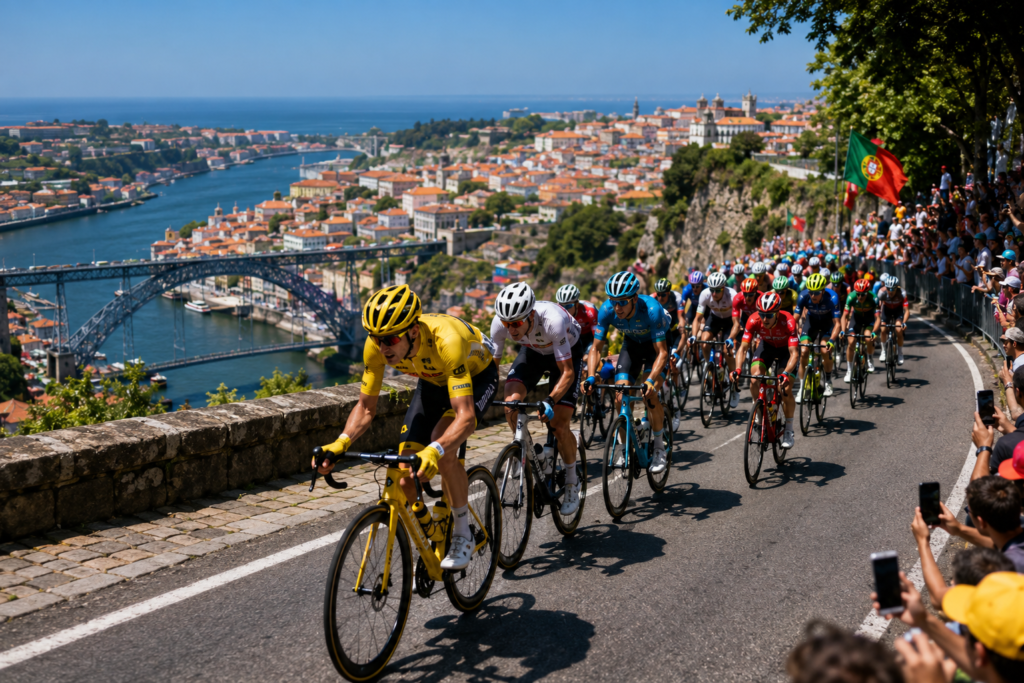
Image Credentials: Image Title: Volta a Portugal 2026: Complete Route Revealed as Portugal’s Biggest Cycling Race Returns with New Era. Source: (chatgpt.com) Date: July 2026. Attribution: This image was created using AI-generated imagery (chatgpt.com) by Open Chronicle and does not depict a real-world scene.
By Open Chronicle News Desk with Agencies
The 2026 Volta a Portugal is set to usher in a new chapter for Portugal’s premier cycling race, featuring a redesigned route that crosses much of the country, visits 15 districts, includes mountain summit finishes, an individual time trial and a ceremonial finale in Porto.
The 87th edition of the race will take place from August 5 to August 16, covering 1,422.5 kilometres over 10 stages and a prologue, with one rest day. Organizers describe the event as the beginning of a new cycle leading toward the race’s centenary in 2027.
É amarela e linda. Acaba de ser revelada na Sala de Extrações da Santa Casa da Misericórdia de Lisboa a Camisola Amarela da Volta a Portugal 2026, com as presenças do Provedor Paulo Sousa, do presidente da FPC, Cândido Barbosa, e do novo diretor da prova, Ezequiel Mosquero. 1/2 pic.twitter.com/JhcswEG5jO
— Alexandre Guerra (@alex_d_guerra) July 1, 2026
A route across Portugal
Unlike recent editions that concentrated heavily on northern Portugal, the 2026 race travels through nearly every region of the country.
The event begins with a 6-kilometre individual time trial in Lisbon, then heads west to the coast, south through the Algarve, east toward the Spanish border, and finally north into Portugal’s famous mountain regions before finishing in Porto.
The race will visit 71 municipalities, pass through 15 districts, include a brief crossing into Spain, and total more than 1,420 kilometres of racing.
Stage-by-stage route
Prologue – August 5
Lisbon – 6 km Individual Time Trial
A short but demanding opening time trial will establish the first general classification gaps and award the first leader’s jersey.
Stage 1 – August 6
Lourinhã → Sintra (Queluz) – 153 km
A rolling opening road stage ending near Lisbon with terrain suited to aggressive classics specialists.
Stage 2 – August 7
Sines → Albufeira – 177 km
The longest coastal stage of the race is expected to favour sprinters, although crosswinds could split the peloton.
Stage 3 – August 8
Beja → Elvas – 180 km
A fast stage across Portugal’s Alentejo region before finishing close to the Spanish border.
Stage 4 – August 9
Figueiró dos Vinhos → Covilhã (Torre) – 148 km
The first major mountain test finishes atop Torre, Portugal’s highest point, and is expected to produce the first major general classification battle.
Stage 5 – August 10
Anadia → Águeda – 17 km Individual Time Trial
A decisive individual time trial that could significantly reshape the standings before the race heads north.
Rest Day – August 11
Santa Maria da Feira (Europarque)
The peloton enjoys its only rest day before entering the decisive second half of the race.
Stage 6 – August 12
Santa Maria da Feira → Peso da Régua – 129 km
The race reaches the Douro Valley with a challenging stage through Portugal’s famous wine region.
Stage 7 – August 13
Vieira do Minho → Termas do Gerês – 147 km
A mountainous stage finishing in Gerês National Park offers another opportunity for climbers.
Stage 8 – August 14
Melgaço → Fafe – 166 km
A demanding northern stage featuring constant climbs and technical roads that could encourage long-range attacks.
Stage 9 – August 15
Paredes → Mondim de Basto (Senhora da Graça) – 141 km
The queen stage concludes with the legendary climb to Senhora da Graça, including the race’s first-ever double ascent of the mountain, likely deciding the overall winner.
Stage 10 – August 16
Maia → Porto – 124 km
The race concludes in Porto with a ceremonial final stage expected to crown the overall champion.
The key battles
While the opening week offers opportunities for sprinters and all-rounders, the overall classification is expected to be determined by three decisive stages:
- Stage 4: Summit finish at Torre.
- Stage 5: Individual time trial.
- Stage 9: Double ascent of Senhora da Graça.
Those stages are likely to create the largest time gaps and decide the fight for the yellow jersey.
International ambitions
The 2026 edition marks an important step in the international expansion of the Volta a Portugal.
For the first time, the race will receive live international coverage on HBO Max, while Eurosport will broadcast daily highlights outside Portugal. Portuguese viewers will continue to watch the race live on RTP1, accompanied by the daily “Há Volta” programme.
The organizers hope the increased exposure will attract more international teams and elevate the event’s status within professional cycling.
Portuguese stars ready to compete
Among the riders generating significant interest is Rui Oliveira, the Olympic Madison champion, who is preparing for his debut in the Volta a Portugal.
Oliveira recently described winning a stage in his home race as “a dream come true,” highlighting the importance of the event for Portuguese cyclists.
A new chapter before the centenary
With a route stretching from Lisbon to Porto, summit finishes on Portugal’s highest mountains, an expanded international television audience and the race approaching its 100th anniversary in 2027, the 2026 Volta a Portugal promises to be one of the most significant editions in its modern history.
The redesigned course combines opportunities for sprinters, climbers and time-trial specialists while showcasing much of Portugal’s diverse landscape, offering what organizers hope will be one of the most competitive and internationally visible editions of the race to date.