
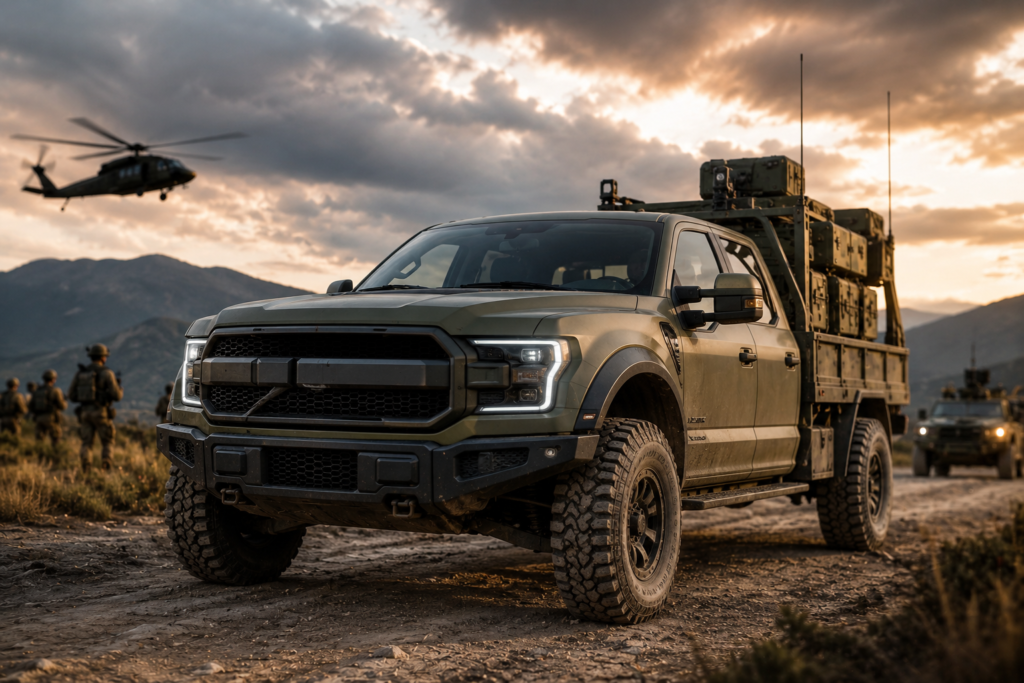
Image Credentials: Image Title: Ford enters race to build next-generation U.S. Army tactical truck. Source: (chatgpt.com) Date: July 2026. Attribution: This image was created using AI-generated imagery (chatgpt.com) by Open Chronicle and does not depict a real-world scene.
By Open Chronicle News Desk with Agencies
Ford has entered the competition to develop the U.S. Army’s next-generation tactical truck, marking the automaker’s biggest pursuit of a military vehicle contract in decades. The company will compete against rivals including General Motors and off-road vehicle specialist BC Customs as the Pentagon seeks a new platform capable of supporting future battlefield operations.
The U.S. Department of Defense has awarded prototype development contracts to the three manufacturers. Ford will build three prototype vehicles based on its F-Series Super Duty platform, demonstrating how commercial truck technology can be adapted for military requirements. Prototype deliveries are expected next year, after which the Army will evaluate each design before selecting a production winner.
Ford joins GM in race for massive U.S. Army tactical truck contract!#Ford #GM #USMilitary #USArmy #Tech pic.twitter.com/HEsJIXCRWv
— "Pulse" by Shams TV (@PulseInDc) July 29, 2026
The future tactical truck is intended to do far more than transport troops. Military planners want a highly capable vehicle that can also act as a mobile power source, supplying electricity to communications equipment, drones, sensors and other battlefield systems while maintaining a reduced acoustic and thermal signature. These capabilities reflect the Army’s increasing focus on distributed operations and electrically powered equipment.
The Army is expected to acquire around 600 of the new vehicles, although the final value of the production contract has not been disclosed. The programme forms part of a wider Pentagon effort to modernise military equipment and strengthen domestic manufacturing capacity following years of heavy demand created by conflicts in Europe and the Middle East.
Ford described the project as an opportunity to demonstrate the capability of its commercial vehicle technology in military service. A company spokesperson said Ford looks forward to delivering prototypes that showcase the value its vehicles can provide to soldiers and military operations.
General Motors currently holds an advantage in the competition, having already developed and tested its ISV Heavy tactical vehicle, which is derived from the Chevrolet Silverado Heavy Duty. Several GM prototypes have already undergone Army field testing, providing valuable operational data before the next stage of the programme.
Ford’s return to major defence contracting reflects a broader trend across the American automotive industry. As the Pentagon seeks to modernise its vehicle fleet and expand industrial capacity, traditional car manufacturers are increasingly being called upon to apply their large-scale manufacturing expertise to military programmes.
If successful, the contract would represent Ford’s largest military vehicle programme since the Cold War and reinforce the growing relationship between the U.S. defence sector and commercial automotive manufacturers.