
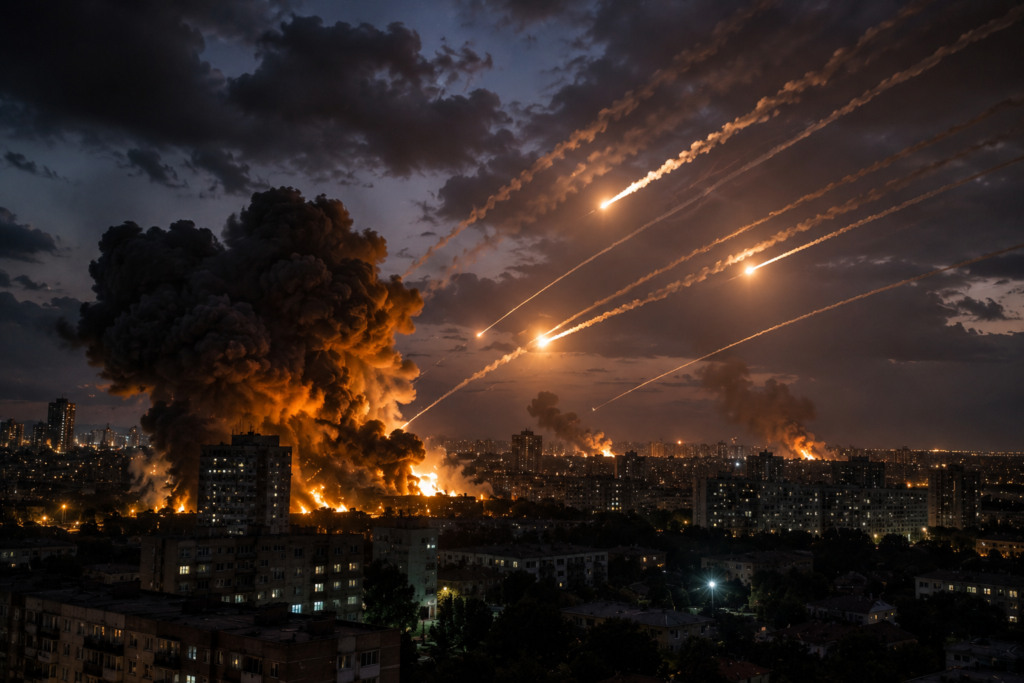
Image Credentials: Image Title: Russia launches large-scale ballistic missile attack across Ukraine as explosions rock Kyiv. Source: (chatgpt.com) Date: July 2026. Attribution: This image was created using AI-generated imagery (chatgpt.com) by Open Chronicle and does not depict a real-world scene.
By Open Chronicle News Desk with Agencies
Russia launched a large-scale wave of ballistic missile attacks across Ukraine in the early hours of Wednesday, with multiple explosions reported in Kyiv only hours after Ukrainian President Volodymyr Zelensky warned that Moscow was preparing another major overnight strike.
Explosions were heard across the Ukrainian capital shortly after 1:18 a.m. local time, as air raid sirens sounded and residents sought shelter. The attack appeared to be part of a coordinated nationwide missile assault targeting multiple regions of the country.
Four Russian ballistic missiles exploded in Kyiv, one launched at Kryvyi Rih.
Shahed kamikaze drones cluster in northern Ukraine. Monitoring channels report a big missile attack is ahead: 4 Tu-95 bombers have departed Olenya airbase
📷 Monitor/TG pic.twitter.com/yIEtxxErJi
— Euromaidan Press (@EuromaidanPress) July 29, 2026
Earlier on Tuesday, Zelensky had urged Ukrainians to remain vigilant, saying intelligence indicated that Russia was preparing a significant strike.
“The Russians prepared a massive attack several days ago, and there is a high probability that the strike will be carried out tonight,” Zelensky wrote on social media.
He also urged citizens in every region to pay close attention to air raid alerts and follow safety instructions.
The latest assault continues a pattern that has intensified throughout the spring and summer of 2026. As Russia’s ground offensive has slowed, Moscow has increasingly relied on large-scale missile barrages designed to overwhelm Ukraine’s already strained air defence network.
Ballistic missiles have become one of the Kremlin’s preferred weapons in these attacks, with residential neighbourhoods, infrastructure and cultural sites frequently coming under fire. Russian President Vladimir Putin said earlier this month that such long-range strikes “must continue,” signalling that Moscow intends to maintain pressure despite limited progress on the battlefield.
Ukraine has responded with increasingly sophisticated long-range drone and missile operations targeting Russian oil facilities, military bases and strategic infrastructure. In recent months, Ukrainian forces have successfully struck targets deep inside Russia, including areas around Moscow and St. Petersburg, demonstrating an expanding ability to project force far beyond the front lines.
Despite those successes, Ukrainian officials continue to warn that the country’s ability to intercept ballistic missiles remains critically dependent on supplies of Patriot interceptor missiles. These interceptors remain the only proven defence against many of Russia’s most advanced ballistic weapons, and shortages have raised growing concerns about the protection of major cities.
The renewed attacks come as diplomatic efforts to reduce hostilities continue. Ukrainian and U.S. officials are preparing a new package of peace proposals that reportedly includes a partial ceasefire covering aerial attacks. The initiative is expected to be presented to Moscow in the coming weeks.
The issue was discussed during Zelensky’s meeting with U.S. President Donald Trump at the White House on July 28. According to both leaders, the talks focused on strengthening Ukraine’s air defences, including additional Patriot interceptors, while also exploring ways to revive negotiations aimed at ending the war.
Following the meeting, both presidents described their discussions as constructive, suggesting an improvement in relations between Kyiv and Washington. In a television interview afterwards, Zelensky argued that Russia has lost the strategic initiative in the conflict but accused Putin of refusing to agree to a ceasefire despite increasing international pressure.
The full extent of the damage from the overnight missile attacks was not immediately known, while emergency services continued responding to incidents across affected areas.