
Image: from War Updates FC X @k_c_shivansh
By Open Chronicle News Desk with Agencies
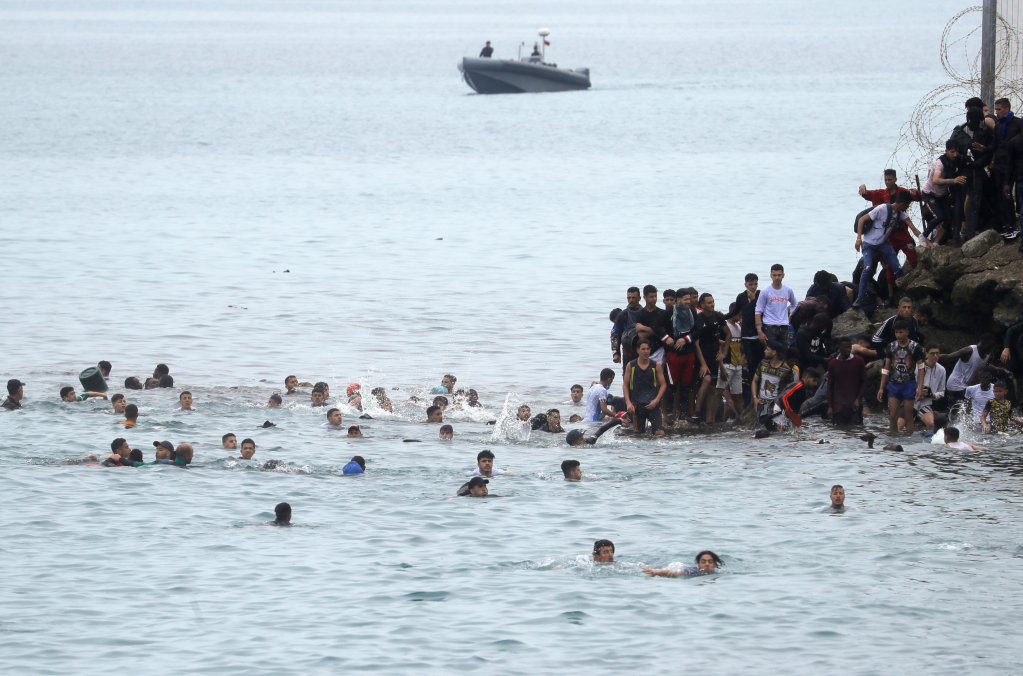
Spain has ordered the deployment of military forces to the North African enclave of Ceuta after thousands of migrants crossed the border from Morocco in one of the largest migration surges since the 2021 crisis, leaving at least nine people dead.
The Spanish government announced that the Armed Forces will reinforce the Civil Guard to restore order after local authorities described the situation as a complete collapse of border security. Prime Minister Pedro Sánchez and Interior Minister Fernando Grande Marlaska travelled to Ceuta to oversee the government’s response.
The latest crisis unfolded after large crowds breached the frontier near Tarajal beach, with migrants entering Spanish territory on foot and by swimming around coastal breakwaters. Video footage showed thousands of people, mostly young Moroccan men but also women and children, making their way into the enclave. At the same time, some shouted “Viva España!” as they reached Spanish soil.
Thousands of people, most of them Moroccans, attempted to cross into Spain's North African enclave of Ceuta yesterday, with many swimming around breakwaters or crossing border barriers in hopes of reaching Europe. The sudden surge overwhelmed local authorities, prompting Spain to…
— Angwenyi🐝 (@sprinterkingemp) July 31, 2026
Authorities confirmed that at least nine people died during the chaotic crossings. Although officials have not released details surrounding the fatalities, bodies were reportedly seen floating in the water. Local authorities noted that dozens of migrants have already lost their lives this year while attempting to reach Ceuta.
“The situation is absolute chaos,” said Rachid Sbihi, head of the association representing Civil Guard officers stationed at the border. He said the number of arrivals was impossible to determine precisely but described the border as having “totally collapsed.”
Ceuta’s regional president, Juan Jesús Vivas, urged Madrid to declare a national emergency on security grounds and requested additional police officers together with military deployment to secure the frontier and protect residents.
📹These images show Moroccan authorities are emptying trucks full of young people near the border with #Ceuta.
"Step into the breach"#Morocco | #Spain https://t.co/0Ths8Sovzapic.twitter.com/sLuDD4Hv0n
▪️Mass Influx: An estimated 2,000 to 3,000 migrants, mostly young…— ⚡️🌎 World News 🌐⚡️ (@ferozwala) July 30, 2026
Reception centres in the enclave had already exceeded capacity before the latest influx, with hundreds of migrants reportedly sleeping on the streets after more than 1,500 arrivals during the previous week. Thursday’s mass crossings significantly increased those numbers.
Spain’s Interior Ministry confirmed that Moroccan authorities are cooperating closely to stem further crossings and have intercepted numerous people attempting to reach the enclave. Both governments also agreed to work together on the rapid return of migrants who entered Spain illegally.
Morocco has not publicly explained what triggered the sudden surge, and its Interior Ministry has not commented on the unprecedented movement across the border.
The migration crisis has also generated political repercussions elsewhere in Europe. Italian Prime Minister Giorgia Meloni warned that Italy could suspend aspects of the Schengen free movement system with Spain if the situation continues to deteriorate, arguing that stronger measures are necessary to protect European borders.
Spanish officials rejected calls to declare a formal national emergency, stating that current legislation does not classify migration flows as a national security threat requiring such measures. Nevertheless, authorities insisted that all government agencies are coordinating an accelerated response.
Some local officials suggested that a recent Spanish Supreme Court ruling, which strengthened legal protections for migrants arriving by sea, may have encouraged more attempts to reach Ceuta. However, Moroccan human rights activists questioned that explanation, arguing that most migrants were unlikely to be aware of recent judicial decisions.
The scenes recall the dramatic events of May 2021, when more than 8,000 migrants entered Ceuta within 48 hours after Morocco was accused of relaxing border controls during a diplomatic dispute with Spain over Western Sahara.
Located on the northern coast of Africa, Ceuta has remained under Spanish sovereignty since 1580. Its strategic location has made it one of Europe’s most sensitive migration gateways, attracting thousands of people each year seeking safety, economic opportunities or entry into the European Union.
The latest influx is expected to renew debate across Europe over migration policy, border management and cooperation between the European Union and North African countries.