
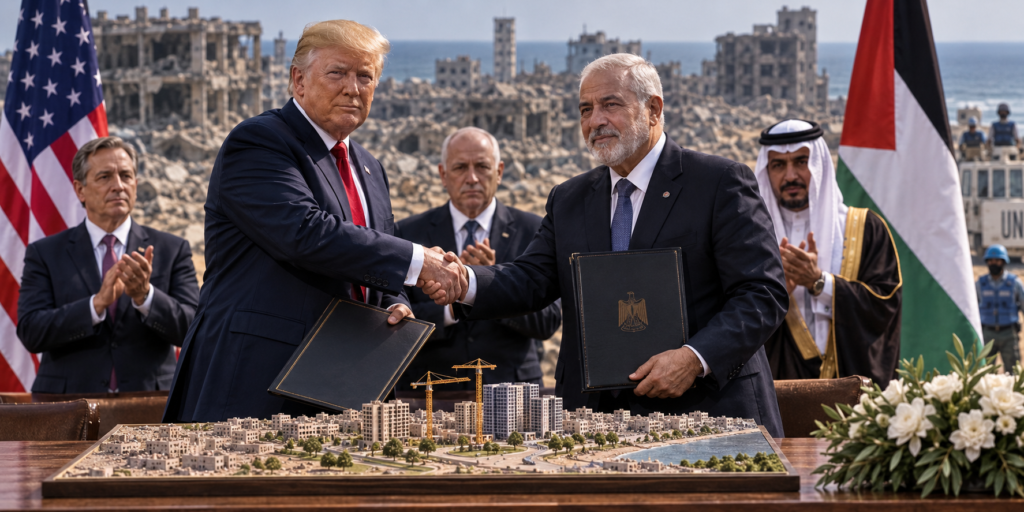
Image Credits: Trump announces phased Gaza peace agreement as Hamas signals acceptance of disarmament frameworks. AI-generated illustration created by Open Chronicle using ChatGPT (OpenAI). July 2026. This image is illustrative and does not depict a real-world scene.
By Open Chronicle News Desk with Agencies
U.S. President Donald Trump has announced what he described as a “historic deal” aimed at ending the war in Gaza, with Hamas indicating it has agreed in principle to an arrangement that includes its gradual disarmament and the phased withdrawal of Israeli forces from the territory.
The agreement, negotiated through the newly established Board of Peace, is intended to implement Trump’s 20-point peace plan through what he called “carefully structured phases.” Although Trump hailed the breakthrough as a “monumental step” toward lasting peace, he did not provide a specific timeline for completing the process.
The proposed accord follows the ceasefire reached nine months ago in Sharm el Sheikh, Egypt, which halted more than two years of large-scale fighting between Israel and Hamas. However, negotiations had remained stalled over the implementation of the second phase, particularly regarding Hamas’ weapons, the reconstruction of Gaza and Israel’s military withdrawal.
Phased disarmament and Israeli withdrawal
According to officials familiar with the negotiations, the agreement calls for Hamas and other armed groups operating in Gaza to surrender their weapons in stages while dismantling military infrastructure, including the extensive tunnel network built over many years.
Initial steps are expected to focus on the transfer of weapons held by Gaza’s police force to a new technocratic administration backed by the Board of Peace. Officials stressed that this police force does not control the majority of Hamas’ military arsenal, meaning the surrender of heavy weapons and the destruction of tunnels will occur during later stages of the agreement.
Sources involved in the negotiations estimate that the complete disarmament process could take between 200 and 350 days.
Once those objectives are achieved, Israeli forces would gradually withdraw from Gaza. Security responsibilities would then be transferred to a newly created International Stabilisation Force operating alongside Palestinian police under the authority of the new administration.
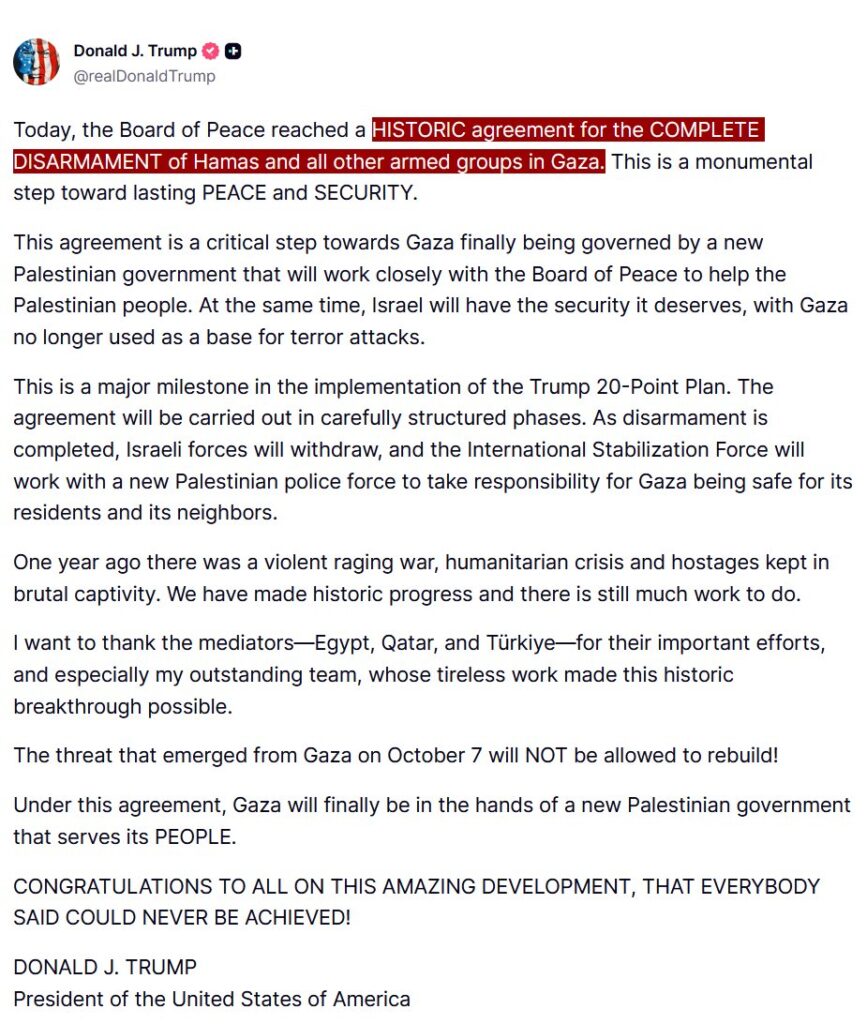
Today, the Board of Peace reached a HISTORIC agreement for the COMPLETE DISARMAMENT of Hamas and all other armed groups in Gaza.
A monumental step toward lasting PEACE and SECURITY. pic.twitter.com/RYUKUdrwIJ
— The White House (@WhiteHouse) July 30, 2026
New administration planned for Gaza
Trump’s peace initiative envisions the establishment of a technocratic Palestinian government to oversee Gaza’s reconstruction and civil administration.
According to the proposal, former British Prime Minister Tony Blair would lead international reconstruction efforts, coordinating humanitarian aid, infrastructure rebuilding and governance reforms designed to stabilise the territory after years of conflict.
Trump said the agreement would ensure that Gaza could no longer be used as a base for attacks against Israel while allowing a new government to focus on serving the civilian population.
Israel remains cautious
Despite participating throughout the negotiations, Israeli officials remain cautious about Hamas’ willingness to fully disarm.
According to U.S. officials, Israel was consulted at every stage of the discussions and is only being asked to fulfil commitments already contained in Trump’s broader peace proposal, namely withdrawing military forces from Gaza and ending air strikes once security conditions are met.
Trump reportedly warned that he would be “very, very disappointed” if Israel failed to honour the agreement after Hamas fulfilled its obligations.
Humanitarian crisis continues
The proposed deal comes as Gaza continues to face a severe humanitarian crisis.
Although fighting has been reduced since the ceasefire, Israeli forces still control significant portions of the territory, leaving many Palestinians displaced in temporary camps or heavily damaged urban areas.
The United Nations has repeatedly warned that living conditions remain extremely difficult, with shortages of housing, medical services and essential infrastructure.
Earlier this month, Hamas announced it had dissolved its governing administration in Gaza and was preparing to transfer civilian authority to a technical committee backed by the United Nations, a move widely viewed as part of the broader political transition envisioned under the proposed peace framework.
While diplomats welcomed the announcement as a potentially significant breakthrough, officials acknowledged that the most difficult stages of the agreement, particularly the complete disarmament of Hamas and the long-term security arrangements, remain to be implemented before a lasting peace can be secured.