
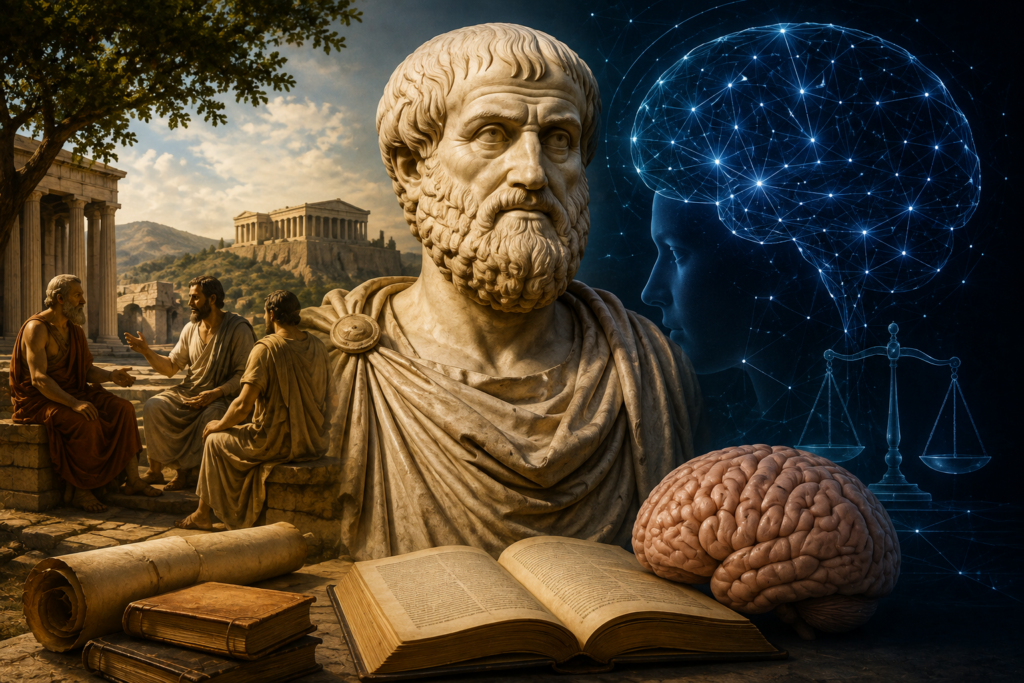
Image Credits: Aristotle’s Virtue Ethics Gains New Scientific Support from Modern Moral Psychology. AI-generated illustration created by Open Chronicle using ChatGPT (OpenAI). August 2026. This image is illustrative and does not depict a real-world scene.
By Open Chronicle with agencies
More than 2,300 years after Aristotle first explored the foundations of ethical living, new research suggests that his ideas may offer one of the most accurate explanations of how human beings actually make moral decisions.
A study published in Humanities and Social Sciences Communications, part of the Nature Portfolio, argues that Aristotle’s theory of virtue aligns remarkably well with contemporary findings in moral psychology. Rather than viewing ethical decision-making as the result of strict rule-following or complex calculations of consequences, the researchers contend that Aristotle anticipated many of the principles now emerging from modern cognitive science.
Their work proposes a renewed direction for moral psychology by placing character, intuition and practical wisdom at the centre of ethical behaviour.
Moving beyond rules and consequences
For much of the modern era, ethical philosophy has been dominated by two major traditions.
Utilitarianism argues that moral choices should maximise overall happiness or well-being, while deontology, most famously associated with Immanuel Kant, maintains that moral actions are determined by universal duties and principles regardless of their consequences.
The new study argues that Aristotle offers a fundamentally different approach.
Instead of asking whether an action follows a rule or produces the greatest benefit, Aristotle asks what kind of person acts. Moral excellence, he believed, develops through the cultivation of stable virtues such as courage, honesty, justice and generosity over an entire lifetime.
According to the researchers, this perspective reflects how people often make real-world moral decisions far more accurately than purely rule-based theories.
Intuition plays a central role
One of the study’s most significant conclusions is that Aristotle recognised the importance of moral intuition long before modern psychology.
The researchers argue that virtuous individuals do not typically solve ethical dilemmas by consciously weighing every possible consequence or applying abstract moral principles step by step. Instead, they often recognise the appropriate course of action almost immediately through experience, character and practical judgment.
This closely resembles contemporary intuitionist models of moral psychology, which suggest that many moral judgments arise rapidly and automatically before deliberate reasoning begins.
Reasoning remains important, but it often serves to explain, refine or justify an intuitive judgment that has already been formed.
Virtue as a learned skill
The study also highlights Aristotle’s belief that morality is developed through experience rather than innate knowledge.
Just as musicians, athletes, and physicians improve through years of disciplined practice, ethical excellence emerges through repeated moral actions that gradually shape character.
The researchers note striking similarities between Aristotle’s account and modern psychological studies showing that experts frequently rely on intuitive pattern recognition built through long experience rather than constant analytical calculation.
From this perspective, becoming a moral person resembles mastering any other complex skill: judgment improves through education, reflection and habitual practice.
Practical wisdom in an uncertain world
At the heart of Aristotle’s philosophy lies the concept of practical wisdom, known in Greek as phronesis.
Practical wisdom enables individuals to recognise what is appropriate in unique and often complicated circumstances where rigid rules may conflict or prove insufficient.
The researchers argue that this concept has become increasingly relevant in today’s world, where ethical decisions involving artificial intelligence, medicine, business and public policy rarely present simple right-or-wrong answers.
Rather than replacing moral principles, practical wisdom helps individuals interpret them within the complexity of real life.
Bridging philosophy and science
The study suggests that Aristotle’s ethics provides an important bridge between classical philosophy and empirical research.
Instead of treating philosophy and psychology as separate disciplines, the authors argue that Aristotle anticipated many discoveries now being confirmed by behavioural science, particularly regarding intuition, emotion, experience and character development.
This interdisciplinary perspective is attracting growing interest among researchers working in psychology, neuroscience, education and leadership studies, as well as those examining the ethical implications of artificial intelligence.
Ancient wisdom for modern challenges
The renewed scientific interest in Aristotle demonstrates the enduring relevance of classical philosophy.
In an age increasingly shaped by rapid technological change, complex ethical dilemmas and artificial intelligence, researchers believe that virtue ethics offers valuable insights into how individuals develop moral judgment and responsible decision-making.
Rather than reducing ethics to rules or mathematical calculations, Aristotle reminds us that moral excellence is ultimately rooted in the lifelong cultivation of character, wisdom and good habits.
More than two millennia after it was first developed, his philosophy continues to influence one of the most important questions facing both philosophers and scientists: how human beings become good.
Research Reference
Amormino, P., Law, K. F., & Inbar, Y. (2026). Aristotle’s intuitionist approach to morality guides a new direction in moral psychology. Humanities and Social Sciences Communications, Nature Portfolio. https://doi.org/10.1057/s41599-026-07942-1
Journal: Humanities and Social Sciences Communications (Nature Portfolio)