
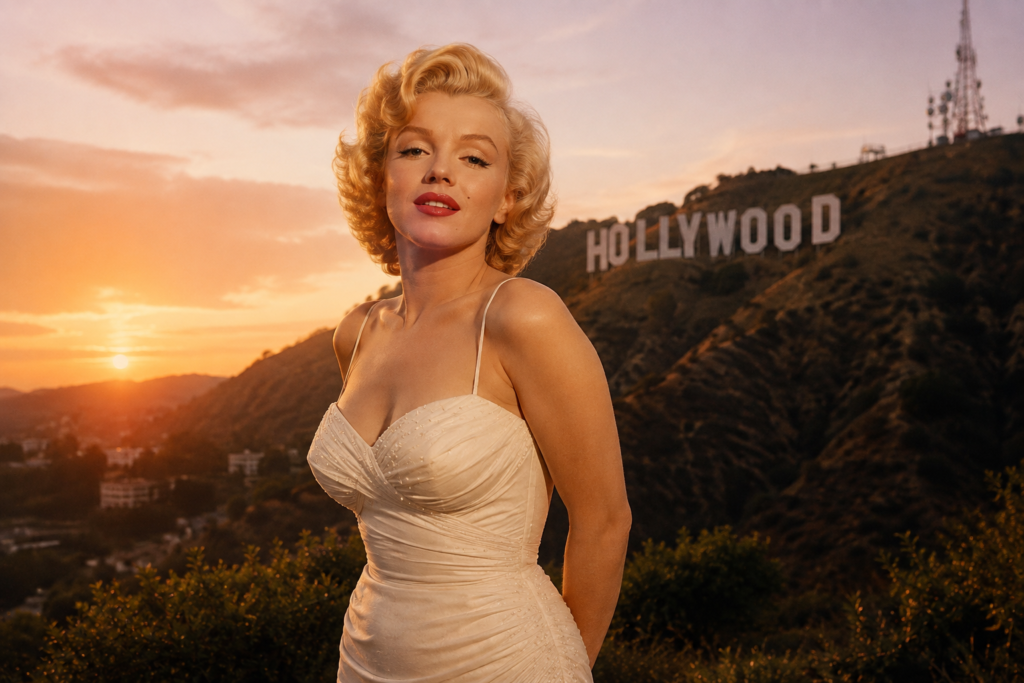
Image Credits: Today in History, August 5: 1962 Marilyn Monroe Is Found Dead at Her Home in Los Angeles. AI-generated illustration created by Open Chronicle using ChatGPT (OpenAI). August 2026. This image is illustrative and does not depict a real-world scene.
By Open Chronicle
5 August 1962
On 5 August 1962, American actress Marilyn Monroe was found dead at her home in the Brentwood neighbourhood of Los Angeles, California. She was 36 years old. The sudden death of one of Hollywood’s most celebrated stars shocked the world and marked the tragic end of a career that had transformed Monroe into one of the most enduring cultural icons of the twentieth century.
Born Norma Jeane Mortenson on 1 June 1926 in Los Angeles, Monroe experienced a difficult childhood marked by instability, foster homes, and orphanages. During the Second World War, she began working in a military factory, where she was discovered by a photographer. Her modelling career soon led to contracts with major film studios, and she adopted the stage name Marilyn Monroe.
Throughout the 1950s, Monroe became one of Hollywood’s biggest stars. Her combination of screen presence, comic timing and charisma captivated audiences around the world. Films such as Gentlemen Prefer Blondes (1953), How to Marry a Millionaire (1953), The Seven Year Itch (1955) and Some Like It Hot (1959) established her as one of the era’s defining actresses.
Although often cast in glamorous or comedic roles, Monroe worked to demonstrate her dramatic abilities, studying at the Actors Studio in New York under Lee Strasberg. She also founded Marilyn Monroe Productions, becoming one of the first actresses to challenge the traditional Hollywood studio system by seeking greater control over her career.
Behind her public success, however, Monroe struggled with anxiety, insomnia, and recurring health problems. She frequently relied on prescription medication, and her personal life attracted intense media attention through high-profile marriages to baseball legend Joe DiMaggio and playwright Arthur Miller.
By 1962, Monroe was filming Something’s Got to Give, a production repeatedly delayed by illness and scheduling difficulties. Her professional future remained uncertain, although discussions about new projects suggested she hoped to rebuild her career.
During the early hours of 5 August 1962, Monroe’s housekeeper, Eunice Murray, became concerned after noticing that the actress remained inside her locked bedroom with the lights still on. Monroe’s psychiatrist, Dr. Ralph Greenson, was summoned to the house. After entering the room through a window, he found Monroe unresponsive in her bed.
Authorities were called shortly afterwards, and Monroe was pronounced dead at the scene. The official investigation concluded that she had died from acute barbiturate poisoning and classified the death as a probable suicide.
Despite the official ruling, Monroe’s death has remained the subject of speculation for decades. Numerous theories have emerged concerning the circumstances surrounding her final hours, involving alleged political figures, organised crime and other claims. Multiple official reviews conducted over the years, however, have found no conclusive evidence to overturn the original findings.
Monroe’s funeral took place on 8 August 1962 at Westwood Village Memorial Park Cemetery in Los Angeles. Joe DiMaggio, who had remained close to Monroe despite their divorce, organised the private service attended by family and close friends.
Although her life ended prematurely, Monroe’s influence continued to grow after her death. Her image became one of the most recognisable in popular culture, inspiring generations of artists, photographers, filmmakers and fashion designers. Andy Warhol’s celebrated portraits of Monroe helped cement her status as a global cultural symbol.
Historians increasingly recognise Monroe not only as a Hollywood star but also as a figure who challenged expectations placed upon women in the entertainment industry. Her efforts to establish her own production company and pursue more serious acting roles demonstrated a determination that contrasted with the public image often assigned to her.
Today, Marilyn Monroe remains one of cinema’s most enduring legends. More than six decades after her death, her films continue to reach new audiences, while her life and career remain the subject of biographies, documentaries and academic study. Her story reflects both the extraordinary opportunities and the immense personal pressures associated with fame during Hollywood’s Golden Age.
The discovery of Marilyn Monroe’s death on 5 August 1962 brought an abrupt end to one of the twentieth century’s most remarkable entertainment careers. Yet her artistic legacy, cultural influence and enduring fascination continue to make her one of the most iconic figures in film history.