
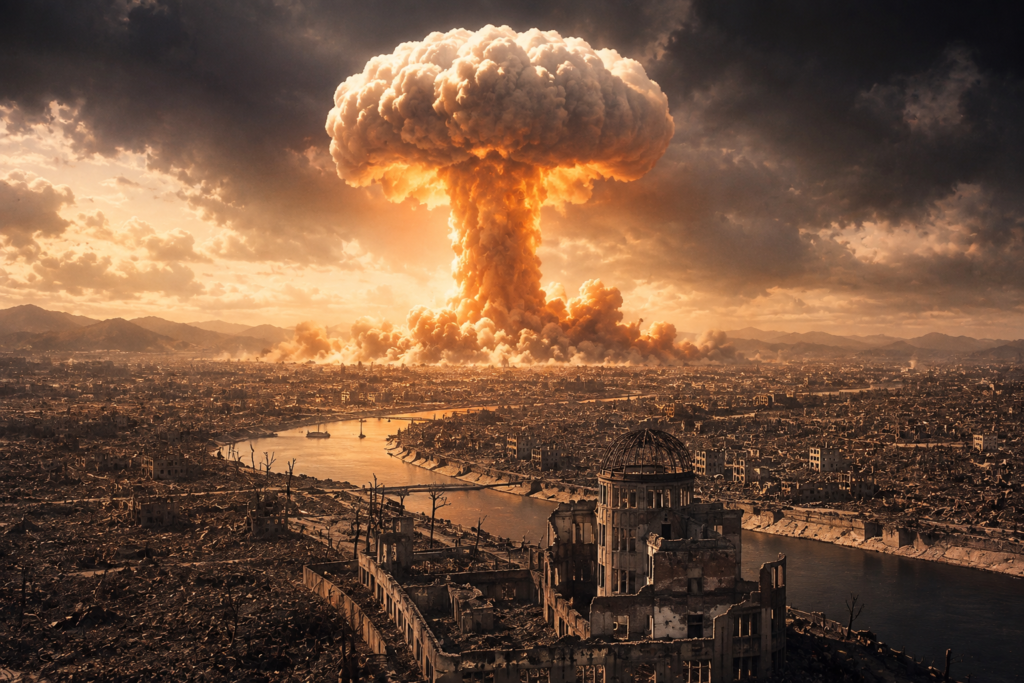
Image Credits: Today in History, August 6: 1945 The United States Drops the Atomic Bomb on Hiroshima. AI-generated illustration created by Open Chronicle using ChatGPT (OpenAI). August 2026. This image is illustrative and does not depict a real-world scene.
By Open Chronicle
6 August 1945
On 6 August 1945, the United States dropped the world’s first atomic bomb used in warfare on the Japanese city of Hiroshima, marking a turning point in military history and ushering humanity into the nuclear age. The attack caused unprecedented destruction, killing tens of thousands of people instantly and many more in the weeks, months and years that followed from injuries and radiation exposure.
The bombing took place during the final weeks of the Second World War. Although Germany had surrendered in May 1945, Japan continued to resist despite suffering devastating military defeats, a naval blockade and sustained conventional bombing of its cities. Allied leaders sought a way to end the war as quickly as possible while avoiding the enormous casualties expected from an invasion of the Japanese home islands.
The atomic bomb was the result of the Manhattan Project, a secret research programme launched in 1942 by the United States with assistance from Britain and Canada. Led by General Leslie Groves and physicist J. Robert Oppenheimer, the project brought together thousands of scientists, engineers and workers to develop nuclear weapons before Nazi Germany could do the same.
On 16 July 1945, the first successful nuclear test, known as the Trinity Test, took place in the New Mexico desert. With the weapon proven to work, President Harry S. Truman authorised its use against Japan after the Potsdam Declaration, issued on 26 July, called on Japan to surrender unconditionally. The Japanese government did not accept the Allied terms.
In the early hours of 6 August 1945, the American B-29 Superfortress Enola Gay, commanded by Colonel Paul W. Tibbets, departed from Tinian Island in the Mariana Islands carrying a uranium bomb codenamed Little Boy.
At 8:15 a.m. local time, the bomb was released over Hiroshima. It detonated approximately 600 metres above the city, producing an explosion equivalent to about 15 kilotons of TNT.
A blinding flash of light, an immense shockwave and temperatures reaching several thousand degrees Celsius instantly destroyed much of Hiroshima. Buildings collapsed or caught fire across the city, while thousands of people near the hypocentre were killed within moments.
An estimated 70,000 to 80,000 people died immediately. By the end of 1945, the death toll had risen to approximately 140,000 because of burns, traumatic injuries and radiation sickness. In subsequent years, many survivors developed cancers and other long-term illnesses linked to radiation exposure.
The survivors became known as hibakusha, a Japanese term referring to those affected by the atomic bombings. Many endured lifelong physical injuries, psychological trauma and social discrimination while becoming powerful advocates for nuclear disarmament and peace.
Three days later, on 9 August 1945, the United States dropped a second atomic bomb, Fat Man, on the city of Nagasaki. On the same day, the Soviet Union intensified its offensive against Japanese forces in Manchuria after declaring war on Japan.
Facing military collapse and the unprecedented destructive power of nuclear weapons, Emperor Hirohito announced Japan’s acceptance of the Allied surrender terms on 15 August 1945. The formal surrender was signed aboard the battleship USS Missouri on 2 September 1945, bringing the Second World War to an end.
The decision to use atomic bombs remains one of the most debated issues in modern history. Supporters argue that the bombings accelerated Japan’s surrender and prevented the enormous casualties that would likely have resulted from a full-scale invasion. Critics contend that Japan was already nearing defeat and question both the military necessity and the moral justification for using nuclear weapons against populated cities.
Whatever the interpretation, Hiroshima fundamentally changed international politics, military strategy and scientific responsibility. The atomic bombings initiated the nuclear age, leading to an arms race during the Cold War and prompting global efforts to prevent the future use of nuclear weapons.
Today, Hiroshima Peace Memorial Park and the preserved ruins of the Genbaku Dome, recognised as a UNESCO World Heritage Site, stand as enduring reminders of the human cost of nuclear warfare. Annual commemorations on 6 August honour the victims while renewing calls for peace, reconciliation and the elimination of nuclear weapons.
The bombing of Hiroshima remains one of the defining events of the twentieth century, symbolising both the extraordinary achievements of scientific innovation and the devastating consequences that technology can bring when used in war.