
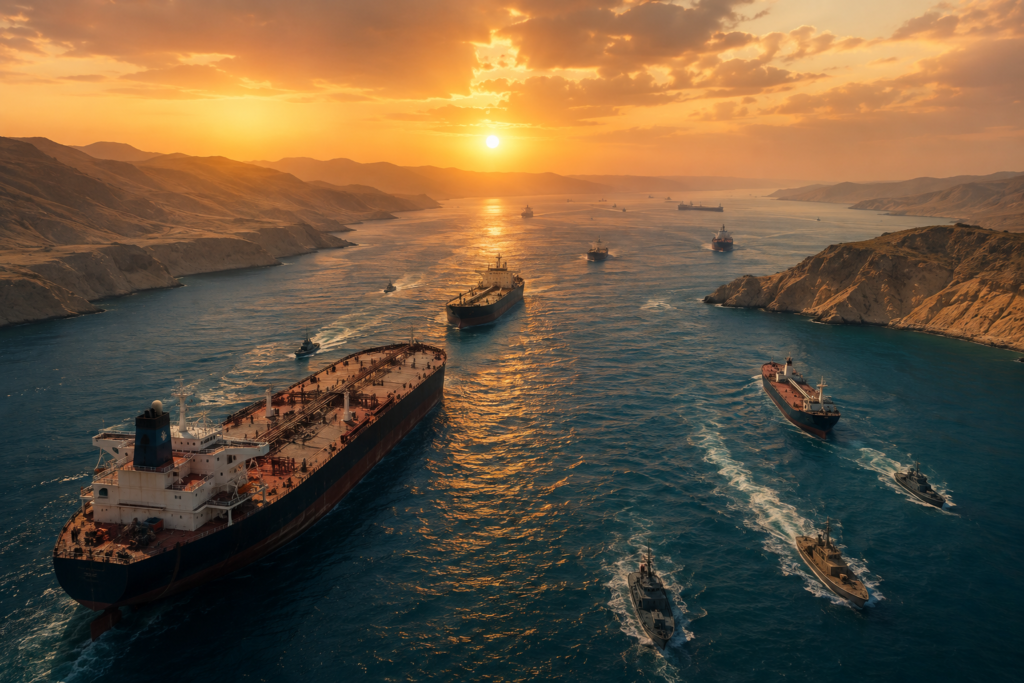
Image Credits: Iran and United States Signal Breakthrough as Strait of Hormuz Shipping Deal Nears. AI-generated illustration created by Open Chronicle using ChatGPT (OpenAI). August 2026. This image is illustrative and does not depict a real-world scene.
By Open Chronicle with agencies
The United States and Iran have indicated that a breakthrough agreement to restore commercial navigation through the Strait of Hormuz could be reached within days, raising cautious hopes that one of the world’s most strategically important maritime chokepoints may soon reopen after months of disruption.
Officials in Tehran and Washington say negotiations are approaching their final stage, with neighbouring Oman acting as the principal mediator between the two sides.
If finalised, the agreement would represent one of the most significant diplomatic developments since the outbreak of the conflict earlier this year, with potentially far-reaching implications for global energy markets, regional security and future nuclear negotiations.
Iran and Oman finalising the agreement
Iranian officials confirmed that negotiations over new shipping arrangements in the Strait of Hormuz are nearing completion.
Foreign Ministry spokesman Esmail Baghaei said the draft agreement with Oman has entered its final stage and suggested that a joint announcement could be made if the remaining political obstacles are resolved.
Deputy Foreign Minister Kazem Gharibabadi also stated that discussions on the new maritime framework are almost complete.
According to regional officials familiar with the negotiations, Iranian and Omani representatives have already agreed on the draft text, which now awaits final approval from Iran’s Supreme Leader, Ayatollah Mojtaba Khamenei.
Trump signals optimism
Speaking to reporters and in television interviews, U.S. President Donald Trump expressed confidence that an agreement could soon be announced.
Trump described recent negotiations with Iran as productive, saying both sides had engaged in extensive discussions throughout the day.
“There has been a lot of progress,” the president said, adding that the Strait of Hormuz “is going to be open very soon.”
While emphasising his preference for diplomacy, Trump also warned that failure to honour any agreement could trigger renewed military action.
“I’d rather make a deal because I don’t want to kill people,” he said. “But if they back out again, they are going to get hit really hard.”
A vital artery for global energy
The Strait of Hormuz is one of the world’s most important maritime trade routes.
Roughly one-fifth of global oil exports and a substantial share of the world’s liquefied natural gas shipments normally pass through the narrow waterway connecting the Persian Gulf to the Gulf of Oman and the Arabian Sea.
Since the outbreak of the conflict, commercial shipping has been severely disrupted, forcing energy companies and international shipping operators to reroute vessels, increase insurance costs and absorb significant logistical challenges.
The resulting uncertainty has repeatedly triggered sharp swings in global oil prices.
Conditions remain under negotiation
Despite the positive tone surrounding the talks, significant issues remain unresolved.
Iran has indicated that it does not intend to restore the Strait of Hormuz to its previous status as a fully unrestricted international waterway.
Instead, Tehran has insisted on maintaining a degree of authority over navigation through the strait, reflecting its long-standing strategic position that the waterway forms part of its national security interests.
Reports also suggest that any broader agreement may depend on the United States easing restrictions affecting Iranian ports, although neither side has publicly confirmed the final terms.
Potential path toward renewed nuclear diplomacy
Regional officials believe a successful shipping agreement could create the conditions for a broader resumption of negotiations over Iran’s nuclear programme.
Diplomatic contacts between Washington and Tehran have remained extremely limited since the conflict began, but analysts say confidence-building measures surrounding maritime security could provide a foundation for future talks.
Oman has long played a discreet but influential role as an intermediary between Iran and the United States, hosting numerous rounds of indirect negotiations over the past decade.
Markets react cautiously
Financial markets initially welcomed reports of progress, with oil prices easing as investors anticipated a gradual return of shipping through the Strait of Hormuz.
However, prices later recovered some of those losses as traders remained cautious about the durability of any agreement.
Brent crude continued trading around US$80 per barrel, well below the peaks reached during the height of the conflict but still reflecting the ongoing geopolitical uncertainty surrounding one of the world’s most critical energy corridors.
Although negotiators appear closer than ever to reaching an agreement, analysts caution that implementation will ultimately determine whether the Strait of Hormuz returns to stable commercial operation or remains a recurring source of international tension.