
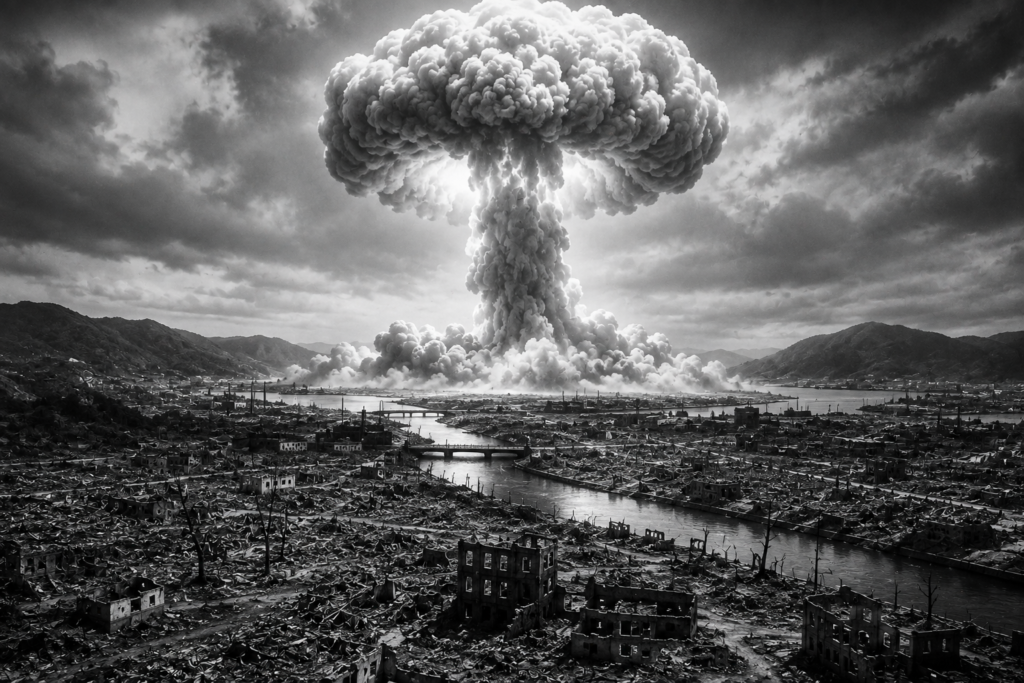
Image Credits: Today in History, August 9: 1945 The Atomic Bombing of Nagasaki Devastates the Japanese City. AI-generated illustration created by Open Chronicle using ChatGPT (OpenAI). August 2026. This image is illustrative and does not depict a real-world scene.
By Open Chronicle
9 August 1945
On 9 August 1945, the United States dropped an atomic bomb on the Japanese city of Nagasaki, three days after the destruction of Hiroshima. The attack killed tens of thousands of people and became the second, and so far last, use of a nuclear weapon in warfare.
The bombing came during the final days of the Second World War, as Japan faced an increasingly desperate military situation. Its navy had been devastated, many of its cities had suffered extensive conventional bombing, Allied forces were advancing across the Pacific, and a naval blockade was severely restricting supplies.
Then, on 6 August, the United States dropped the uranium bomb Little Boy on Hiroshima.
Three days later, the war entered another dramatic phase.
The Soviet Union Enters the War
Shortly before the Nagasaki bombing, another major development transformed Japan’s strategic position.
On 8 August 1945, the Soviet Union declared war on Japan. Soviet forces then launched a massive offensive against the Japanese Kwantung Army in Manchuria.
Japan had previously hoped that Moscow might help negotiate an end to the war. Soviet intervention effectively destroyed that possibility while opening another military front.
Japan now faced pressure from both the Western Allies and the Soviet Union.
At almost the same moment, preparations were already underway for the use of a second American atomic bomb.
The B-29 Bockscar Takes Off
During the early hours of 9 August, a B-29 Superfortress named Bockscar departed from the island of Tinian in the Mariana Islands.
Major Charles W. Sweeney commanded the aircraft.
Inside the bomber was a plutonium implosion weapon codenamed Fat Man.
Unlike the uranium-based Little Boy bomb dropped on Hiroshima, Fat Man used plutonium and an implosion mechanism similar to the device successfully tested during the Trinity nuclear test in New Mexico on 16 July 1945.
Nagasaki was not originally the primary target for the mission.
The first target was the industrial city of Kokura.
Kokura Escapes Destruction
When Bockscar reached Kokura, clouds and smoke obscured the target.
The crew made several attempts to locate the designated aiming point, but visibility remained inadequate.
Fuel was becoming increasingly limited.
Sweeney therefore abandoned the attempt and turned toward the mission’s secondary target, Nagasaki.
That decision determined the fate of two cities.
The circumstances gave rise to the Japanese expression sometimes translated as the “luck of Kokura,” referring to an unexpected escape from disaster.
Nagasaki
Nagasaki was an important industrial and naval centre with major shipyards, weapons factories and military facilities.
Unlike Hiroshima, however, Nagasaki was surrounded by hills and divided into several valleys. Its geography would influence the effects of the explosion.
When Bockscar arrived, clouds also covered much of Nagasaki.
A break in the cloud layer eventually allowed the bombardier to identify the target area.
At approximately 11:02 a.m., Fat Man exploded above the Urakami Valley.
The explosion produced an estimated yield of about 21 kilotons of TNT, making it more powerful than the bomb dropped on Hiroshima.
The Explosion
The detonation generated an enormous fireball, intense thermal radiation and a devastating shockwave.
Buildings near the hypocentre were destroyed almost instantly. Factories, homes, schools and religious buildings collapsed or burned.
One of the most important landmarks in the affected area was Urakami Cathedral, then one of the largest Christian churches in East Asia. Located relatively close to the hypocentre, it was almost completely destroyed.
Thousands of people died within moments.
The city’s mountainous terrain limited some of the blast’s effects compared with the relatively flat landscape of Hiroshima, but the destruction within the Urakami Valley was catastrophic.
Approximately 40,000 people are estimated to have died immediately or shortly after the explosion. By the end of 1945, estimates generally place the death toll at around 70,000, although exact numbers remain uncertain.
Many more suffered severe burns, injuries and radiation exposure.
The Hibakusha
As in Hiroshima, survivors of Nagasaki became known as hibakusha, meaning people affected by the atomic bomb.
Their suffering did not end when the fires disappeared.
Radiation sickness produced symptoms that were poorly understood at the time. Some people who initially appeared to have survived later developed severe illness.
In subsequent years, survivors experienced increased rates of certain cancers and other health problems associated with radiation exposure.
Many hibakusha also faced social discrimination because of fears and misconceptions surrounding radiation-related illnesses.
Their testimony would later become an important part of international movements opposing nuclear warfare.
Japan Faces a Historic Decision
The bombing occurred while Japan’s leadership was already confronting the consequences of Hiroshima and the Soviet declaration of war.
Government leaders were deeply divided over whether to accept the Allied demand for surrender contained in the Potsdam Declaration.
Some military leaders hoped to continue fighting, expecting that a costly Allied invasion of Japan might yield more favourable surrender terms.
Others concluded that the country’s situation had become hopeless.
Emperor Hirohito ultimately intervened in the debate and supported acceptance of the Allied terms, provided that the imperial institution could continue.
In the early hours of 10 August, Japan communicated its willingness to surrender under that understanding.
The End of the Second World War
On 15 August 1945, Emperor Hirohito addressed the Japanese population by radio.
For many Japanese citizens, it was the first time they had ever heard the emperor’s voice.
He announced that Japan would accept the Allied terms and end the war.
The formal surrender took place on 2 September 1945 aboard the battleship USS Missouri in Tokyo Bay.
The Second World War was over.
Six years of global conflict had resulted in tens of millions of deaths and transformed the international order.
A Debate That Continues
The atomic bombings of Hiroshima and Nagasaki remain among the most intensely debated military decisions in history.
Supporters of President Harry S. Truman’s decision argue that the bombs accelerated Japan’s surrender and avoided an invasion of the Japanese home islands that could have caused enormous casualties among Allied troops and Japanese civilians.
Critics question whether the second bombing was necessary, particularly because only three days separated Hiroshima and Nagasaki and because Japan’s strategic position was already collapsing.
Historians have also examined the importance of the Soviet invasion of Manchuria in Japan’s decision to surrender.
The debate therefore extends beyond the weapons themselves. It concerns military necessity, diplomacy, morality, civilian casualties and the emerging geopolitical rivalry between the United States and the Soviet Union.
The Beginning of the Nuclear Age
Hiroshima and Nagasaki demonstrated that a single weapon could destroy much of a city within seconds.
That reality fundamentally changed warfare and international politics.
During the following decades, the United States, Soviet Union, and other powers developed weapons vastly more powerful than those used against Japan.
Nuclear deterrence became one of the foundations of Cold War strategy, while the possibility of nuclear annihilation became a permanent concern for humanity.
At the same time, international movements emerged calling for arms control, disarmament and the abolition of nuclear weapons.
Remembering Nagasaki
Today, the Nagasaki Peace Park, the Atomic Bomb Museum and surviving historical sites preserve the memory of the attack and its victims.
Every year on 9 August, Nagasaki holds a memorial ceremony. At 11:02 a.m., the time of the explosion, participants observe a moment of silence.
The city has become an international symbol of peace and nuclear disarmament.
The atomic bombing of Nagasaki on 9 August 1945 helped bring the most destructive war in human history to its conclusion, but it also revealed a new and terrifying dimension of warfare.
Together, Hiroshima and Nagasaki marked the beginning of the nuclear age, an era in which humanity acquired the ability to destroy cities, and potentially civilisation itself, with weapons of unprecedented power.