
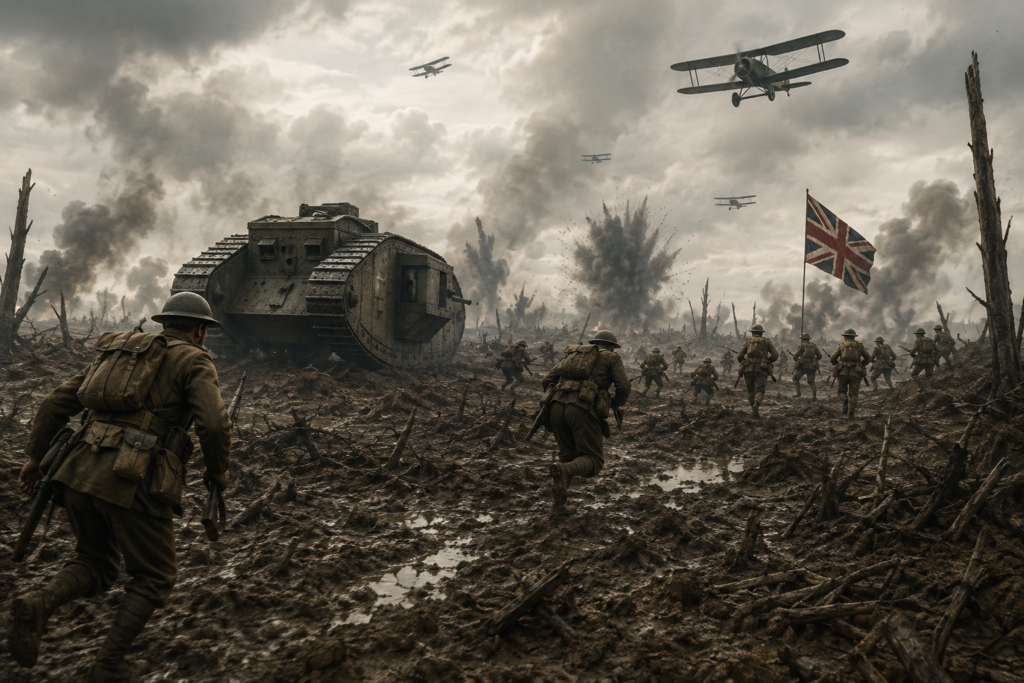
Image Credits: The Battle of Amiens: The Blow That Helped Break Germany’s Imperial Army. AI-generated illustration created by Open Chronicle using ChatGPT (OpenAI). August 2026. This image is illustrative and does not depict a real-world scene.
By Open Chronicle History Desk
On 8 August 1918, Allied armies launched a massive attack near Amiens in northern France. By the end of the day, German positions had been shattered across a broad section of the Western Front, thousands of prisoners had been taken and Allied troops had advanced farther than had become customary in years of trench warfare.
The Battle of Amiens did not end the First World War. Nor did it destroy the German Army in a single engagement. Its importance was greater than that. Amiens demonstrated that the strategic initiative had passed decisively to the Allies and helped begin the sequence of offensives that would drive German forces backwards until the Armistice of 11 November 1918.
For an army that had come close to victory only months earlier, the psychological consequences were profound.
The Western Front in the Summer of 1918
The battle came after one of the most dangerous periods of the war for the Allies.
In the spring of 1918, Germany had launched a series of major offensives on the Western Front. The collapse of Imperial Russia had allowed German commanders to transfer large numbers of troops from the Eastern Front to France and Belgium, creating a temporary opportunity to achieve victory before the growing strength of the United States could become decisive.
German forces made substantial territorial gains, but they failed to achieve the strategic breakthrough their commanders needed.
The offensives also came at an enormous cost. Germany’s best assault formations suffered severe casualties, supply difficulties increased and the army became progressively more exhausted.
By the summer, the balance was changing.
American troops were arriving in increasing numbers, while Britain, France and their imperial forces retained substantial resources. Allied command was also becoming more coordinated under Marshal Ferdinand Foch.
The German offensives had failed to produce victory. The Allies were now preparing to take the initiative.
The Attack at Amiens
The offensive began in the early hours of 8 August.
British forces attacked alongside Australian and Canadian troops, while French forces operated farther south. The assault represented a sophisticated combination of infantry, artillery, tanks and aircraft.
Surprise was central to the operation.
Rather than relying on a lengthy preliminary bombardment that would have warned German defenders of an approaching offensive, Allied planners sought to conceal their preparations. Artillery could then provide support as the attack began, while tanks helped infantry cross defensive positions and overcome strongpoints.
The result was devastating.
German units were caught off guard across significant portions of the front. Allied troops penetrated defensive positions, captured large numbers of prisoners and advanced rapidly.
After years in which advances were often measured in hundreds of metres and purchased at terrible human cost, the movement achieved around Amiens was striking.
It showed how far Allied offensive methods had developed since the disastrous battles of the earlier war.
Australians and Canadians at the Centre of the Offensive
Australian and Canadian formations played particularly important roles in the attack.
Both had developed considerable experience in offensive warfare during the conflict. At Amiens, their troops were integrated into a wider operation in which artillery, armour and infantry were expected to work together rather than operate as largely independent arms.
The British Fourth Army, commanded by General Henry Rawlinson, formed the core of the offensive, while French forces extended the attack to the south.
The coordination mattered enormously.
Tanks could suppress or bypass defensive positions. Artillery isolated German troops and disrupted communications. Aircraft provided reconnaissance and attacked targets behind the front. Infantry followed through the openings created by these combined efforts.
No single weapon had suddenly solved the problem of trench warfare. Instead, the Allies had become considerably better at combining different military capabilities.
Amiens therefore represented not merely an Allied numerical advantage but an important development in battlefield methods.
The Psychological Shock
Territory alone does not explain why Amiens occupies such an important place in the history of the First World War.
The condition of the German Army made the battle particularly significant.
Years of fighting had exhausted Germany’s manpower and resources. The failure of the spring offensives had further weakened units that had been expected to deliver victory.
At Amiens, Allied forces encountered evidence that morale within sections of the German Army was deteriorating.
German troops surrendered in unusually large numbers. Some formations were unable to offer the resistance expected of them. The scale and speed of the Allied advance exposed weaknesses that could no longer easily be concealed.
General Erich Ludendorff, one of Germany’s most powerful military leaders, later famously described 8 August as the “black day of the German Army.”
The phrase has become inseparable from the battle.
It did not mean that every German soldier had lost the will to fight. German forces would continue to offer determined resistance for another three months. But Amiens demonstrated that the German Army could no longer reliably recover the initiative.
Something fundamental had changed.
From Trench Stalemate to Mobile Warfare
Amiens also illustrated the changing character of warfare on the Western Front.
The popular image of the First World War is dominated by trenches, barbed wire, mud and repeated frontal assaults. Those images accurately describe much of the conflict, but they can obscure the considerable tactical evolution that occurred between 1914 and 1918.
Armies learned through enormous sacrifice.
Artillery became more accurate. Communications improved. Aircraft performed increasingly sophisticated reconnaissance and combat missions. Tanks, still mechanically unreliable, could nevertheless provide valuable support when employed effectively.
Infantry tactics also evolved.
By 1918, successful operations increasingly depended upon the coordination of all these elements.
Amiens demonstrated what could happen when that coordination worked.
The attack did not eliminate the problems of offensive warfare. Tanks broke down, casualties remained significant and German resistance hardened after the initial shock. But the Allies had shown that heavily defended positions could be penetrated without returning automatically to the enormous, prolonged battles of attrition associated with earlier years.
The Hundred Days Offensive
Amiens became the opening phase of the Allied operations remembered collectively as the Hundred Days Offensive.
This is crucial to understanding the battle’s historical significance.
The Allies did not simply achieve a breakthrough at Amiens and stop. Pressure continued elsewhere along the Western Front.
Rather than allowing Germany sufficient time to stabilize the situation permanently, Allied commanders launched successive operations against different sections of the German defensive system.
German armies were increasingly forced to retreat.
Positions captured at immense cost during earlier campaigns were abandoned. Defensive lines that had once seemed formidable came under sustained pressure. Allied forces pushed towards and eventually through elements of the Hindenburg Line.
The nature of the strategic situation had been reversed.
During the spring, the Allies had feared that Germany might break their armies before American power could be fully deployed. By the autumn, German commanders faced the increasingly difficult question of whether their army could continue the war at all.
An Army Under Growing Pressure
Germany’s military difficulties cannot be understood through battlefield events alone.
The Imperial German Army remained a powerful force, but it was fighting within a country subjected to years of blockade, shortages and economic strain.
Manpower was becoming increasingly difficult to replace. Experienced soldiers had been lost in enormous numbers. Civilians faced deprivation at home.
Germany’s allies were also weakening.
As the Central Powers’ military position deteriorated during the autumn of 1918, the German leadership faced not only an increasingly unfavourable Western Front but the possibility of broader strategic collapse.
Amiens therefore mattered because it accelerated a crisis that was already developing.
The battle demonstrated that the Allies possessed the ability and determination to continue attacking. Germany, by contrast, had diminishing resources with which to restore the strategic balance.
Why Amiens Was Not a Simple Allied Victory
It is tempting to portray 8 August as the moment when Germany suddenly collapsed. The reality was more complicated.
German resistance did not disappear.
After the extraordinary Allied gains of the opening phase, the offensive became more difficult. German commanders reorganized defensive positions, and the effectiveness of Allied tanks declined as machines were destroyed, damaged or suffered mechanical failures.
This was one reason Foch and other Allied commanders increasingly favoured maintaining pressure through successive offensives rather than allowing another battle to become an enormous static struggle.
The strategic lesson was important.
The Allies no longer needed to destroy the German Army in one gigantic battle. They could force it to respond repeatedly, exhausting reserves and denying commanders the opportunity to regain the initiative.
Amiens was therefore both a battle and the beginning of a new operational rhythm.
The Beginning of the End
During the weeks that followed, Germany’s military and political situation deteriorated rapidly.
The German Army continued its retreat as Allied forces attacked across the Western Front. By September and October, Germany’s leadership increasingly recognized that outright military victory was impossible.
Political consequences followed.
The prospect of defeat intensified domestic tensions within the German Empire. Pressure grew for political reform, while military leaders increasingly sought a negotiated end to the conflict.
By early November, revolution was spreading through Germany.
Kaiser Wilhelm II abdicated on 9 November. Two days later, the Armistice came into effect.
The First World War on the Western Front was over.
Amiens had taken place only 95 days earlier.
Why the Battle of Amiens Matters
The Battle of Amiens deserves its reputation as one of the decisive battles of the First World War, but not because it independently defeated Germany.
Its importance lies in what it revealed and what followed.
The battle demonstrated the effectiveness of increasingly sophisticated Allied combined arms warfare. It exposed the declining resilience of German forces after the failure of the spring offensives. It inflicted a serious psychological shock upon the German high command and helped begin an almost continuous period of Allied pressure.
Most importantly, Germany never regained the strategic initiative.
From August 1918 onwards, the question was increasingly no longer whether Germany could win the war, but how long its armies and political system could withstand the mounting consequences of defeat.
Amiens therefore stands at the threshold of the First World War’s final chapter.
The trenches had not disappeared, and the fighting was far from finished. Thousands more soldiers would die before the guns fell silent.
But on 8 August 1918, the direction of the war had unmistakably changed.