
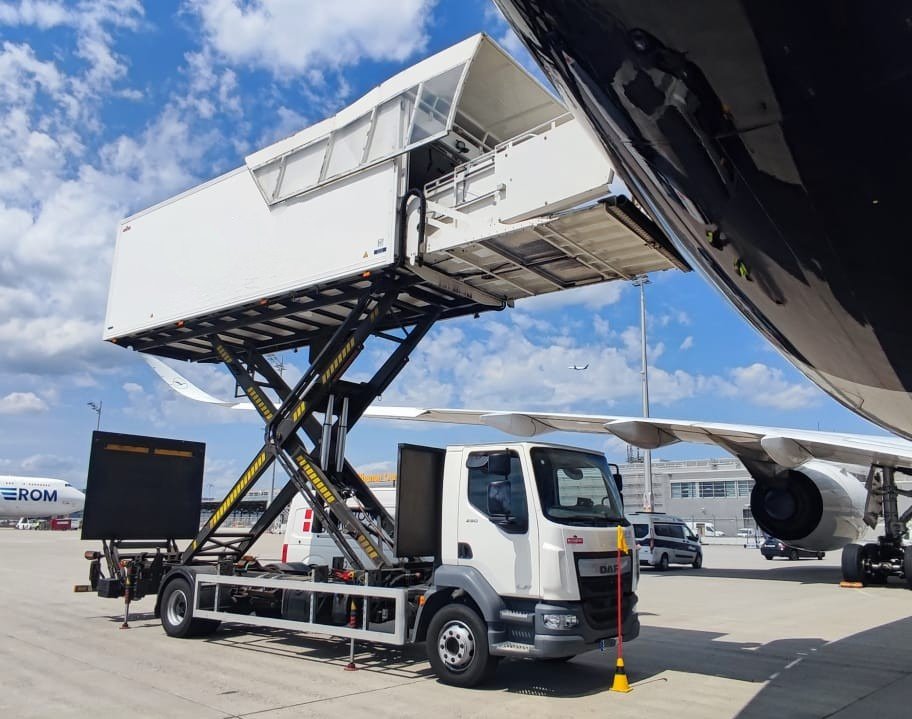
Image: from Global Strategy X @World_At_War_6
By Open Chronicle with agencies
An extraordinary security operation involving President Donald Trump, multiple aircraft and a discreet transfer aboard an airport catering vehicle has revealed the lengths taken to conceal the U.S. president’s movements following an alleged Iranian assassination threat.
According to reporting cited by CNN Brasil, Trump secretly left Turkey aboard a U.S. military aircraft during a NATO summit in Ankara, while journalists and even some members of his entourage believed he was travelling aboard the presidential aircraft.
The elaborate operation involved several aircraft changes between Turkey and the United Kingdom, apparently designed to make it difficult for potential adversaries to determine exactly where the president was travelling.
The unusual precautions underline the seriousness with which American security officials were treating threats connected to escalating tensions between Washington and Tehran.
Video shows the airport catering truck used in a secret operation to move President Trump from Air Force One to another U.S. government plane amid a credible Iranian threat last month.
The truck can be seen pulling away from Air Force One after the president had boarded the… pic.twitter.com/IwJTaWlmSb
— CBS News (@CBSNews) August 11, 2026
A presidential departure unlike any other
Trump was attending a NATO summit in Ankara when the security operation unfolded.
Under normal circumstances, the movements of an American president travelling internationally are carefully choreographed.
The presidential motorcade arrives at the airport, the president boards the designated aircraft and the travelling press corps follows the journey.
This time, the sequence was very different.
It was already known that Trump had not initially boarded the newer presidential aircraft associated with his delegation.
Instead, he entered an older presidential aircraft distinguished by its traditional light blue appearance.
For observers accompanying the president, that appeared to settle the question of how Trump would leave Turkey.
It did not.
A second, secret aircraft transfer was about to take place.
🇺🇸🇮🇷 IRANIAN ASSASSINATION THREAT FORCED SECRET TRUMP ESCAPE FROM TURKEY
A credible Iranian threat against President Trump reportedly triggered an extraordinary covert operation during his trip to Turkey last month.
According to The Washington Post, Trump publicly boarded the… pic.twitter.com/Bh9xP7uVOy
— Mossad Commentary (@MOSSADil) August 11, 2026
Trump reportedly concealed himself inside an airport vehicle
Minutes after entering the presidential aircraft, Trump reportedly left it without the travelling press corps seeing him.
The method used to conceal the movement was particularly unusual.
According to the account, Trump entered an airport catering truck of the type commonly used to load food and supplies onto passenger aircraft.
These vehicles contain hydraulic platforms capable of raising containers to the height of an aircraft cabin.
Trump was reportedly concealed during the transfer and transported to another aircraft parked nearby.
The operation allowed the president to leave the aircraft without making the highly visible journey down the normal presidential staircase.
Journalists told to close their window shades
Another unusual instruction now appears to have been connected to the operation.
Journalists aboard the presidential aircraft were reportedly ordered to lower their window shades.
The instruction confused at the time.
The later reporting provides a possible explanation.
Closing the shades would have prevented journalists from observing activity outside the aircraft while Trump was being moved to the second plane.
The operation appears to have been conducted on a strict need-to-know basis.
Even some officials travelling with the White House delegation reportedly did not know that the president had changed aircraft.
The secret aircraft was a U.S. Air Force C-32
Trump was transferred to a C-32, a modified Boeing aircraft operated by the United States Air Force.
The C-32 is commonly associated with transportation for senior American officials.
It can carry the vice president, cabinet secretaries, the first lady, and other high-ranking members of the U.S. government.
When the president is aboard a U.S. Air Force aircraft, that aircraft normally assumes the radio call sign Air Force One.
The C-32 involved in the operation had reportedly been transporting U.S. Defense Secretary Pete Hegseth, who was also attending the NATO summit in Ankara.
Trump therefore departed Turkey aboard a smaller aircraft while the larger presidential plane continued on a separate route.
The decoy Air Force One departed for Britain
The older presidential aircraft subsequently took off toward the United Kingdom.
Journalists and members of the delegation remained aboard.
But Trump was reportedly no longer there.
Some people on the aircraft apparently believed the president was still travelling with them.
Even communications between air traffic controllers reportedly continued referring to the larger aircraft in a way that preserved the impression that Trump remained aboard.
From the outside, therefore, the presidential journey appeared relatively normal.
Behind the scenes, the actual president was travelling separately.
The arrangement effectively transformed the larger aircraft into a highly convincing decoy.
The operation continued in Britain
The deception did not end when the aircraft left Turkey.
Trump’s smaller C-32 reportedly reached the United Kingdom several minutes before the larger presidential aircraft.
The timing allowed another carefully coordinated transfer.
Before the larger aircraft landed, Trump reportedly left the C-32 and boarded the presidential plane again.
When the larger aircraft arrived at its destination, Trump then descended its stairs in front of cameras.
To observers watching the arrival, everything appeared normal.
The president seemed to have travelled aboard the aircraft throughout the journey from Turkey.
In reality, according to the reporting, he had completed much of the flight aboard another aircraft.
Yet another aircraft change
Trump then reportedly made another transfer.
After publicly leaving the older presidential aircraft, he walked toward the newer aircraft associated with the presidential fleet.
The sequence meant that several different aircraft had played roles in the president’s journey.
The complexity was not simply theatrical.
Each movement appears to have been designed around a security problem.
Potential attackers attempting to identify the president’s location would have faced several competing possibilities.
Why use the older aircraft?
The security concerns reportedly extended to the capabilities of the aircraft themselves.
CNN Brasil reported that the newer aircraft available to Trump had been adapted from an aircraft donated to the U.S. government rather than originally constructed from the beginning specifically for presidential service.
According to the report, it was not considered fully prepared at that point for the particular aerial threat confronting the presidential delegation and would require additional upgrades.
The older presidential aircraft, despite its age, was considered better prepared for the security environment.
Presidential aircraft contain extensive communications and defensive capabilities that distinguish them from ordinary commercial airliners.
Protecting the president while airborne therefore involves much more than simply choosing the newest available aircraft.
The Iranian threat
The entire operation was reportedly prompted by intelligence concerning a possible Iranian assassination threat.
That context transforms what might otherwise appear to be an elaborate travel manoeuvre into a significant national security story.
Relations between Washington and Tehran have deteriorated dramatically amid military confrontation and continuing disputes over Iran’s nuclear programme, regional security and the Strait of Hormuz.
The location of the NATO summit added another concern.
Turkey shares a land border of more than 500 kilometres with Iran.
Parts of Turkish territory therefore lie within the operational reach of Iranian missile systems.
American security planners had to consider not only traditional assassination scenarios but potentially more sophisticated threats against presidential transportation.
Protecting a president in an era of precision weapons
The episode illustrates how presidential security is changing.
Protecting a head of state traditionally focuses heavily on threats on the ground.
Motorcade routes are secured. Buildings are searched. Airspace is restricted. Local security services cooperate with American agencies.
Modern warfare adds another dimension.
Long range missiles, drones, sophisticated surveillance networks and electronic intelligence systems can potentially threaten important targets from considerable distances.
The location of a president can itself become sensitive intelligence.
Deception consequently becomes part of protection.
If an adversary cannot determine which aircraft actually carries the president, planning an attack becomes considerably more difficult.
Air Force One is a call sign, not simply an aircraft
The operation also highlights a frequently misunderstood aspect of presidential aviation.
Air Force One is not technically the permanent name of one specific airplane.
It is the call sign normally assigned to a U.S. Air Force aircraft while the president is aboard.
The iconic Boeing VC-25 aircraft are most closely associated with the presidency because they usually perform that role.
But other Air Force aircraft can become Air Force One when carrying the president.
The C-32 therefore provides presidential planners with an alternative aircraft when operational or security requirements demand greater flexibility.
Its smaller size can also make it useful when travelling to airports unsuitable for the larger presidential aircraft.
A carefully constructed illusion
Perhaps the most remarkable aspect of the operation was not any individual aircraft change.
It was the effort to preserve the appearance of an ordinary presidential journey.
Journalists remained aboard the expected aircraft.
Window shades prevented observation of activity outside.
The larger plane departed as expected.
Trump arrived publicly from the aircraft observers expected him to use.
Only later did the reported sequence become clear.
The operation demonstrates a fundamental principle of protective security: sometimes the safest movement is one that potential adversaries never realise has happened.
A window into presidential security
Many details surrounding presidential protection are understandably classified, and the full intelligence assessment behind the operation has not been made public.
That means important questions remain unanswered.
The precise nature of the alleged Iranian threat is unclear. It is also unknown what intelligence convinced American officials that extraordinary precautions were necessary.
Nevertheless, the reported operation offers a rare glimpse into the complexity surrounding the protection of an American president during an international crisis.
Aircraft, communications, airport vehicles, flight schedules and even the movements of journalists can become components of a coordinated deception plan.
Trump’s journey from Turkey demonstrates how quickly normal presidential travel can transform into a military security operation when intelligence indicates a credible threat.
For the public, Air Force One remains one of the most visible symbols of the American presidency.
During this journey, however, the central objective was exactly the opposite.
The safest presidential aircraft was the one nobody knew the president was aboard.