
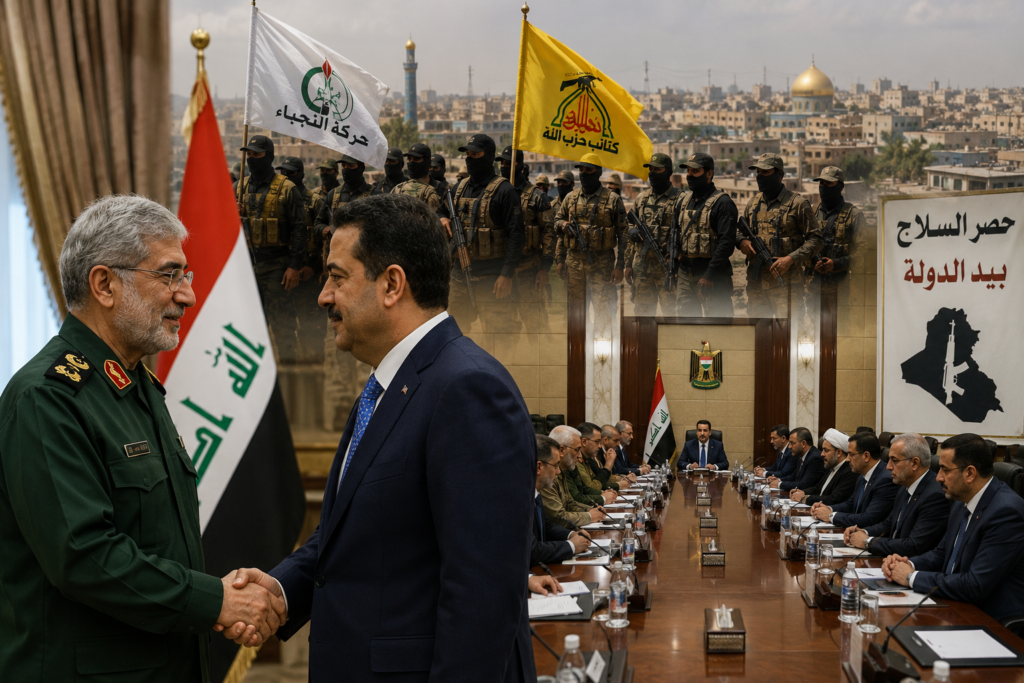
Image Credits: Iran’s Quds Force Chief Visits Baghdad as Iraq Faces Crucial Armed Groups Disarmament Deadline. AI-generated illustration created by Open Chronicle using ChatGPT (OpenAI). August 2026. This image is illustrative and does not depict a real-world scene.
By Open Chronicle with agencies
Iran’s Quds Force commander Esmail Qaani has travelled to Baghdad for high-level talks over Iraq’s increasingly sensitive effort to bring weapons held by powerful armed factions under state control, as the country approaches a September 30 deadline that could reshape its security order.
According to an Iraqi political source cited by Al Jazeera, Qaani met political and security officials as well as commanders of Shia paramilitary factions. The discussions focused on the Iraqi government’s plan to restrict weapons to official state institutions and the growing disagreement over how that process should be implemented.
Tehran has reportedly urged allied Iraqi factions not to surrender their weapons for now. At the same time, Iran is seeking to prevent the dispute from developing into an armed confrontation between the factions and the Iraqi government.
The issue has become one of the most difficult challenges facing Prime Minister Ali al Zaidi’s government. Some armed groups have indicated that they are prepared to integrate into official security forces, while influential factions including Kataib Hezbollah and Harakat al Nujaba continue to resist disarmament.
With the deadline approaching, Baghdad is attempting to strengthen state sovereignty without triggering another internal security crisis.
Qaani makes unannounced visit to Baghdad
Qaani, who commands the Quds Force of Iran’s Islamic Revolutionary Guard Corps, reportedly travelled to Iraq without a prior public announcement.
An Iraqi source from the Coordination Framework, an umbrella grouping of Shia political parties, said Qaani met political and security officials and commanders from Shia paramilitary organisations on Monday.
At the centre of the meetings was Baghdad’s attempt to establish state authority over weapons currently controlled by armed factions.
According to the source, Tehran delivered a clear message through Qaani that there should be “no handing over of weapons of the factions at the present time”.
Iran nevertheless appears to favour negotiation rather than confrontation.
Tehran reportedly believes another regional war could erupt and wants the Iraqi government and armed factions to find a political settlement that preserves stability.
That leaves Iran attempting to balance two objectives: protecting the military capabilities of allied groups while preventing those same organisations from entering into conflict with the Iraqi state.
Iraqi political parties also oppose forced disarmament
Opposition to an immediate military solution extends beyond Iran and the armed factions themselves.
The Iraqi source said political parties also oppose the use of force against groups that refuse to surrender their weapons.
That position illustrates the difficulty facing Baghdad.
Powerful factions possess established military organisations, political connections and constituencies developed over years of conflict. An attempt to disarm them forcibly could produce violence inside the country and potentially fracture the political alliances supporting the government.
Negotiation is therefore emerging as the preferred approach.
The question is whether a political compromise can genuinely establish state control or merely postpone the underlying dispute.
Baghdad pushes for state control
The approaching September 30 deadline has placed the issue at the centre of Iraqi politics.
Al Zaidi has told parliament that Iraq remains committed to a 2024 agreement with the US led coalition providing for the end of its presence in Iraq as combat forces by the end of September.
The timing connects two major security questions.
As foreign combat forces prepare to leave, Baghdad wants to demonstrate that Iraqi institutions can exercise effective authority over the country’s security.
That includes controlling armed organisations operating within Iraqi territory.
The prime minister has argued that weapons outside state authority weaken the rule of law and undermine official security institutions.
Government seeks new legislation
On Tuesday, al Zaidi instructed parliament’s Security and Defence Committee to prepare legislation restricting weapons to the state in accordance with Iraq’s constitution.
The proposed legislation could provide a legal framework for the government’s campaign after September 30.
Al Zaidi told lawmakers that the continued existence of weapons beyond state control undermines both the authority of the law and Iraq’s security institutions.
The argument goes beyond individual militias.
It addresses a fundamental question of sovereignty: whether decisions involving military force ultimately belong to elected constitutional institutions or can also be made independently by armed organisations.
Broad political coalition backs the government
The government’s position has received support from the State Administration Coalition, which brings together major Shia political parties alongside Sunni and Kurdish groups.
At a meeting earlier this month, the coalition called for all weapons to be placed under state control.
Its language was particularly significant.
The coalition described groups conducting activities that threaten security outside official institutions as “outlaws that must be fought”.
It also indicated that Iraq’s Anti Terrorism Law could potentially be applied to armed activity after the government deadline expires.
That creates a potentially important legal threshold.
Before September 30, Baghdad is concentrating on negotiation.
After the deadline, factions continuing to operate independently could face a considerably harder government response.
Al Zaidi takes the issue to Washington and Tehran
The prime minister has also placed the weapons question at the centre of Iraq’s foreign policy.
During his visit to the United States last month, his first overseas trip since becoming prime minister in May, al Zaidi discussed Baghdad’s effort to consolidate state control over weapons as well as Iraq’s relationship with Iran.
After meeting US President Donald Trump, al Zaidi travelled to Tehran, where he held talks with Iranian President Masoud Pezeshkian.
The sequence demonstrated Iraq’s delicate geopolitical position.
Baghdad maintains important relationships with Washington while sharing deep political, economic and security ties with Tehran.
The armed factions question sits directly between those relationships.
Several of the organisations Baghdad is attempting to bring under tighter control maintain close links with Iran. Some have also been accused of attacks against American interests.
Any attempt to restructure them therefore has consequences far beyond Iraqi domestic politics.
Some factions appear prepared to integrate
Not every armed organisation is rejecting the government’s initiative.
Several groups have reportedly agreed to integrate into Iraq’s official security forces.
That could provide Baghdad with a path toward consolidating military authority without attempting immediate forced disarmament.
Integration, however, raises its own questions.
Simply transferring fighters into an official institution does not necessarily eliminate independent command structures, political loyalties or separate arsenals.
The crucial test will be whether integrated units ultimately answer to the Iraqi state through a unified chain of command.
For Baghdad, integration can only strengthen sovereignty if the government genuinely controls decisions concerning deployment, weapons and military operations.
Kataib Hezbollah and Harakat al Nujaba remain major obstacles
The positions of Kataib Hezbollah and Harakat al Nujaba remain particularly important.
Both factions have longstanding relationships with Iran and form part of the wider network of armed organisations through which Tehran has historically exercised regional influence.
Their resistance creates a serious problem for the government.
Allowing heavily armed factions to retain independent capabilities would undermine Baghdad’s stated objective.
Attempting to forcibly dismantle them, however, could trigger precisely the internal confrontation that Iraqi political leaders and Tehran are attempting to prevent.
The government is consequently searching for an arrangement between those two extremes.
Ammar al Hakim seeks a compromise
Political efforts to prevent confrontation are intensifying as the deadline approaches.
Ammar al Hakim, leader of the Hikma Movement, has reportedly been attempting to persuade resistant factions to accept restrictions on their weapons during the remaining period before September 30.
Such mediation could prove important.
Rather than demanding immediate and complete disarmament, political leaders may attempt to negotiate limits on how, where and under whose authority weapons can be used.
That could create an intermediate step toward eventual state control.
Whether the government would consider such an arrangement sufficient remains uncertain.
Regional consequences extend beyond Iraq
The dispute also has implications for Iraq’s neighbours.
Ghazi Faisal, head of the Iraqi Center for Strategic Studies, warned that factions retaining independent arsenals could transform the disagreement into a broader regional security problem.
The danger would become particularly serious if Iraqi territory or military capabilities were used to launch attacks against neighbouring countries.
Those governments could respond directly or establish new security arrangements intended to counter armed organisations operating from Iraq.
That possibility could draw Iraq into regional confrontations even when its government wants to remain outside them.
Strategic waterways and Gulf security arrangements add another dimension.
Any future regional architecture designed to protect Gulf states, energy infrastructure and maritime routes may have to account for armed factions operating from Iraqi territory.
Decisions on war and peace
Faisal argued that the solution ultimately requires state control over weapons and the restoration of constitutional authority over decisions involving war and peace.
That principle goes to the heart of Baghdad’s argument.
An armed organisation capable of independently attacking another country can potentially trigger retaliation against Iraq as a whole.
The consequences would then be borne by the Iraqi state and population regardless of whether the government authorised the original action.
For Baghdad, monopolising armed force is therefore not simply an administrative reform.
It is intended to prevent nonstate actors from determining Iraq’s foreign and security policy.
Recent strikes have increased the pressure
The debate is unfolding after a period of heightened tension in Baghdad.
Armed factions threatened retaliation following Saudi and American strikes on Popular Mobilisation Forces sites late last month.
US Central Command said American and Saudi forces conducted joint attacks on July 28 against what it described as Iran aligned groups.
According to CENTCOM, the targeted organisations had been directed by the IRGC to attack US forces and Saudi energy infrastructure.
Saudi Arabia separately accused Iran backed Iraqi militias of conducting drone attacks against the kingdom and described their actions as irresponsible.
Those accusations demonstrated exactly why the question of independent armed groups has become so sensitive.
Military actions conducted by factions inside Iraq can expose Baghdad to retaliation from other states.
Baghdad prevented immediate escalation
Despite threats following the July strikes, efforts by the Iraqi government and political factions succeeded in containing the situation.
The immediate confrontation did not develop into a wider cycle of retaliation.
That episode may provide a model for the current negotiations.
Baghdad appears determined to use political mediation wherever possible while simultaneously building the legal framework necessary to assert stronger authority.
Qaani’s visit suggests Iran is pursuing a similar short term objective, even though Tehran disagrees with the demand that allied factions surrender their weapons.
Neither side appears to want an armed showdown inside Iraq.
The Quds Force has deep roots in Iraq
Qaani’s involvement also demonstrates Iraq’s continuing importance within Iranian regional strategy.
The Quds Force is responsible for many of the IRGC’s external operations and has historically maintained relationships with armed and political movements across the Middle East.
Qaani became commander after Qassem Soleimani was killed in a US drone strike near Baghdad International Airport in January 2020.
Soleimani had spent years developing close relationships with Iraqi political leaders and militia commanders.
Qaani inherited those networks, but in a rapidly changing regional environment.
Iran now faces increasing military pressure and questions about the future role of armed movements traditionally associated with Tehran.
The Iraqi disarmament initiative could therefore have consequences for Iran’s broader regional influence.
The Popular Mobilisation Forces complicate the picture
The status of Iraq’s armed factions cannot be understood without the Popular Mobilisation Forces.
The PMF emerged as a major military force during the fight against Islamic State after 2014.
Numerous armed groups mobilised as the jihadist organisation captured large areas of Iraqi territory.
Their contribution to defeating Islamic State gave many factions significant political legitimacy.
The PMF subsequently acquired formal status within Iraq’s security architecture.
But the relationship between formal incorporation and actual state control has remained complicated.
Some organisations maintain distinct identities, political structures and relationships with external actors despite their connection to official institutions.
Baghdad’s current initiative is therefore partly an attempt to resolve a problem left behind by the wars of the previous decade.
The US withdrawal changes the equation
The planned end of the US-led coalition’s combat presence adds urgency.
As foreign combat forces leave, Baghdad will increasingly bear responsibility for preventing Islamic State remnants, managing internal armed groups and protecting Iraq from becoming a battlefield for regional powers.
That makes unified command more important.
It also changes one of the arguments historically used by armed factions to justify maintaining independent military capabilities.
If the coalition combat mission ends, the government will face growing pressure to demonstrate that Iraq’s own institutions can provide security.
For some factions, however, continuing regional instability provides the opposite argument.
They contend that the possibility of another war means disarmament would be premature.
Iran appears to share that concern.
Washington and Tehran want different outcomes
The dispute also exposes the competing interests of the United States and Iran.
Washington has long sought to reduce the ability of Iran-aligned groups to operate independently inside Iraq.
Tehran wants to preserve relationships with organisations that provide political influence and strategic depth.
Baghdad sits between them.
The Iraqi government must therefore ensure that its disarmament programme is perceived as an exercise of Iraqi sovereignty rather than a victory imposed by either Washington or Tehran.
That will be difficult.
Al Zaidi’s decision to visit both capitals reflects an attempt to maintain that balance.
September 30 could become a turning point
The coming weeks may determine whether Iraq can fundamentally alter the relationship between the state and armed factions.
Several possible outcomes remain.
A negotiated settlement could bring additional groups into official security institutions.
A compromise could restrict independent weapons without immediately eliminating them.
The government could extend the deadline if negotiations remain unresolved.
Or resistant factions could reject the process entirely, forcing Baghdad to decide whether it is prepared to enforce its demands.
The most dangerous scenario would be a confrontation between Iraqi security forces and powerful armed groups.
Political leaders, Iran and the government currently appear determined to prevent that outcome.
A struggle over the future Iraqi state
Ultimately, the dispute is larger than the fate of individual militias.
It concerns the nature of the Iraqi state itself.
Can Baghdad determine when military force is used?
Can it prevent armed organisations from conducting independent attacks against neighbouring countries?
Can fighters currently loyal to separate factions be integrated into a unified national security structure?
And can Iraq maintain relationships with both Iran and the United States without becoming an arena for confrontation between them?
Qaani’s visit demonstrates that these questions now have regional significance.
Iran does not want its allies disarmed while another conflict remains possible. Iraqi political leaders do not want to trigger an internal war. The government, meanwhile, insists that weapons outside constitutional authority cannot remain a permanent feature of the country’s security system.
For the moment, negotiation remains the preferred path.
But September 30 is approaching.
If Baghdad intends to make the deadline meaningful, Iraq will soon have to transform years of debate over militias and state authority into concrete decisions about who controls weapons, who commands armed forces and, ultimately, who has the authority to decide when Iraq goes to war.