
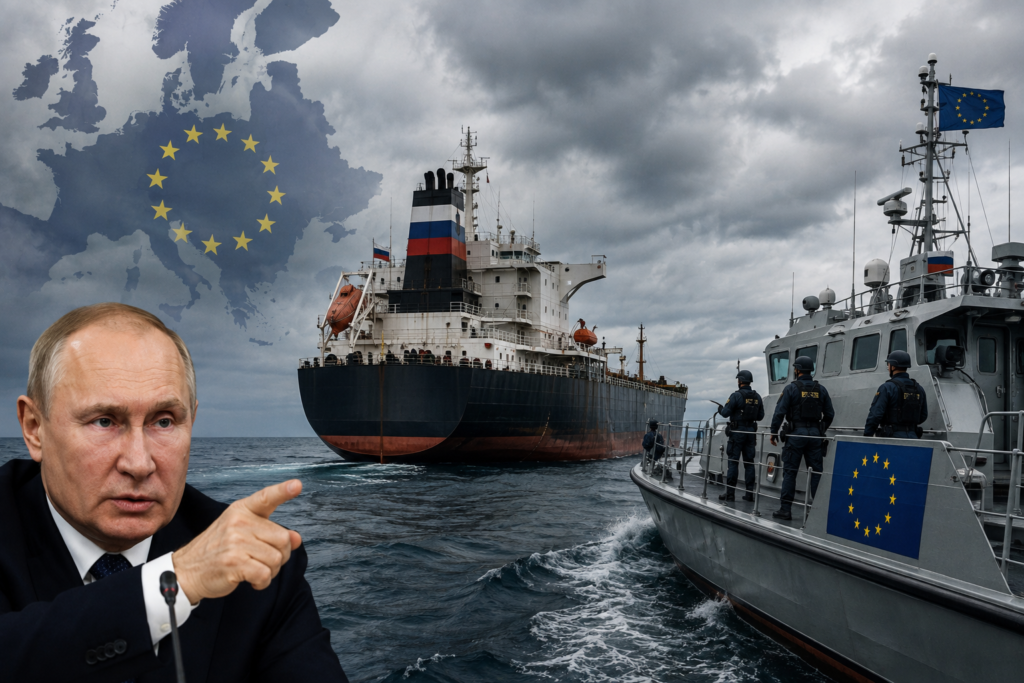
Image Credits: Putin Warns Russia Could Seize European Vessels if Russian Ships Are Targeted. AI-generated illustration created by Open Chronicle using ChatGPT (OpenAI).
By Open Chronicle with agencies
Russian President Vladimir Putin has warned that Moscow could seize European commercial vessels in retaliation if European countries begin intercepting or confiscating Russian ships, raising the prospect of a new maritime confrontation between Russia and Europe.
Speaking during a meeting with commanders of Russia’s Pacific Fleet, Putin said Moscow would be “forced to respond in kind” to actions against Russian shipping.
The warning comes as European governments consider tougher measures against vessels associated with Russia’s so-called shadow fleet, the network of ships used to maintain Russian maritime trade, particularly oil exports, despite Western sanctions.
Putin indicated that any Russian response would not necessarily be confined to the waters where Russian vessels had been intercepted.
“Of course, we will be forced to respond in kind,” Putin said.
He added that Russia could act “wherever we deem it necessary and appropriate”, signalling that Moscow could potentially respond against European shipping beyond the immediate location of any seizure.
Europe increases pressure on Russia’s shadow fleet
At the centre of the dispute is Russia’s shadow fleet.
The term is widely used to describe vessels involved in transporting Russian oil and other commodities while operating outside many of the traditional structures of Western shipping, insurance and financial services.
The network expanded substantially after Western governments imposed sanctions and a price cap on Russian oil following Moscow’s invasion of Ukraine.
European governments have increasingly focused on these vessels as part of efforts to restrict Russia’s ability to generate revenue from energy exports.
Authorities are also concerned about ageing vessels, opaque ownership structures, uncertain insurance arrangements and environmental risks associated with some ships linked to the network.
For Moscow, however, increasingly aggressive European enforcement represents a potential challenge to freedom of navigation.
Putin invokes international maritime law
Putin argued that the seizure of Russian commercial vessels would violate international law.
Moscow has repeatedly rejected Western restrictions targeting Russian shipping and has criticised the description of vessels involved in its trade as a shadow fleet.
The Kremlin maintains that the terminology is being used to justify restrictions against otherwise legitimate commercial activity.
Russia has also argued that European measures targeting ships associated with its oil exports undermine established principles governing international maritime navigation.
Putin’s latest comments suggest Moscow could move beyond diplomatic protests if European governments begin physically intercepting or confiscating vessels.
The Baltic Sea could become a major flashpoint
Although Putin suggested Russia could respond wherever it considers appropriate, the Baltic Sea is one of the most sensitive areas in the emerging confrontation.
The accession of Finland and Sweden to NATO has dramatically changed the strategic environment surrounding the Baltic.
With the exception of Russia, every country bordering the Baltic Sea is now a NATO member.
At the same time, the sea remains an important route for Russian maritime trade.
That combination has created an increasingly complicated security environment in which commercial shipping, military activity and sanctions enforcement operate in close proximity.
Any attempt to seize a Russian linked vessel could therefore produce consequences extending well beyond a commercial or legal dispute.
Commercial vessels could become part of geopolitical confrontation
Putin’s warning is significant because it explicitly raises the possibility of retaliatory action against European commercial shipping.
Until now, much of the confrontation between Russia and Europe at sea has revolved around sanctions, inspections, insurance restrictions and monitoring vessels suspected of helping Moscow circumvent Western measures.
Reciprocal vessel seizures would represent a significant escalation.
European shipping companies operate globally, while major ports and maritime routes connect Europe with Asia, Africa and the Middle East.
Putin’s statement that Russia could respond wherever it considered necessary therefore creates deliberate uncertainty over where retaliation might occur.
Such uncertainty itself can have economic consequences.
Shipping companies assess geopolitical risk when determining routes, insurance requirements and operating costs.
Even the possibility of vessels becoming caught in a confrontation between governments can increase the cost of maritime commerce.
Oil remains at the heart of the dispute
Russia’s ability to continue exporting oil despite Western sanctions has been one of the central economic issues surrounding the war in Ukraine.
After the invasion, the European Union and other Western governments introduced increasingly extensive restrictions intended to reduce Moscow’s energy revenues.
Russia responded by redirecting substantial quantities of oil toward markets outside Europe, particularly in Asia.
Maritime transportation became essential to that strategy.
Ships associated with the shadow fleet allow Russian oil to continue reaching international customers even when Western insurers, shipping companies and financial institutions are restricted from participating in transactions.
European efforts to disrupt that system therefore strike directly at an important source of Russian state revenue.
For Moscow, protecting the vessels is consequently both an economic and strategic priority.
A difficult legal environment
The dispute also raises complicated questions of maritime law.
Commercial vessels operating in international waters generally benefit from freedom of navigation, while enforcement powers depend on factors including a ship’s flag, location, ownership, sanctions status and the legal jurisdiction of the state attempting an intervention.
European governments therefore face a difficult balance.
They want sanctions against Russia to have meaningful consequences, but maritime enforcement measures must also have a clear legal foundation.
Russia is likely to challenge aggressive enforcement precisely on those grounds.
If Moscow responds by detaining European vessels, competing interpretations of international law could quickly become part of a broader geopolitical confrontation.
Risk of escalation at sea
The greatest concern is that what begins as a sanctions enforcement operation could develop into a security crisis.
Intercepting a commercial ship is very different from imposing financial sanctions on its owner.
A physical operation may involve coast guard vessels, naval forces or other state authorities.
If Russia attempts to prevent such an interception, military assets from opposing countries could find themselves operating in the same area.
That creates the possibility of miscalculation.
A disputed boarding, collision, warning shot or misunderstanding between naval forces could rapidly transform a legal dispute into a political and military emergency.
This is particularly dangerous at a time when relations between Russia and NATO countries are already deeply strained by the war in Ukraine.
Russia signals that retaliation could be asymmetric
Putin’s choice of words also deserves attention.
His suggestion that Russia could respond “wherever we deem it necessary and appropriate” implies that Moscow does not necessarily consider retaliation to be geographically restricted.
Russia could therefore seek to create uncertainty rather than simply mirror a European action in the same location.
That approach is consistent with a broader principle of asymmetric response, in which a government reacts to pressure in a different location or through a different instrument.
Exactly what Moscow would consider an appropriate response remains unclear.
Putin did not provide operational details.
His comments nevertheless appear designed to make European governments consider the wider consequences before authorising vessel seizures.
Europe’s sanctions strategy faces a new test
For European governments, the challenge is significant.
Sanctions lose effectiveness when targeted entities develop successful methods of avoiding them.
Allowing Russia’s maritime networks to operate without meaningful restrictions could therefore weaken one of Europe’s principal economic tools against Moscow.
But stronger enforcement creates new risks.
The more directly European authorities intervene against vessels connected with Russia, the greater the possibility that Moscow will respond against European commercial interests.
The shadow fleet has consequently become more than a sanctions enforcement problem.
It is increasingly becoming a maritime security issue.
From economic pressure to maritime confrontation
The confrontation illustrates how the war in Ukraine continues to spread into areas far beyond the battlefield itself.
Energy markets, banking systems, technology exports, aviation and international shipping have all become arenas of competition between Russia and Western governments.
Maritime trade may now become one of the most dangerous.
European countries want to make sanctions increasingly difficult to circumvent.
Russia wants to demonstrate that interference with its commercial shipping will carry costs.
Neither side wants to appear willing to retreat.
That combination creates the conditions for escalation.
For now, Putin’s statement remains a warning rather than an announcement that Russia has begun systematically seizing European ships.
But the message from Moscow is unmistakable.
If Europe transforms its campaign against Russia’s shadow fleet from financial restrictions into physical seizures at sea, Russia says European vessels could become targets for reciprocal action.
The next question is whether European governments believe the economic value of stronger sanctions enforcement outweighs the risk of opening another front in their confrontation with Moscow.