
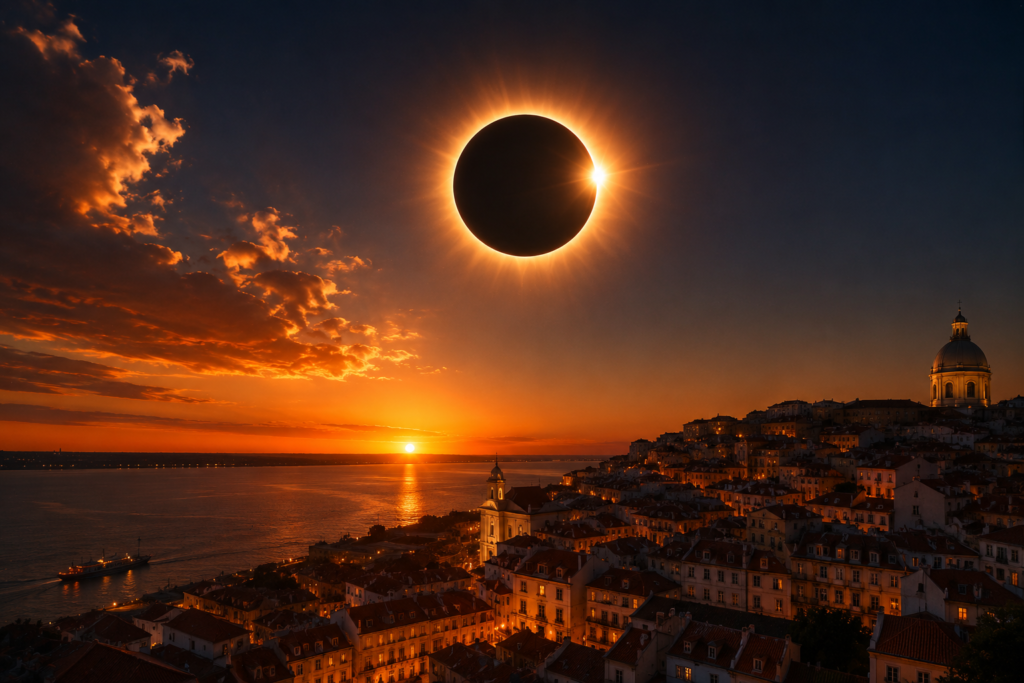
Image Credits: Solar Eclipse Today: What Time to Watch and How to Follow It Live. AI-generated illustration created by Open Chronicle using ChatGPT (OpenAI). August 2026. This image is illustrative and does not depict a real-world scene.
By Open Chronicle Science Desk
The wait is almost over.
Today, 12 August 2026, the Moon will pass directly between Earth and the Sun, producing one of the most important astronomical events visible from Europe in years.
A total solar eclipse will sweep across parts of the Northern Hemisphere before reaching Europe late in the day. Greenland, Iceland, northern Spain and the extreme northwestern tip of Portugal are among the areas touched by the narrow path of totality, while millions of people across a much wider region will witness a partial eclipse.
Open Chronicle is following the event through the dedicated Solar Eclipse 2026 Live Center, bringing together live timing, the path of totality, viewing information for Portugal, scientific resources and access to eclipse coverage.
Follow the Eclipse Live
The Open Chronicle Solar Eclipse 2026 Live Center is now open.
Readers can use the page throughout the day to follow the countdown and the progression of the eclipse, explore the route of the Moon’s shadow, and access essential information for observing the phenomenon safely.
Open the Solar Eclipse 2026 Live Center:
https://openchronicle.org/open-chronicle-solar-eclipse-2026-live-center/
The Live Center automatically changes as the event progresses, moving from the countdown phase into live eclipse tracking and eventually becoming a permanent archive of the event.
What Time Is the Eclipse in Portugal?
The exact timing and appearance of the eclipse depend on the observer’s location.
In Lisbon, the eclipse will be partial.
The Moon is expected to begin crossing the solar disc at approximately 18:39 local time.
Maximum eclipse occurs at approximately 19:36, when the eclipse reaches a magnitude of about 0.950 as seen from the Portuguese capital.
The partial eclipse ends at approximately 20:29.
That means Lisbon will experience almost two hours of eclipse activity during the evening, with the most dramatic phase occurring relatively close to sunset.
Portugal Has a Place in the Path of Totality
Portugal has an especially interesting position during today’s event.
While most of the country experiences a partial eclipse, the extreme northwestern tip of mainland Portugal is reached by the narrow path of totality.
For observers inside that extremely limited corridor, the Moon can completely cover the bright disc of the Sun.
The situation changes rapidly over relatively short distances, making precise location important for anyone attempting to reach the totality zone.
Across the rest of Portugal, including Lisbon, the eclipse remains partial.
Spain Becomes One of Europe’s Main Viewing Areas
Northern Spain is among the most important European locations for today’s eclipse.
The path of totality crosses a substantial part of the country during the evening, shortly before sunset.
For observers positioned inside the path and with clear western horizons, daylight will briefly collapse as the Moon completely covers the Sun.
The event is particularly unusual because totality occurs with the Sun relatively low in the sky, potentially producing striking views of the eclipsed Sun above the landscape.
Iceland and Greenland See Totality First
Before reaching the Iberian Peninsula, the Moon’s central shadow crosses Greenland and Iceland.
These regions will therefore experience totality earlier than Spain and Portugal.
The progression creates a remarkable astronomical sequence across the North Atlantic, allowing the eclipse to be followed from the Arctic toward Europe over the course of several hours.
What Will You See During the Eclipse?
Outside the path of totality, observers using proper solar protection will see the Moon gradually move across the Sun.
The familiar circular solar disc will become an increasingly narrow crescent as maximum eclipse approaches.
As the eclipse deepens, changes may also become noticeable in the environment.
Daylight can take on an unusual appearance, shadows may become sharper, and temperatures can temporarily fall as less direct solar radiation reaches the ground.
Inside the path of totality, the experience becomes dramatically different.
When the Moon completely covers the bright solar surface, the much fainter solar corona can become visible around the dark lunar silhouette.
It is one of the most extraordinary sights visible from Earth.
How to Watch the Eclipse Safely
Eye protection is essential.
Ordinary sunglasses are not safe for direct observation of the Sun, regardless of how dark they appear.
During all partial phases, observers should use proper eclipse glasses or another approved solar viewing method.
Cameras, telescopes, and binoculars also require appropriate solar filters. Looking at the Sun through magnifying optics without the correct equipment can cause severe eye damage.
This is particularly important for observers in Lisbon and most of Portugal because the eclipse remains partial throughout the event.
There is no safe naked-eye phase during a partial solar eclipse.
Watch the Eclipse Even if the Weather Does Not Cooperate
Clouds remain one of the biggest uncertainties surrounding any eclipse.
Even observers positioned perfectly along the eclipse path can lose their view if clouds cover the Sun at the critical moment.
Online coverage therefore provides another way to experience the event.
The Open Chronicle Live Center provides access to official scientific resources and eclipse coverage, allowing readers to follow the Moon’s shadow even if local conditions prevent direct observation.
Europe Looks Up
For a brief period this evening, an astronomical alignment involving the Sun, Moon and Earth will transform the sky across part of the Northern Hemisphere.
Some observers will experience the extraordinary darkness of totality.
Millions more will see the Sun transformed into a crescent.
In Portugal, the eclipse arrives during the final hours of daylight, providing an unusual opportunity to watch one of nature’s great astronomical events unfold close to the western horizon.
The next few hours are the countdown.
Solar Eclipse 2026 · Europe’s Great Eclipse
Today · 12 August 2026
Follow the event:
https://openchronicle.org/open-chronicle-solar-eclipse-2026-live-center/
Viewing Information
Lisbon
Partial eclipse begins: 18:39
Maximum eclipse: 19:36
Eclipse magnitude at maximum: 0.950
Partial eclipse ends: 20:29
All times are local.
Essential Reminder
Never look directly at the partially eclipsed Sun without appropriate solar viewing protection.