
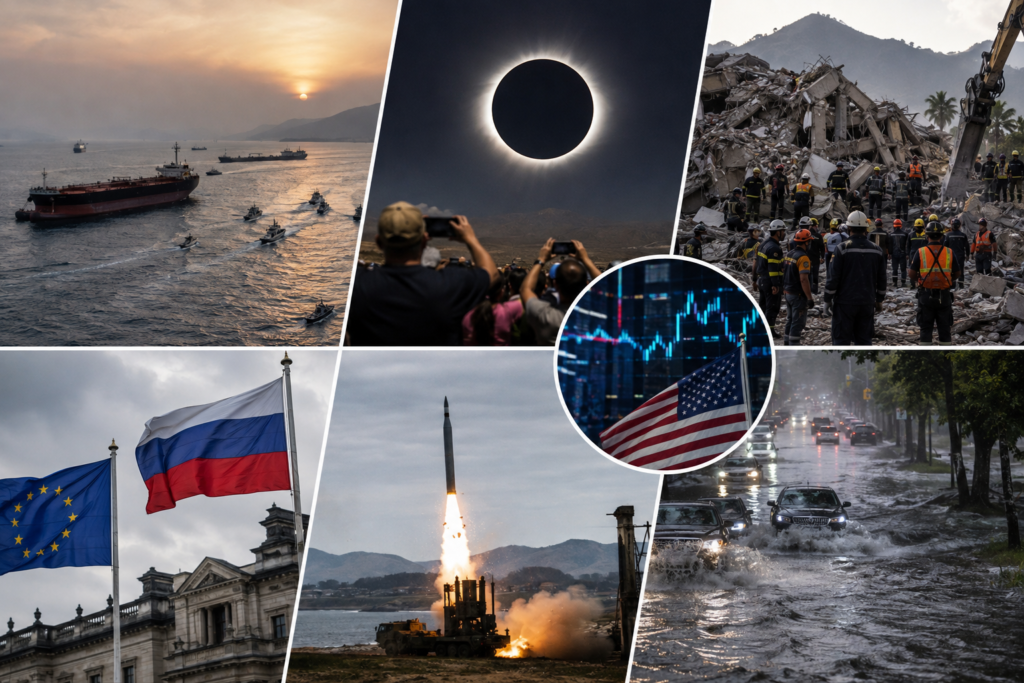
Image Credits: World News Brief: The Top Global Stories Shaping August 12, 2026. AI-generated illustration created by Open Chronicle using ChatGPT (OpenAI). August 2026. This image is illustrative and does not depict a real-world scene.
By Open Chronicle with agencies
From an escalating confrontation over the Strait of Hormuz and new tensions between Russia and Europe to the aftermath of Colombia’s devastating earthquake and a historic solar eclipse crossing Europe, August 12 is being shaped by geopolitics, natural disasters, economic uncertainty and an extraordinary astronomical event.
Here are the major global stories defining the day.
1. US and Iran remain deadlocked as Hormuz crisis deepens
The confrontation between the United States and Iran remains at the centre of the international agenda.
Iran said Wednesday that no progress had been made toward restoring an interim peace agreement with Washington, with both sides remaining divided over the conditions required for a more permanent settlement.
Tehran says the United States must return to commitments contained in the earlier interim agreement, while communication between the two sides continues largely through intermediaries.
The Strait of Hormuz remains central to the dispute. Commercial traffic through the strategic waterway remains dramatically below normal levels, keeping energy markets and global shipping companies on alert.
President Donald Trump added another dimension to the confrontation on Wednesday by declaring that the United States has “total control” of the Strait of Hormuz.
The waterway normally carries a major share of global oil and liquefied natural gas shipments, meaning continued disruption could have consequences far beyond the Middle East.
2. Russia threatens retaliation if European countries seize Russian vessels
Tensions between Moscow and Europe intensified Wednesday after Russian President Vladimir Putin warned that Russia would respond if European governments begin seizing Russian vessels.
Putin said Moscow would retaliate in kind against countries involved in such actions.
The warning comes amid growing European efforts to disrupt maritime networks linked to Russia and enforce restrictions on Moscow’s international trade.
The dispute adds a potentially dangerous maritime dimension to the wider confrontation between Russia and NATO and the European Union.
3. Colombia earthquake death toll passes 250
Rescue operations continue in Colombia following the devastating earthquake that struck the western part of the country on Monday.
At least 254 people had been reported dead by Tuesday, making the disaster one of Colombia’s deadliest earthquakes in recent decades.
Pereira and Cali were among the worst affected cities, while communities closer to the epicentre in Chocó have faced severe disruption to communications and essential services.
More than 100 aftershocks have complicated rescue operations as emergency workers continue searching damaged and collapsed buildings for survivors.
International assistance is beginning to arrive.
On Wednesday, the European Union pledged €2 million in emergency assistance for communities affected by the disaster.
The final human cost could still rise as rescuers reach isolated communities.
4. Millions gather for historic total solar eclipse
One of the day’s biggest stories is unfolding above Europe.
Millions of people have travelled to Spain and Iceland to witness the August 12 total solar eclipse, the first total eclipse visible from Europe in 27 years.
Northern Spain has become one of the principal destinations for eclipse observers, with authorities expecting millions of additional visitors.
Spain mobilised around 25,000 police officers and nearly 100 aircraft as authorities attempted to manage enormous crowds while simultaneously dealing with extreme heat and wildfire risks.
Iceland has also experienced an extraordinary influx of eclipse visitors, with some areas selling out of protective viewing glasses.
The eclipse is particularly significant for Spain because it begins what astronomers have described as an unusual sequence of major eclipses affecting the Iberian Peninsula in 2026, 2027 and 2028.


5. Typhoon Dolphin brings torrential rain to Beijing
China continues to deal with severe weather associated with Typhoon Dolphin.
After disrupting eastern China and forcing the cancellation of hundreds of flights around Shanghai earlier this week, remnants of the storm have brought torrential rainfall to Beijing.
Flooding affected important roads in the Chinese capital on Wednesday as authorities responded to the strongest typhoon to affect China so far this year.
The extreme weather has also renewed attention on China’s efforts to improve forecasting.
Chinese meteorologists are increasingly experimenting with artificial intelligence based weather models designed to predict rapidly developing extreme events.
6. Middle East shipping routes remain under severe pressure
Beyond Hormuz itself, maritime security across the wider Middle East remains extremely fragile.
The continuing Iran conflict and attacks associated with regional armed groups have placed both the Strait of Hormuz and Bab el Mandeb under pressure.
A deadly Houthi attack on an Egyptian vessel has further heightened concerns about navigation around the Red Sea, while military activity continues around the Gulf.
Together, Hormuz and Bab el Mandeb represent two of the most strategically important maritime chokepoints on the planet.
Disruption around both simultaneously creates major risks for oil shipments, container traffic and global supply chains.
The deteriorating security situation helped Brent crude extend its recent gains as markets assessed the possibility of further disruption.
7. North Korean missile launch raises tensions ahead of military exercises
Security concerns are also increasing in East Asia.
North Korea has conducted another ballistic missile launch as the region prepares for major military exercises involving the United States and South Korea.
The timing adds to tensions surrounding the Korean Peninsula and comes as Pyongyang continues developing increasingly sophisticated missile and military capabilities.
The launch also contributed to a wider atmosphere of geopolitical uncertainty in Asian markets on Wednesday.
8. US inflation slows slightly to 3.4%
The latest American inflation figures provided some relief to global financial markets.
The U.S. Consumer Price Index increased 0.1% in July, following a 0.4% decline in June.
Annual inflation slowed from 3.5% to 3.4%.
The figures were broadly consistent with economists’ expectations and helped global equities maintain gains Wednesday.
Investors are now assessing what the figures could mean for the Federal Reserve’s next interest rate decision.
Energy prices remain an important uncertainty, particularly because disruption associated with the Iran conflict could eventually feed through into broader inflation.
9. Syria begins reckoning with the Assad era
Syria continues to confront the legacy of more than a decade of civil war following a landmark court decision against former President Bashar al Assad.
A Syrian court sentenced Assad to death in absentia on Tuesday after convicting him of crimes including killings, torture and arbitrary arrest during the country’s nearly 14 year conflict.
It was the first Syrian conviction of Assad since his government was overthrown in December 2024.
The ruling is largely symbolic while Assad remains outside Syrian custody, but it represents an important moment in the country’s attempt to establish accountability for crimes committed during the war.
Questions surrounding transitional justice, missing detainees, mass graves and responsibility for wartime atrocities are likely to remain central to Syria’s political future.
10. Global markets balance inflation relief against geopolitical danger
Financial markets ended up reflecting many of the contradictions shaping the wider news agenda.
Stocks remained supported after the U.S. inflation figures broadly matched expectations.
At the same time, oil prices moved higher as investors considered deteriorating prospects for a renewed U.S. Iran ceasefire.
Geopolitical risks remain unusually concentrated.
The Iran war, threats to international shipping, tensions between Russia and Europe, instability on the Korean Peninsula and extreme weather are all influencing investor calculations simultaneously.
A world shaped by conflict, disaster and a rare celestial event
August 12 presents an unusually broad international news agenda.
The Iran conflict remains the most consequential geopolitical story because of its potential impact on Middle Eastern stability, energy supplies and global trade.
Colombia is confronting the enormous human cost of its earthquake while rescue workers continue searching for survivors.
Russia and Europe are exchanging increasingly serious warnings over maritime activity.
East Asia faces renewed military tension.
And China continues battling extreme weather.
Yet for several minutes today, another event will command attention across much of the world.
Millions of people will look upward as the Moon passes directly between Earth and the Sun, temporarily turning day into darkness across part of Europe.
Amid war, political confrontation and natural disaster, the August 12 total solar eclipse provides one of those rare moments when the same event captures attention across borders.
For today, at least, one of the world’s biggest stories is happening not in a capital, parliament or battlefield, but in the sky.