
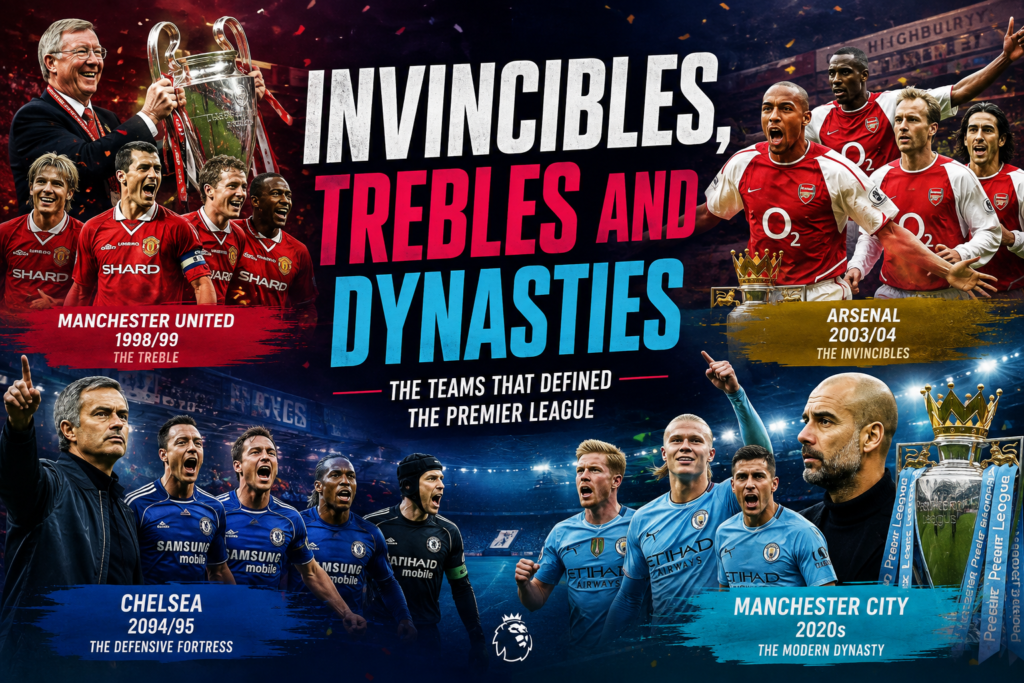
Image Credits: Invincibles, Trebles and Dynasties: The Teams That Defined the Premier League. AI-generated illustration created by Open Chronicle using ChatGPT (OpenAI). August 2026. This image is illustrative and does not depict a real-world scene.
By Open Chronicle Sports Desk
Great football teams are remembered for more than trophies.
Some dominate a season. Some transform the way the game is played. Others build dynasties that stretch across years, forcing every rival to reconsider what is required to become champions.
Since the Premier League began in 1992, English football has produced teams belonging to each of those categories. Manchester United conquered England and Europe in the same extraordinary campaign. Arsenal achieved something no Premier League side has repeated. Chelsea constructed a defensive machine that remains statistically astonishing. Manchester City turned sustained excellence into an era of unprecedented domestic domination.
Different teams. Different philosophies. Different generations.
Together, they tell the story of how the standards of the Premier League became increasingly difficult to reach.
Manchester United 1998/99: The Treble
There had been great Manchester United teams before 1998/99, and there would be great United teams afterwards.
None produced a season quite like this one.
Sir Alex Ferguson’s side entered the campaign attempting to reclaim the Premier League title from Arsenal. By the end of May, they had achieved something no English club had previously managed, winning the Premier League, FA Cup and UEFA Champions League in the same season.
The league itself became a test of nerve.
Arsenal pushed United until the final day, when Tottenham Hotspur took the lead at Old Trafford and briefly threatened to derail Ferguson’s title challenge. David Beckham equalised before Andy Cole completed the comeback.
United won 2–1 and finished one point ahead of Arsenal.
That was only the beginning.
The FA Cup followed against Newcastle United before one of European football’s most dramatic nights, when late goals from Teddy Sheringham and Ole Gunnar Solskjær overturned Bayern Munich’s lead in the Champions League final.
Three competitions had been won during an extraordinary conclusion to the season.
Yet the greatness of that United side extended beyond the trophies.
Peter Schmeichel provided authority in goal. Jaap Stam transformed the defence. Roy Keane embodied the team’s competitive personality. David Beckham and Ryan Giggs offered contrasting threats from midfield, while Dwight Yorke and Andy Cole formed one of the defining attacking partnerships of the era.
There was also extraordinary depth.
Sheringham and Solskjær could change matches from the bench, while players developed through United’s academy remained fundamental to Ferguson’s team.
The Treble became the ultimate expression of Manchester United’s first great Premier League dynasty.
Arsenal 2003/04: The Invincibles
If United’s Treble represented achievement across competitions, Arsenal’s masterpiece was about perfection within one.
Thirty eight Premier League matches.
Twenty six victories.
Twelve draws.
Zero defeats.
Arsène Wenger’s Arsenal became the first team in the Premier League era to complete an entire league campaign unbeaten.
They finished 11 points ahead of Chelsea and scored 73 goals, but statistics alone cannot explain why the Invincibles remain so admired.
This was a team of extraordinary balance.
Sol Campbell gave Arsenal defensive authority. Ashley Cole provided speed and adventure from left back. Gilberto Silva brought discipline to midfield. Patrick Vieira combined power, technique and leadership.
Ahead of them was one of the most elegant collections of attacking talent English football has seen.
Robert Pirès drifted into dangerous spaces. Freddie Ljungberg attacked them. Dennis Bergkamp could see passes before defenders understood that the opportunity existed.
And then there was Thierry Henry.
The French striker scored 30 Premier League goals that season and became the symbol of Wenger’s Arsenal, devastating opponents with pace, intelligence and technical brilliance.
Their achievement did not end with the championship.
Arsenal’s unbeaten league sequence ultimately reached 49 matches, from May 2003 until October 2004, which remains the longest unbeaten run in Premier League history.
Other champions have accumulated more points.
Others have scored more goals.
None has completed another 38 match Premier League season without losing.
That single fact ensures the Invincibles will always occupy a unique place in English football.
Chelsea 2004/05: Mourinho Builds a Fortress
Then English football changed again.
José Mourinho arrived at Chelsea in 2004 having just won the Champions League with Porto. His impact was immediate.
Chelsea accumulated 95 points and won 29 matches on their way to the Premier League title.
More extraordinary was what happened at the other end of the pitch.
They conceded just 15 league goals.
Across an entire 38 match Premier League season.
Petr Čech was protected by a defensive structure built around John Terry, Ricardo Carvalho, Paulo Ferreira and William Gallas, with Claude Makélélé providing another barrier in midfield.
Chelsea were not simply difficult to beat. They made scoring against them feel like an event.
Their defensive record remains one of the great benchmarks of Premier League football.
Mourinho combined that resilience with the athleticism and intelligence of Frank Lampard, the influence of players such as Damien Duff and Arjen Robben, and Didier Drogba’s increasingly important presence in attack.
Chelsea lost only once in the league.
They finished 12 points clear of Arsenal and then retained their championship in 2005/06.
A new power had arrived.
The traditional Manchester United and Arsenal rivalry that had defined much of the previous decade now had another superpower to contend with.
Manchester City: The Guardiola Dynasty
Premier League greatness eventually acquired another definition.
Sustained dominance.
Pep Guardiola’s Manchester City did not merely produce one extraordinary team. They repeatedly rebuilt an extraordinary team while continuing to win.
The culmination came in 2023/24.
City defeated West Ham United on the final day to become the first club in English top flight history to win four consecutive league championships.
It was their sixth Premier League title in seven seasons.
That sequence demonstrated the defining characteristic of Guardiola’s City.
Adaptability.
Personnel changed. Tactical structures evolved. Different players became central figures. Yet the ability to control matches and accumulate victories remained.
Kevin De Bruyne became one of the era’s great creators. Sergio Agüero had earlier provided relentless goals. David Silva and Bernardo Silva represented different generations of technical mastery. Rodri became the controlling force at the base of midfield.
Then Erling Haaland added an entirely different attacking dimension.
Behind all of it was Guardiola’s insistence on positional control, technical precision and constant tactical evolution.
City could overwhelm opponents through possession, press them into mistakes, dominate territory or patiently wait for defensive structures to collapse.
Their 2022/23 side also joined Manchester United’s 1998/99 team in the most exclusive category of English football achievement by winning the Premier League, FA Cup and Champions League.
But the wider dynasty may ultimately be their greater Premier League legacy.
Winning once requires excellence.
Winning four consecutive championships requires something approaching institutional dominance.
Different Forms of Greatness
Comparing teams from different eras is inevitably imperfect.
The football changes.
Tactical ideas evolve. Sports science develops. Squad depth increases. Financial conditions change. The intensity of schedules fluctuates.
That is why the greatest Premier League teams should perhaps not be reduced to a single ranking.
Instead, each represents a different form of supremacy.
Manchester United’s 1998/99 team demonstrated competitive resilience across three competitions.
Arsenal’s Invincibles achieved perfection measured not by winning every match, but by refusing to lose one.
Chelsea established a defensive standard that more than two decades of Premier League football has failed to surpass.
Manchester City demonstrated that exceptional performance could be repeated season after season.
Each moved the benchmark.
The Teams Behind the Numbers
Statistics inevitably dominate discussions about football’s greatest sides.
Points.
Goals.
Wins.
Clean sheets.
Trophies.
Yet the teams that survive longest in football’s collective memory usually possess something beyond numbers.
They have an identity.
Supporters can picture Vieira driving through midfield at Highbury.
They remember Beckham crossing from the right at Old Trafford.
They see Terry organising Chelsea’s defensive line.
They imagine De Bruyne receiving the ball with space opening ahead of him at the Etihad.
Great teams create images as much as records.
They become reference points against which future generations are judged.
Dynasties Change the Competition
There is another reason these teams matter.
Their rivals had to respond.
Ferguson’s Manchester United forced challengers to build squads capable of surviving a relentless title race.
Wenger demonstrated that English football could combine physical power with continental technique and preparation.
Mourinho raised defensive organisation and tactical discipline to extraordinary levels.
Guardiola pushed positional football, pressing and technical control to new extremes.
Premier League history is therefore not simply a sequence of champions.
It is an arms race.
Every dominant team creates the conditions for the next challenger to become stronger.
A New Chapter
The story continues.
Arsenal’s 2025/26 championship, their first Premier League title in 22 years, has opened another possible chapter in the history of great English teams.
One championship establishes a champion.
What happens afterwards determines whether that champion becomes an era.
That is the challenge facing Mikel Arteta’s Arsenal in 2026/27.
The Invincibles left an unbeaten season.
Manchester United left a Treble and a dynasty.
Mourinho’s Chelsea left defensive records that still stand.
Guardiola’s Manchester City left four consecutive championships.
Those achievements represent the standard.
For every new Premier League champion, the question eventually becomes the same.
Can they win again?
Because championships create memories.
Dynasties create history.
Premier League 2026/27
Return to the Open Chronicle Premier League hub for fixtures,
standings, clubs, transfers, analysis, history and complete
coverage of the 2026/27 season.