
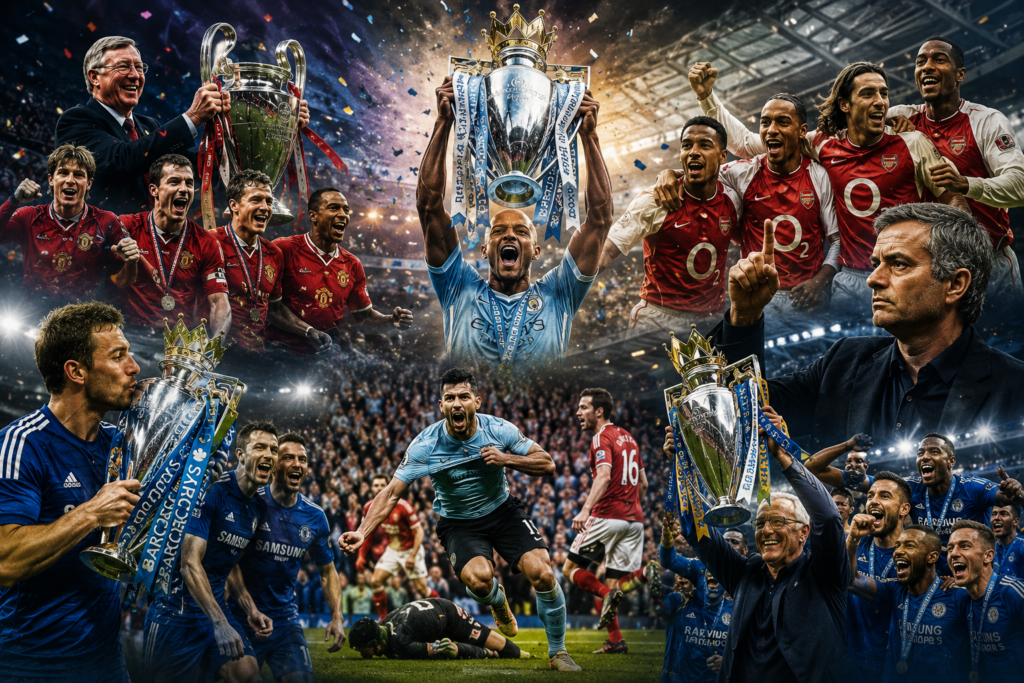
Image Credits: The Seasons That Changed the Premier League. AI-generated illustration created by Open Chronicle using ChatGPT (OpenAI). August 2026. This image is illustrative and does not depict a real-world scene.
From Blackburn’s triumph to Agüero’s miracle, Leicester’s impossible title and Manchester City’s 100 points
By Open Chronicle Sports Desk
Every Premier League season produces a champion. Only a handful change the competition forever.
Since English football entered a new era in 1992, certain campaigns have become more than entries in the record book. They introduced new powers, created dynasties, produced achievements that seemed impossible and delivered moments that became part of football culture.
Blackburn Rovers broke Manchester United’s early dominance. Sir Alex Ferguson’s United conquered England and Europe. Arsenal completed a league season without defeat. Manchester City won a championship with virtually the final kick of the campaign. Leicester City transformed one of sport’s greatest improbabilities into reality.
Then Pep Guardiola’s City pushed the statistical limits of what a Premier League champion could achieve.
These are some of the seasons that changed the Premier League.
1992/93: The Beginning
Everything started here.
The inaugural Premier League season began in August 1992 after the leading First Division clubs had broken away from the Football League.
English football was entering a different commercial and cultural age. Television would become increasingly influential, stadiums were changing and the competition would gradually develop an international audience unimaginable when the first matches were played.
Manchester United became the first Premier League champions.
For Alex Ferguson, the significance went far beyond inaugurating a new competition. United had waited 26 years for another English league championship.
Eric Cantona, Peter Schmeichel, Steve Bruce, Bryan Robson, Mark Hughes and Ryan Giggs were among the figures who helped establish the foundations of what was about to become the dominant English football institution of the decade.
United’s victory was not simply the first Premier League championship.
It was the beginning of a dynasty.
1994/95: Blackburn Break the Establishment
For the first two Premier League seasons, Manchester United had been champions.
Then came Blackburn Rovers.
Backed by owner Jack Walker and managed by Kenny Dalglish, Blackburn assembled a team capable of challenging the emerging power at Old Trafford.
At the centre of it was Alan Shearer.
Shearer scored 34 Premier League goals as Blackburn pursued a championship that would be decided on an extraordinary final afternoon.
Rovers travelled to Liverpool holding a two-point advantage over Manchester United.
Blackburn lost 2–1 at Anfield.
Suddenly, United could become champions by defeating West Ham.
They could not.
A 1–1 draw meant Blackburn finished on 89 points, one ahead of United.
After an 81-year wait, Blackburn Rovers were champions of England again.
It remains one of the defining titles of the early Premier League era, proof that the emerging competition did not necessarily belong exclusively to its biggest traditional institutions.
1995/96: You Can’t Win Anything With Kids
Manchester United responded by reinventing themselves.
The summer of 1995 had seen established players leave Old Trafford while Ferguson increasingly trusted the generation emerging from the club’s academy.
David Beckham.
Paul Scholes.
Nicky Butt.
Gary Neville.
Phil Neville.
They joined Ryan Giggs in a team whose youth prompted one of the most famous predictions in English football.
United then overturned Newcastle United’s commanding advantage at the top of the table and became champions.
The season became fundamental to the mythology surrounding Ferguson’s Manchester United.
It demonstrated that the manager was prepared to dismantle successful teams before decline forced him to do so.
More importantly, it established the group that would become known as the Class of ’92 at the heart of United’s next great era.
1998/99: The Treble
There are championship seasons.
Then there is 1998/99.
Manchester United entered the final Premier League match against Tottenham Hotspur knowing victory would guarantee the championship.
Tottenham scored first.
United responded through David Beckham and Andy Cole to win 2–1 and finish one point ahead of Arsenal.
The league was only the first act.
United defeated Newcastle United in the FA Cup final before travelling to Barcelona for the Champions League final against Bayern Munich.
They entered stoppage time losing 1–0.
Teddy Sheringham equalised.
Ole Gunnar Solskjær scored again.
Within minutes, Manchester United had transformed defeat into immortality.
Premier League.
FA Cup.
Champions League.
The Treble had never previously been achieved by an English club.
It became the defining season of Ferguson’s first great Manchester United dynasty.
2003/04: The Invincibles
Arsène Wenger had once suggested Arsenal could complete a league season undefeated.
In 2003/04, they did it.
Arsenal played 38 Premier League matches.
They won 26.
They drew 12.
They lost none.
Thierry Henry scored 30 league goals, while Patrick Vieira, Robert Pirès, Dennis Bergkamp, Sol Campbell, Ashley Cole, Freddie Ljungberg and Gilberto Silva formed part of one of the most complete teams of the Premier League era.
Arsenal finished 11 points ahead of Chelsea.
But the championship itself only tells part of the story.
Their unbeaten sequence continued into the following campaign and eventually reached 49 Premier League matches.
No other club has completed a 38-match Premier League season without defeat.
That is why the word attached to Wenger’s team remains enough on its own.
The Invincibles.
2004/05: Chelsea Change the Balance of Power
One year later, English football changed again.
José Mourinho arrived at Chelsea after winning the Champions League with Porto and immediately transformed the competitive landscape.
Chelsea accumulated 95 points.
They won 29 matches.
They lost once.
Most astonishingly, they conceded only 15 league goals.
Petr Čech kept 24 clean sheets, still the Premier League record for a goalkeeper in a single season.
John Terry and Ricardo Carvalho formed the core of a formidable defence. Claude Makélélé controlled the space ahead of them. Frank Lampard provided goals and authority from midfield.
Chelsea finished 12 points ahead of Arsenal.
The Manchester United-Arsenal rivalry, which had defined much of the previous decade, suddenly had another superpower.
Roman Abramovich’s investment had already transformed Chelsea’s possibilities.
Mourinho turned those possibilities into dominance.
2011/12: Agüerooooo
Some championships are remembered for an entire season.
This one is remembered for seconds.
Manchester City entered the final day level on points with Manchester United but ahead on goal difference.
Beat Queens Park Rangers at home and City would be champions.
Instead, with the match entering stoppage time, City were losing 2–1.
United had already defeated Sunderland.
The title appeared to be heading back to Old Trafford.
Edin Džeko equalised.
There was still time for one final attack.
Mario Balotelli found Sergio Agüero.
Agüero drove the ball past Paddy Kenny.
3–2.
Manchester City were champions.
They finished level with United on 89 points and won the title on goal difference, the narrowest championship margin in Premier League history.
The goal became one of the defining images of modern English football.
It also represented something much larger.
Manchester City’s transformation from ambitious challenger into Premier League champion was complete.
2015/16: Leicester City Make the Impossible Real
Nothing quite compares with Leicester City.
They had spent much of the previous campaign fighting relegation.
One year later, they were champions of England.
Claudio Ranieri’s side repeatedly challenged conventional assumptions about what a Premier League champion should look like.
They did not possess the financial power of Manchester City.
They did not have Manchester United’s commercial empire.
They did not have Arsenal’s established Champions League status or Chelsea’s recent record of success.
They had something else.
A perfectly constructed team.
Jamie Vardy stretched defences and scored relentlessly. Riyad Mahrez provided imagination and decisive quality. N’Golo Kanté covered extraordinary amounts of ground. Wes Morgan and Robert Huth gave the defence authority.
Week after week, the expected collapse never came.
Leicester lost only three league matches and finished ten points clear of Arsenal.
Their championship remains one of the greatest underdog stories in the history of professional sport.
The Premier League had always sold itself on unpredictability.
Leicester proved how far that unpredictability could go.
2017/18: The Centurions
Pep Guardiola’s first Premier League title did not merely establish Manchester City as champions.
It changed the numerical expectations surrounding championship football.
City accumulated 100 points, becoming the first Premier League team to reach three figures.
They won 32 of their 38 matches.
They scored 106 goals.
They finished 19 points ahead of Manchester United, still the largest championship-winning margin in Premier League history.
Kevin De Bruyne, David Silva, Sergio Agüero, Raheem Sterling, Leroy Sané and Fernandinho formed the core of a team that combined relentless possession with devastating attacking movement.
The city’s achievement set a new benchmark.
Ninety points had traditionally represented an extraordinary championship campaign.
After the Centurions, even that might not be enough.
The consequences soon became apparent.
2018/19: When 97 Points Were Not Enough
Liverpool produced one of the greatest league seasons in English football history.
They lost only once.
They collected 97 points.
They still did not win the Premier League.
Manchester City finished on 98.
The title race became an extraordinary exercise in sustained pressure. Neither team could afford to stumble.
City won their final 14 league matches to retain the championship by a single point.
Liverpool’s total remains the highest points tally recorded by a team that did not become Premier League champions.
The season demonstrated how dramatically Guardiola’s City and Jürgen Klopp’s Liverpool had raised expectations.
Excellence was no longer sufficient.
Near perfection might be required.
2019/20: Liverpool End the Wait
Liverpool did not allow the disappointment to define them.
The following season, they returned with overwhelming force.
After 30 years without an English league championship, Liverpool became Premier League champions under Klopp.
The emotional significance was enormous.
Generations of Liverpool supporters had watched the club dominate English football before the Premier League era, then seen Manchester United become the country’s dominant force.
The wait finally ended in 2020.
Virgil van Dijk provided defensive authority. Jordan Henderson led from midfield. Mohamed Salah, Sadio Mané and Roberto Firmino formed one of Europe’s most dangerous attacking units.
Liverpool finished the season with 99 points.
It was both a championship and the completion of a long historical circle.
2022/23: Manchester City Complete the Treble
Manchester United’s 1999 achievement had stood alone among English clubs for almost a quarter of a century.
Then Manchester City joined them.
Guardiola’s side chased down Arsenal in the Premier League title race before defeating Manchester United in the FA Cup final.
One challenge remained.
The Champions League.
City defeated Inter Milan in Istanbul to become European champions for the first time.
Premier League.
FA Cup.
Champions League.
The Treble.
For Guardiola, it completed the transformation of City from domestic powerhouse into European champion.
For the Premier League, it created an inevitable historical comparison with Ferguson’s United.
Two Manchester clubs.
Two Trebles.
Two defining generations.
2023/24: Four in a Row
Manchester City then entered territory no English champion had reached before.
Arsenal pushed Guardiola’s team deep into the final day of the season.
City defeated West Ham United and secured another championship.
It was their fourth consecutive Premier League title.
No club in the history of the English top flight had previously won four successive championships.
Huddersfield Town had won three.
Arsenal had won three.
Liverpool had won three.
Manchester United had achieved three consecutive titles twice.
City went one further.
What began with Guardiola’s Centurions had become a dynasty.
Why Certain Seasons Survive
Football history is not constructed entirely from statistics.
If it were, supporters would remember tables rather than matches.
The seasons that endure combine achievement with narrative.
Blackburn had the final day at Anfield.
Manchester United had Barcelona.
Arsenal had 38 matches without defeat.
Manchester City had Agüero.
Leicester had an entire season in which the impossible slowly became inevitable.
Liverpool had three decades of waiting.
City’s Centurions had 100 points.
Each campaign contains a number, a moment or an emotion capable of summarising an entire year.
That is what transforms a championship season into a historic season.
The Premier League Never Stands Still
Perhaps the most remarkable feature of the competition’s history is the constant escalation of standards.
Manchester United established the first dynasty.
Arsenal challenged it.
Chelsea changed the financial and tactical landscape.
Manchester City pushed points totals into previously unexplored territory.
Liverpool responded by producing 97 points and then 99.
Leicester demonstrated that football could still produce something nobody had seriously predicted.
Every generation believes it has discovered the limits of what can be achieved.
Then another team arrives and moves them.
That is why the Premier League’s history cannot be understood simply by listing its champions.
Some seasons win trophies.
Some create legends.
And a very small number change the league forever.