
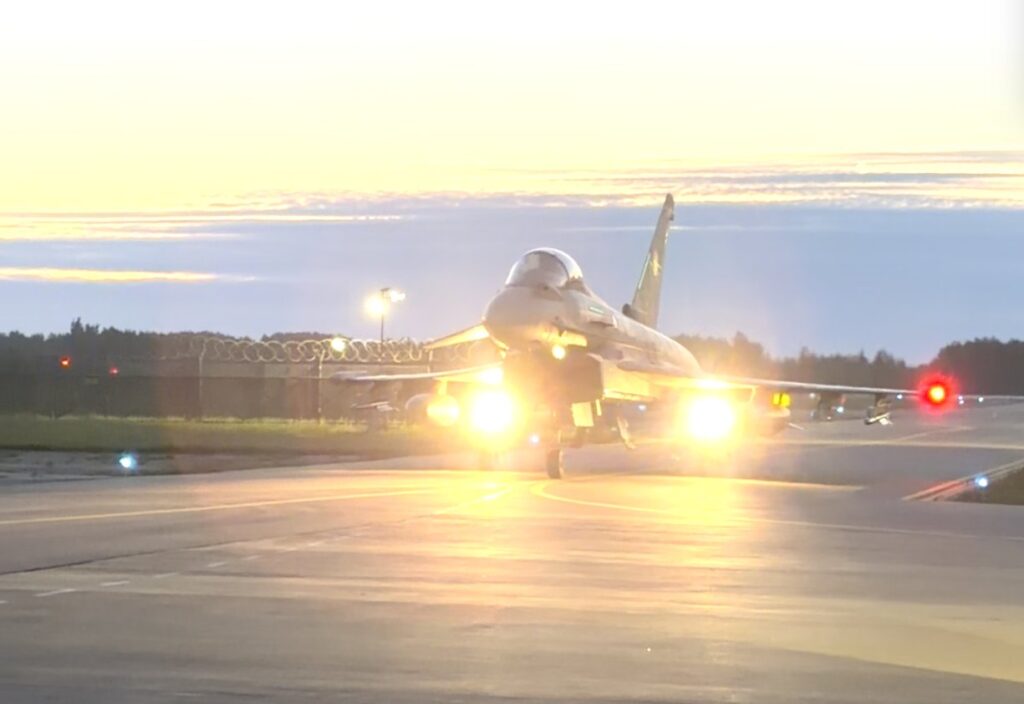
Image: from NATO Allied Joint Force Command Brunssum – JFCBS X @NATOJFCBS
By Open Chronicle with agencies
NATO fighter jets have shot down a drone over northeastern Latvia after the unmanned aircraft entered Latvian airspace near the Russian border, in an incident authorities believe may have been caused by Russian electronic warfare disrupting its navigation.
An Italian Eurofighter Typhoon destroyed the drone during the early hours of Friday after NATO aircraft were scrambled in response to the incursion.
The unmanned aircraft came down near the village of Rugāji in Latvia’s Balvi region, relatively close to the Russian frontier.
Latvia’s National Armed Forces said the foreign unmanned aerial vehicle had entered the country’s airspace “as a result of Russian electromagnetic warfare”, highlighting the growing challenge posed by intensive electronic interference across NATO’s eastern flank.
The origin of the drone has not yet been established. Neither Latvian authorities nor NATO have identified it as Russian or Ukrainian.
An investigation is underway.
Italian Eurofighters scrambled from Lithuania
NATO reacted by deploying aircraft from different parts of its Baltic air defence network.
Two Italian Eurofighter Typhoons stationed in Lithuania were scrambled, according to a NATO spokesperson.
One of the Italian fighters subsequently engaged and destroyed the drone.
Two Turkish Air Force F-16s based in Estonia were also launched as part of the response.
“All aircraft were operating under NATO command,” the alliance spokesperson said.
The multinational response illustrates how NATO’s Baltic air defence architecture works in practice. Aircraft deployed by different allied countries can be rapidly placed under a common command structure when an unidentified aircraft enters alliance airspace.
Latvian Foreign Minister Baiba Braze publicly thanked Italy for helping maintain the integrity of NATO airspace.
Drone falls near Rugāji
The aircraft came down close to Rugāji in Balvi municipality, an area of eastern Latvia located near the Russian border.
Airspace alerts were issued across several eastern and southern Latvian regions while authorities responded to the incident.
Those alerts were lifted at approximately 4:50 a.m. local time.
The interception occurred during a period of heightened military activity elsewhere in the region.
Earlier on Friday, more than 50 Ukrainian drones had reportedly attacked targets across western Russia, including locations in the Leningrad and Tver regions.
Targets included the port of Ust-Luga and a warehouse belonging to Russian e-commerce company Wildberries.
There is currently no confirmed connection between those attacks and the drone intercepted over Latvia.
Finland also temporarily restricts airspace
The uncertainty surrounding the incident produced precautionary measures elsewhere in the Baltic region.
Finland temporarily restricted airspace and a maritime area in the eastern Gulf of Finland.
The Finnish Defence Forces later said no drones had entered Finnish territory.
The restrictions were lifted shortly after 7 a.m.
The measures nevertheless demonstrate how an unidentified drone operating close to national borders can generate military responses across several countries simultaneously.
In a region where NATO territory lies close to Russia and Belarus, determining the trajectory and intentions of an unmanned aircraft can become a time-sensitive security problem.
Second drone shot down over Latvia
Latvia’s Defence Ministry said Friday’s incident was the second occasion on which a drone had been shot down inside Latvian airspace.
The first occurred in June and was also handled by NATO fighter aircraft.
Repeated incidents increase pressure on NATO to develop more effective methods of detecting and defeating relatively small unmanned aircraft along its eastern borders.
Traditional air policing was primarily designed around aircraft such as Russian fighters, bombers and military transports.
The proliferation of drones has fundamentally changed the threat environment.
Electronic warfare may explain the incursion
Latvia’s assessment that Russian electromagnetic warfare pushed the drone off course is particularly significant.
Electronic warfare has become widespread around the Baltic since Russia’s full scale invasion of Ukraine in 2022.
Satellite navigation interference, including jamming and spoofing, has affected civilian aviation, maritime traffic and military operations.
Jamming attempts to prevent receivers from obtaining usable satellite navigation signals.
Spoofing is more sophisticated. False signals can cause a navigation system to calculate an incorrect position.
Both techniques can create serious problems for unmanned aircraft dependent on satellite navigation.
A drone following a GPS-based route could potentially deviate from its intended course if its navigation system is disrupted.
That makes accidental border crossings increasingly plausible in areas experiencing intense electronic warfare.
Deliberate incursion not established
The Latvian assessment therefore makes an accidental incursion more likely than a deliberate penetration of NATO airspace.
However, the investigation will need to determine exactly what happened.
The drone’s origin remains particularly important.
Both Russia and Ukraine operate large numbers of long-range unmanned aircraft, and drones from both sides have previously ended up inside NATO territory during the war.
Without identifying the aircraft, its launch point, and intended route, determining precisely why it crossed into Latvia will remain difficult.
Neither NATO nor Latvia has publicly attributed the drone to either belligerent.
That uncertainty is important because an accidental navigation error and a deliberate violation of NATO airspace would have very different political implications.
NATO territory increasingly exposed to drone spillover
Latvia is not alone in confronting the consequences of drone warfare close to NATO borders.
Romania has repeatedly recovered drone fragments following Russian attacks against Ukrainian infrastructure near the Danube.
Poland has repeatedly scrambled fighter aircraft during major Russian missile and drone attacks against western Ukraine.
Other NATO countries along the eastern flank have increased radar coverage and air defence readiness as the scale of unmanned warfare continues to grow.
These incidents demonstrate one of the strategic consequences of a large drone war taking place immediately beside alliance territory.
Weapons do not always remain within intended boundaries.
Navigation failures, electronic warfare, mechanical problems or errors in mission planning can send aircraft across borders.
NATO must then rapidly determine whether the aircraft is hostile, accidental or simply lost.
Baltic Air Policing enters a different era
The interception also highlights the changing role of NATO’s Baltic Air Policing mission.
The operation has run continuously since 2004, when Estonia, Latvia and Lithuania joined NATO.
The three Baltic states did not maintain fighter forces capable of independently policing their national airspace.
Other NATO members therefore began rotating fighter detachments through the region.
Šiauliai Air Base in Lithuania became the principal operating location, while Ämari Air Base in Estonia has also supported the mission.
Allied deployments generally rotate periodically, allowing different NATO air forces to contribute aircraft and personnel.
For years, the mission was principally associated with intercepting and identifying Russian military aircraft operating around the Baltic.
Russian aircraft travelling between the country’s mainland and Kaliningrad frequently operate close to NATO airspace.
Fighters would scramble, identify the aircraft, escort them when necessary, and return to base.
Drone warfare is making that mission considerably more complicated.
Fighter jets against small drones
A Eurofighter Typhoon was designed primarily to fight sophisticated combat aircraft and perform high-performance air defence missions.
Using such an aircraft to intercept a comparatively small drone illustrates an emerging economic and operational problem.
Small unmanned aircraft are often considerably cheaper than the fighter jets, missiles and operating hours required to intercept them.
They can also be difficult for conventional air defence radar to detect.
Radar systems optimised for fast-moving aircraft and missiles may struggle with small, slow targets flying at low altitude.
A drone may also have a radar signature closer to that of birds or other background clutter than a conventional aircraft.
This creates an uncomfortable problem for air defence commanders.
Even an inexpensive drone cannot simply be ignored when it enters NATO airspace and its intentions are unknown.
The eastern flank needs new counter-drone systems
The changing threat is one reason NATO countries are investing increasingly heavily in counter-unmanned aircraft technology.
A layered system can include conventional radar, passive radio frequency sensors, electro-optical cameras, acoustic detectors and electronic warfare equipment.
Once a drone has been identified, defenders also require an appropriate method of defeating it.
Traditional surface-to-air missiles remain one option.
Fighter aircraft provide another.
But neither is necessarily economically sustainable against enormous numbers of inexpensive drones.
Electronic warfare can potentially jam some aircraft.
Interceptor drones offer another increasingly important solution.
Short-range guns and specialised counter-drone weapons can protect particular locations.
The challenge is combining these systems into a network capable of defending thousands of kilometres of NATO territory.
Ukraine is changing NATO’s assumptions
The war in Ukraine has demonstrated the extraordinary scale at which drones can now be deployed.
Both Russia and Ukraine operate reconnaissance drones, FPV attack aircraft, long range strike drones, naval drones and increasingly sophisticated interceptor systems.
Large attacks can involve dozens or even hundreds of unmanned aircraft.
That scale changes the economics of air defence.
A system designed primarily to intercept occasional aircraft or missiles must now be prepared to confront large numbers of relatively inexpensive targets.
The Latvian incident involved only one unidentified aircraft.
But NATO planners must prepare for circumstances in which many drones approach alliance territory simultaneously.
Electronic warfare adds another layer of uncertainty
The Baltic environment is particularly difficult because electronic interference can affect both hostile and friendly systems.
Russian electronic warfare may be intended to disrupt Ukrainian drones or NATO surveillance and communications.
The resulting electromagnetic effects do not necessarily stop at national borders.
Civilian aircraft and ships can also encounter degraded navigation.
For military planners, this creates an environment where determining intent becomes harder.
A drone flying toward NATO territory might be deliberately attacking.
It might be conducting reconnaissance.
It might have been redirected by electronic warfare.
It might simply have lost navigation and wandered across the border.
Commanders may have only minutes to decide.
NATO’s response demonstrates multinational integration
Friday’s interception also offers an example of NATO’s multinational air defence structure.
The drone entered Latvia.
Italian Eurofighters operating from Lithuania responded.
Turkish F-16s stationed in Estonia were also launched.
All operated under NATO command.
That integration is particularly important for the Baltic states because their defence depends heavily on allied forces being able to operate as a unified system rather than separate national contingents.
The alliance’s plans for its eastern flank increasingly seek to extend that principle beyond fighter aviation.
Radar, drones, ground sensors, satellites, electronic warfare systems and conventional air defence could eventually contribute to a common operational picture.
From Russian aircraft to the drone age
Baltic Air Policing was established for a security environment dominated by conventional military aviation.
Twenty-two years later, the mission is operating in a radically different battlespace.
Russian fighters and military transports remain part of the challenge.
But they are now joined by long-range drones, electronic warfare, GPS interference and the possibility that unmanned aircraft involved in the war in Ukraine may unexpectedly cross alliance borders.
The interception near Rugāji illustrates that transformation.
An unidentified drone entered Latvian airspace. NATO responded with Italian and Turkish combat aircraft. An Italian Eurofighter destroyed the aircraft, while neighbouring Finland temporarily introduced precautionary restrictions.
There were no immediate indications that the incident represented a deliberate attack on NATO.
But that does not make it insignificant.
The episode demonstrates how quickly the drone war surrounding Ukraine can spill into NATO territory and how electronic warfare can blur the boundary between accidental intrusion and potential hostile action.
For the alliance, defending the eastern flank increasingly means preparing not only for Russian fighters, missiles and conventional military forces, but also for small unmanned aircraft whose origins and intentions may initially be impossible to determine.
The Baltic air policing mission has entered the drone age.