
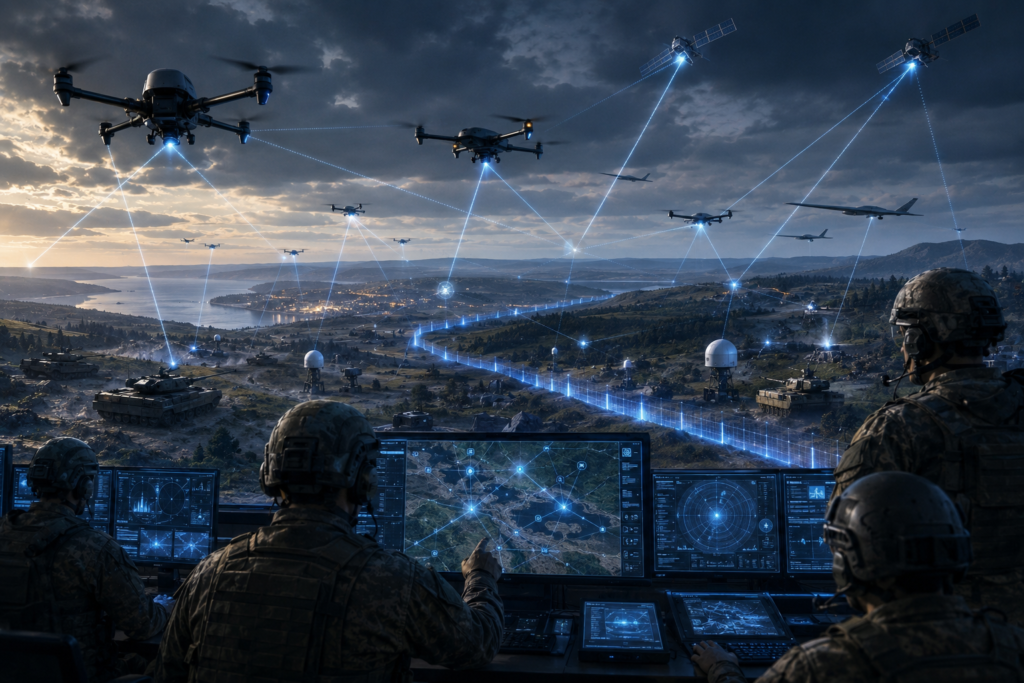
Image Credits: NATO Prepares for the AI Drone Battlefield as Ukraine Redefines Modern Warfare. AI-generated illustration created by Open Chronicle using ChatGPT (OpenAI). August 2026. This image is illustrative and does not depict a real-world scene.
By Open Chronicle with agencies
NATO is preparing for a battlefield in which thousands of drones, sensors and artificial intelligence systems could operate together across its eastern frontier, automating parts of warfare while attempting to preserve one critical principle: humans should remain responsible for decisions to use lethal force.
The concept reflects lessons emerging from the war in Ukraine, where artificial intelligence is increasingly being incorporated into drone navigation, target detection, identification and terminal guidance.
For NATO, the objective is not simply to create autonomous weapons. It is to solve a rapidly growing military problem. Future forces could deploy so many unmanned systems simultaneously that there may simply not be enough operators to manually pilot every aircraft.
The emerging answer is a division of labour between humans and machines.
Artificial intelligence could handle routine flight, navigation, surveillance and some elements of target recognition. Human operators would remain responsible for deciding whether a target should actually be attacked.
As U.S. Army Maj. Ben Schiff explained, people would decide what drones do without necessarily having to physically fly them.
The distinction could become fundamental to NATO’s vision of warfare.
A digital shield along NATO’s eastern frontier
The effort forms part of the Eastern Flank Deterrence Initiative, or EFDI, a developing network intended to strengthen NATO’s ability to detect and respond to threats along the alliance’s borders with Russia and Belarus.
That frontier extends thousands of kilometres, from northern Finland through the Baltic region and Eastern Europe toward the Black Sea.
Defending such an enormous area using traditional forces alone presents significant challenges.
NATO’s emerging concept envisages layers of drones, ground sensors, satellites and other surveillance systems continuously collecting information across the battlespace.
Artificial intelligence could help process the enormous quantity of information generated by those systems.
Instead of requiring personnel to manually examine every video feed or sensor alert, software could identify suspicious activity, classify potential threats and rapidly distribute relevant information to commanders and weapons operators.
The result would effectively be a digital first line of defence.
Tanks, artillery and fighters are not disappearing
The concept does not mean NATO expects autonomous systems to replace conventional military forces.
Tanks, infantry, artillery, air defence systems and combat aircraft would remain central to alliance defence.
Instead, drones and sensors would make those forces better informed and potentially much faster.
A reconnaissance drone might detect an approaching armoured formation.
A ground sensor could identify movement along a border.
Electronic intelligence equipment could detect an enemy radar or communications system.
A satellite could provide additional confirmation.
Rather than those systems operating independently, NATO wants them connected to a common digital environment capable of rapidly moving information to whichever unit is best positioned to respond.
That is where artificial intelligence becomes especially important.
The problem of a million drones
Modern drone warfare presents a basic manpower problem.
A remotely piloted aircraft traditionally requires a human operator.
Scale that model to hundreds of thousands, or potentially millions, of inexpensive drones, and it becomes increasingly impractical.
“We don’t have a million pilots. We can’t fly a million drones at the same time,” Schiff said while discussing the concept at U.S. Army Europe and Africa headquarters in Wiesbaden, Germany.
His argument points toward one of the clearest military applications for artificial intelligence.
Machines can assume tasks that consume human attention without necessarily requiring human judgment.
Routine navigation is one example.
Loitering over an area while waiting for something significant to happen is another.
Automatic route planning, formation management, obstacle avoidance, and maintaining position could potentially be handled by software.
Human operators could then supervise multiple systems instead of manually controlling one drone at a time.
Automating the “boring parts” of flight
Schiff described persistent loitering and similar activities as among “the most boring parts of flying” and therefore logical candidates for automation.
The distinction matters.
Automation does not necessarily mean giving a machine unrestricted authority to select and attack targets.
A drone could autonomously travel toward an assigned area, maintain its position, monitor its sensors, and alert an operator when it identifies something potentially significant.
The operator could then evaluate the information and determine what happens next.
This model reduces workload while retaining human judgment at the most consequential point.
It also creates the possibility that one person could supervise numerous aircraft simultaneously.
For militaries attempting to deploy unmanned systems at enormous scale, that could become essential.
From the kill chain to the kill web
NATO’s technological transformation extends beyond drones.
One of the most significant ideas behind the Eastern Flank Deterrence Initiative is replacing the traditional linear flow of battlefield information with a much more interconnected system.
Military planners frequently describe the traditional process as a “kill chain”.
A sensor identifies something.
Information moves through command structures.
A decision is made.
Orders and targeting information then travel back toward a weapon or unit capable of acting.
Every additional stage takes time.
Against rapidly moving threats, those delays can become critical.
The emerging alternative is often described as a “kill web”.
Instead of information travelling along one predetermined route, sensors, command systems, operators and weapons become interconnected.
Information collected by one platform could therefore be made available almost immediately to multiple units capable of using it.
The EFDI Data Backbone
Schiff serves as a product manager for the EFDI Data Backbone, a framework intended to make that concept technically possible.
One of NATO’s longstanding challenges is interoperability.
The alliance consists of numerous countries operating different sensors, software, communications networks, and command systems.
Equipment designed independently does not automatically communicate seamlessly.
The Data Backbone is intended to bridge some of those incompatibilities, allowing information to move from forward-deployed sensors toward commanders and other military systems across the alliance.
The objective is speed and scale.
A threat detected by one NATO country’s sensor should ideally become useful to other allied forces without requiring a slow series of manual transfers.
Artificial intelligence can potentially accelerate that process by helping classify, prioritise and distribute information.
A drone is only as useful as the network around it
This emphasis on connectivity changes how military equipment is evaluated.
Maj. Matt Blubaugh, a spokesperson for U.S. Army Europe and Africa, argued that the usefulness of an individual platform cannot be measured solely by its independent performance.
“The value of a drone, sensor or other capability is not determined solely by its individual performance,” Blubaugh said. “Its effectiveness depends on how well it integrates into the broader operational ecosystem.”
That principle represents a major change from traditional procurement thinking.
A highly sophisticated drone that cannot effectively exchange information with surrounding forces may be less valuable than a simpler platform fully integrated into the wider network.
The network itself increasingly becomes a weapon.
Ukraine is already testing this future
For NATO planners, Ukraine provides an extraordinary real-world laboratory for many of these concepts.
Ukraine has rapidly expanded its use of artificial intelligence across military technology.
Andrii Hrytseniuk, CEO of the Ukrainian state-backed defence innovation platform Brave1, said AI is increasingly supporting battlefield decision making, drone navigation, terminal guidance and precision.
Earlier this year, Hrytseniuk said more than 200 Ukrainian companies were developing AI-related components for drones, missiles, radar systems and other military technologies.
The scale of that ecosystem illustrates how quickly warfare is changing.
Ukraine has had powerful incentives to innovate.
It faces a larger opponent, persistent electronic warfare, and enormous demand for inexpensive unmanned systems.
Automation can help compensate for shortages of personnel while improving the effectiveness of relatively inexpensive weapons.
AI helps drones survive electronic warfare
One of the most important reasons for increasing drone autonomy is electronic warfare.
Traditional first-person-view drones frequently depend on a communications link between the aircraft and its operator.
That connection can be jammed.
When communications disappear, the operator may lose control of the aircraft.
More advanced systems can potentially use onboard processing to continue parts of a mission when communications become unreliable.
Computer vision could allow a drone to recognise terrain or maintain tracking of an already designated object.
Navigation software could help it continue toward an assigned area without constant human input.
Such capabilities become especially important on battlefields saturated with electronic warfare systems.
Ukraine and Russia have both been adapting their unmanned systems in response to that environment.
AI is entering almost every stage of drone operations
Ukrainian drone manufacturer Wild Hornets has described a gradual integration of artificial intelligence across multiple stages of flight.
The company produces the Sting interceptor drone, designed to counter hostile unmanned aircraft.
AI could support target detection and identification before eventually contributing to terminal guidance.
Yet the company has also emphasised that humans should retain the final decision over what is attacked.
That position reflects both practical and ethical considerations.
Battlefields change rapidly.
Russia continuously adjusts its tactics, equipment and methods.
Human operators remain important for interpreting unexpected situations and adapting procedures when algorithms encounter circumstances that were not anticipated during development.
Humans remain in the loop
Ukrainian commanders operating robotic systems have made a similar argument.
Grek, the call sign of a company commander overseeing robotic systems with Ukraine’s 21st Unmanned Systems “Kraken” Regiment, described automation as a way to concentrate human attention where it matters most.
The objective is to “allow people to focus on the tasks where human judgment has the greatest value.”
That concept could become the foundation of future human-machine military teams.
Machines are exceptionally good at performing repetitive tasks at enormous speed.
They can monitor multiple sensors continuously.
They do not become tired while watching hours of uneventful surveillance footage.
They can calculate routes and process data faster than human operators.
But battlefield decisions frequently involve ambiguity.
Identifying whether someone is a combatant, interpreting behaviour, understanding context and determining whether an attack is proportionate are not simply navigation problems.
NATO’s emerging model attempts to preserve human responsibility for precisely those decisions.
“We’re learning from Ukraine”
American officers involved in the effort have been careful to distinguish learning from imitation.
“We’re not copying Ukraine,” Capt. Ronan Sefton said. “We’re learning from Ukraine.”
The distinction is important because NATO would face a very different strategic environment in a potential conflict with Russia.
Ukraine has developed many systems under the immediate pressure of an ongoing war.
NATO is attempting to incorporate those lessons into a multinational military structure covering an enormous geographical area.
The alliance must also connect the armed forces of multiple countries, each with different equipment, procedures and national legal requirements.
What works for one Ukrainian drone unit cannot simply be reproduced across NATO.
The underlying lessons, however, are difficult to ignore.
Ukraine has changed the economics of warfare
The war has demonstrated that relatively inexpensive unmanned systems can threaten equipment costing millions of dollars.
FPV drones can attack armoured vehicles.
Long range drones can strike infrastructure hundreds of kilometres away.
Unmanned aircraft can perform reconnaissance that once required helicopters or specialised aircraft.
Interceptor drones are increasingly being developed to attack other drones.
The result is a battlefield populated by enormous numbers of relatively inexpensive systems.
That creates another problem: information overload.
A military may be capable of deploying thousands of sensors, but humans cannot manually interpret every piece of information they produce.
AI therefore becomes valuable not simply for controlling drones but for making sense of the battlefield they observe.
The future operator may become a supervisor
The traditional image of a drone operator resembles a pilot.
One person controls one aircraft.
The emerging model looks different.
A future operator may supervise a group of autonomous or semi-autonomous systems, assigning missions and intervening only when necessary.
Instead of controlling every movement, the human establishes intent.
Machines execute routine tasks.
The human concentrates on exceptions and consequential decisions.
That transition resembles changes already seen in other technological fields, but applying it to warfare introduces far greater ethical and legal consequences.
The question is no longer merely whether artificial intelligence can fly an aircraft.
It is where the boundary between machine autonomy and human authority should be placed.
Who decides who dies?
That is ultimately the most consequential question surrounding AI-enabled warfare.
Automating navigation is relatively uncontroversial.
Automatically stabilising an aircraft or avoiding an obstacle is another technical function.
Target recognition is more difficult.
Target selection is more difficult still.
Authorising lethal force crosses into an entirely different category.
NATO’s emerging approach attempts to draw the boundary before that final step.
AI can help find.
AI can help classify.
AI can help navigate.
AI can potentially guide.
But a person should remain responsible for the decision to strike.
Maintaining that distinction becomes more challenging as machines grow faster and more capable.
Speed creates pressure for greater autonomy
A highly automated battlefield creates an inherent tension.
The purpose of connecting sensors, AI, and weapons is partly to shorten response times.
But human decision-making takes time.
Against a slow-moving target, several seconds may not matter.
Against an incoming missile or a swarm of high-speed drones, they could be decisive.
Future militaries will therefore face pressure to allow defensive systems increasing degrees of autonomy.
Air defence already demonstrates this dilemma.
Some automated defensive systems can detect and respond to threats extraordinarily quickly because waiting for detailed human input could make interception impossible.
As drone warfare accelerates, similar pressures may emerge elsewhere.
The challenge will be determining where automation remains acceptable and where meaningful human control must be preserved regardless of operational cost.
AI also creates new vulnerabilities
A networked battlefield is not automatically a safer battlefield.
Dependence on artificial intelligence and digital communications introduces new vulnerabilities.
Networks can be jammed.
Data can be corrupted.
Sensors can be deceived.
Computer vision systems can misidentify objects.
Cyberattacks can target command networks.
An adversary may deliberately feed false information into systems designed to make rapid decisions.
A kill web is therefore only useful if commanders can trust the information flowing through it.
That makes cybersecurity, electronic warfare, authentication and resilient communications just as important as the drones themselves.
NATO’s eastern frontier becomes a technology test
The Eastern Flank Deterrence Initiative could eventually become one of the world’s largest experiments in digitally integrated defence.
Thousands of kilometres of territory must be monitored.
Numerous national militaries must exchange information.
Drones, satellites and ground sensors must work together.
Artificial intelligence must help process the resulting flood of data.
Weapons and commanders must receive useful information quickly enough to act.
Yet political and military leaders must simultaneously ensure that increasing automation does not remove human responsibility from decisions involving lethal force.
Those objectives are not always easy to reconcile.
The battlefield is becoming robotic, but warfare remains human
Ukraine has demonstrated that the robotic battlefield is no longer theoretical.
Unmanned systems already conduct reconnaissance, deliver supplies, attack vehicles, intercept aircraft and strike targets hundreds of kilometres from their operators.
Artificial intelligence is gradually entering those systems.
NATO is now attempting to turn battlefield lessons into a defensive architecture capable of operating across an entire alliance.
The technology may fundamentally change what soldiers do.
Drone pilots may become supervisors of autonomous fleets.
Intelligence analysts may increasingly work alongside algorithms processing enormous sensor networks.
Forward observers may become managers of interconnected reconnaissance and targeting systems.
Electronic warfare specialists may become as important to drone operations as conventional pilots.
But NATO’s emerging concept suggests that one boundary should remain.
Machines may increasingly determine how drones fly and help identify what they see.
Humans would still determine when those machines are permitted to kill.
Whether that distinction can survive the speed and scale of the next generation battlefield may become one of the defining military, legal and ethical questions of the AI era.