
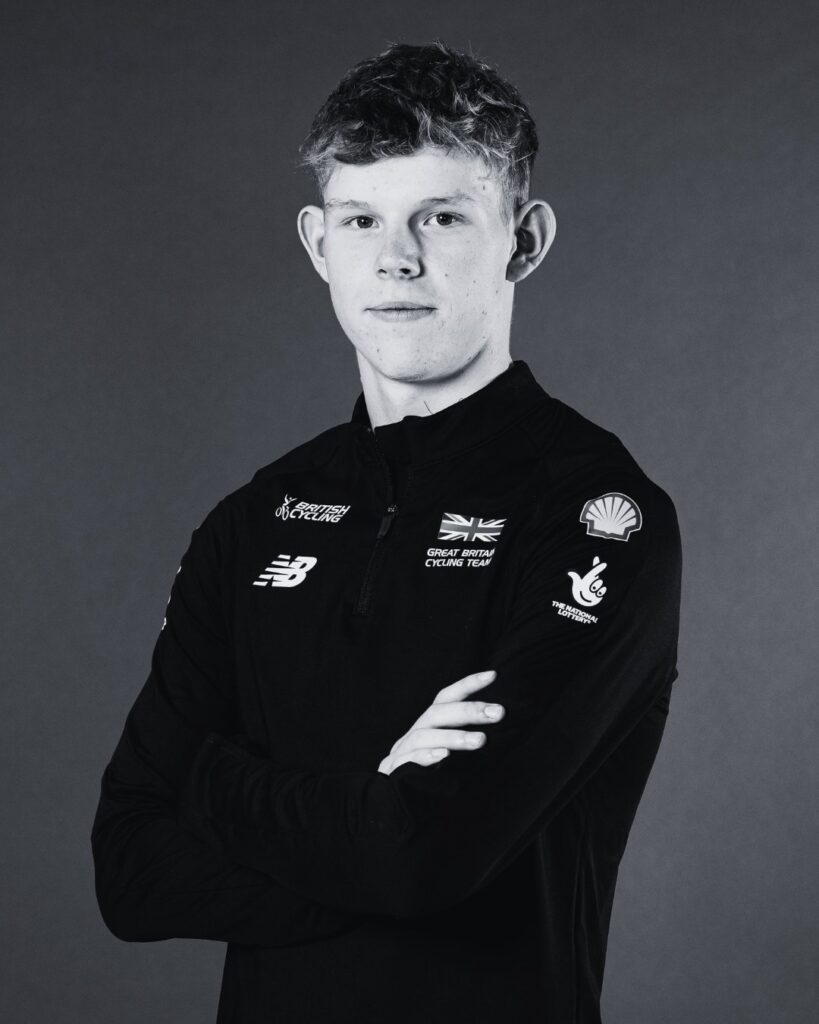
Image: from UCI X @UCI_cycling
By Open Chronicle Cycling
The 87th Volta a Portugal has been struck by tragedy after British cyclist Finlay Tarling died following a serious road collision during Friday’s eighth stage of the race.
Tarling, 19, who was competing for the Swiss NSN Development Team, was involved in a collision with a car on the EN306 road in Arcozelo, Ponte de Lima, while the stage was being contested between Melgaço and Fafe.
Major Tiago Machado of Portugal’s GNR told RTP that the vehicle involved had been travelling against the permitted direction of traffic.
Emergency services responded to the scene, but despite attempts to save the young rider, Tarling could not be resuscitated. His death was declared at approximately 15:40 local time, according to Alto Minho TV.
The circumstances surrounding the collision are now under investigation.
Emergency teams unable to save Tarling
The accident occurred in the Ponte de Lima municipality during Stage 8 of Portugal’s national tour.
Emergency personnel rapidly attended the scene after Tarling was struck.
According to the information available, the British rider suffered cardiorespiratory arrest. Rescuers attempted to reverse his condition but were unsuccessful.
His death was subsequently confirmed at the scene.
Tarling’s body was transported to the Institute of Legal Medicine in Viana do Castelo.
Portuguese authorities have begun investigating the circumstances that allowed the vehicle to be travelling in the opposite direction on a road being used during the Volta a Portugal.
GNR confirms car was travelling against traffic
Speaking live to Portuguese public broadcaster RTP, GNR Major Tiago Machado confirmed that Tarling had been struck by a vehicle travelling against the permitted direction of traffic.
The precise sequence of events remains subject to investigation.
The collision occurred only minutes after the passage of the main peloton, according to the initial reports.
That detail is expected to become particularly important as investigators reconstruct the accident and examine traffic management and road security arrangements surrounding the race.
Authorities have not yet announced the conclusions of their investigation.
Stage 8 neutralised
The organisation of the Volta a Portugal and the Portuguese Cycling Federation responded by neutralising the eighth stage.
The stage had been scheduled to take the peloton from Melgaço to Fafe.
Following confirmation of Tarling’s death, competitive racing was halted and the race continued under neutralised conditions toward the finish.
The planned podium ceremony in Fafe was also cancelled as a mark of respect.
The decision transformed what should have been another important competitive day in the 87th edition of the race into a day of mourning for Portuguese and international cycling.
Volta a Portugal issues statement
The race organisation and Portuguese Cycling Federation issued a joint statement expressing their grief following Tarling’s death.
They said the organisation “deeply regrets” the death of the British rider following the serious accident during Stage 8.
The statement expressed condolences to Tarling’s family, his teammates, the NSN Development Team and his friends and loved ones.
Officials confirmed that the race would remain neutralised until the arrival in Fafe and that the day’s podium ceremony would not take place.
The organisation said additional information would be provided when circumstances allowed.
A 19 year old rider competing in Portugal
Tarling’s age makes the tragedy particularly devastating.
At only 19, he was racing for NSN Development Team, a development squad providing young riders with an opportunity to compete and progress through professional cycling.
The Volta a Portugal is one of the most important races on the Portuguese cycling calendar and represents a major competitive opportunity for both established riders and emerging talents.
For a young international rider, participation in the race offered experience in a demanding multi stage event alongside experienced professionals.
Instead, Friday’s stage ended in tragedy.
Cycling community in mourning
News of Tarling’s death immediately overshadowed the sporting contest.
Results, classifications and the battle for the race became secondary as riders, teams, officials and supporters absorbed what had happened.
Professional cycling carries unavoidable risks. Riders compete at high speeds on public roads and frequently encounter technical descents, narrow sections, difficult weather and roadside obstacles.
Race organisers therefore depend on extensive coordination between police, marshals, emergency services and local authorities to secure roads while the competition passes.
A vehicle travelling against the established traffic direction during an active race raises serious questions that investigators will now have to answer.
Focus turns to investigation
The investigation is expected to establish exactly how the vehicle entered or remained on the road and the circumstances immediately preceding the collision.
Authorities will also need to reconstruct Tarling’s position relative to the main race convoy and determine the traffic restrictions in operation at that location.
Initial information indicates that the accident occurred shortly after the main peloton had passed.
Until the investigation is completed, however, the full chain of events remains unclear.
That distinction is important. While the GNR has confirmed that the vehicle was travelling against the permitted direction, responsibility for the circumstances leading to the collision has not yet been established publicly.
Race safety comes under immediate scrutiny
The tragedy is likely to bring renewed attention to road security at professional cycling events.
Stage races present particularly complicated logistical challenges because organisers must secure long stretches of public road every day while allowing the race convoy, team vehicles, officials, emergency personnel and riders to move through the course.
Unlike racing on a closed circuit, the protected area continually moves with the competition.
Police and race marshals manage intersections and access points while public traffic is temporarily stopped or redirected.
Any breakdown in that system can have serious consequences.
Friday’s accident will inevitably lead to questions about how a vehicle travelling in the wrong direction came into contact with a competitor.
Those questions should ultimately be answered by the official investigation rather than speculation in the immediate aftermath of the tragedy.
Stage from Melgaço to Fafe loses all sporting significance
Stage 8 had been expected to provide another important chapter in the sporting battle of the 2026 Volta a Portugal.
The route between Melgaço and Fafe formed part of the decisive final phase of the race, when accumulated fatigue and increasingly important classification battles were beginning to shape the final outcome.
None of that mattered after news of the accident reached the race.
Neutralisation was the only appropriate sporting response once the scale of the tragedy became clear.
The cancellation of the podium ceremony reinforced the sense that Friday was no longer a day for celebration.
A tragedy beyond competition
Cycling is built around results, victories, classifications and the pursuit of seconds.
Events such as Friday’s accident expose how quickly those concerns can become insignificant.
Finlay Tarling arrived at the Volta a Portugal as a young cyclist pursuing his career in an international development team.
He was 19 years old.
His death during Stage 8 leaves his family, teammates and the wider cycling community confronting a loss that extends far beyond the race itself.
For the Volta a Portugal, the eighth stage of the 2026 edition will not be remembered for an attack, a sprint or a change in the general classification.
It will be remembered for the death of a young rider.
As Portuguese authorities investigate how the collision occurred, the cycling community now mourns Finlay Tarling.