
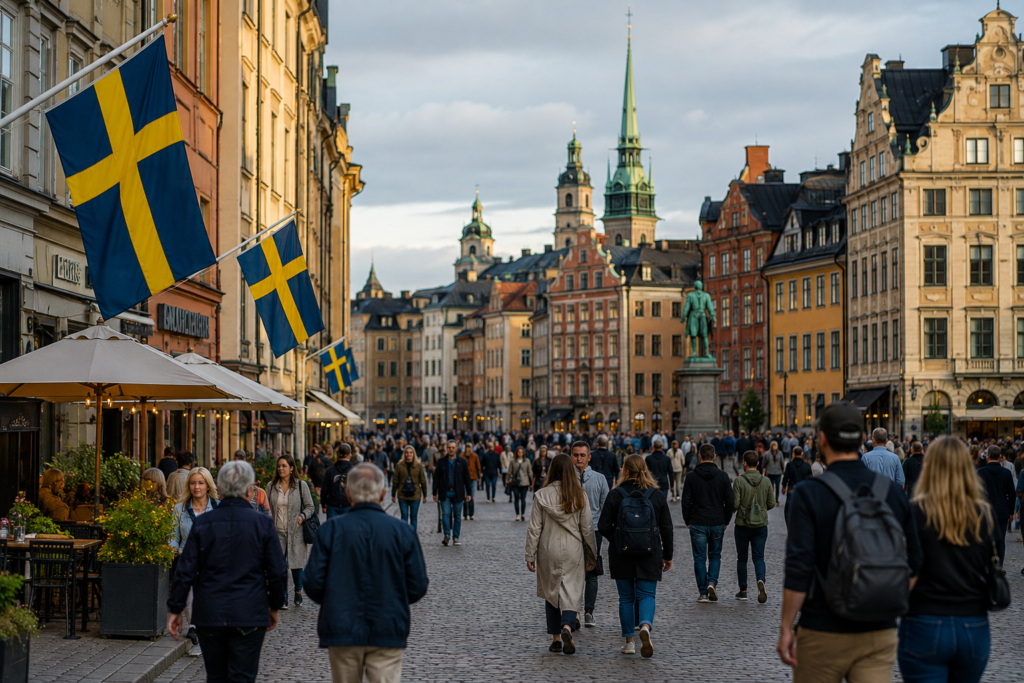
Image Credits: Sweden Faces Demographic Turning Point as Deaths Outnumber Births Across Most Municipalities. AI-generated illustration created by Open Chronicle using ChatGPT (OpenAI). August 2026. This image is illustrative and does not depict a real-world scene.
By Open Chronicle with agencies
Sweden is approaching a significant demographic turning point as falling fertility and an ageing population reshape communities across the country, with nearly 80 percent of Swedish municipalities already recording more deaths than births.
Official figures cited by Swedish public broadcaster SVT show that deaths exceeded births in 79 percent of Sweden’s municipalities in 2025, a pattern that was once concentrated mainly in smaller and sparsely populated areas but has now spread across much of the country.
At the national level, Sweden has not yet crossed into natural population decline. There were 97,488 births and 92,212 deaths in 2025, leaving a relatively small natural increase of 5,276 people. But projections from Statistics Sweden indicate that this balance is likely to disappear soon.
From 2027, Sweden is expected to record more deaths than births nationwide.
The change places Sweden among a growing number of European countries confronting the long-term consequences of low fertility, population ageing and increasing dependence on migration for demographic growth.
Nearly four in five municipalities record natural decline
The geographical scale of the shift is particularly striking.
In 2025, 79 percent of Swedish municipalities registered more deaths than births. The phenomenon has traditionally been associated with rural areas where younger residents move toward larger cities and the remaining population gradually becomes older.
That explanation is becoming less sufficient.
The imbalance is now affecting a much broader part of Sweden, suggesting that the country’s demographic challenge is increasingly national rather than predominantly rural.
For individual municipalities, the consequences can accumulate over decades.
Fewer births eventually mean fewer children entering schools, followed later by fewer young adults joining local labour markets. At the same time, ageing communities require greater resources for healthcare and elderly care.
Municipal governments can consequently face simultaneous pressure to maintain services for older residents while adapting schools and other infrastructure to smaller younger populations.
Sweden’s fertility rate reaches a record low
Behind the transformation is a sustained decline in fertility.
Sweden’s fertility rate fell to approximately 1.4 children per woman in 2025, the lowest level ever recorded in the country.
That is considerably below the level generally associated with long-term population replacement.
In developed societies with relatively low mortality, a fertility rate of approximately 2.1 children per woman is usually considered necessary for one generation to replace itself without migration.
Sweden is therefore producing considerably fewer births than would be required to maintain its population through natural demographic change alone.
The difference does not immediately translate into population decline because demographic change unfolds over decades.
Large generations born earlier continue to influence the total population, while migration can compensate for declining births.
But sustained fertility below replacement level gradually changes the age structure of a country.
Deaths expected to exceed births from 2027
Statistics Sweden projects that the remaining national surplus of births over deaths will continue shrinking during 2026.
The decisive change is expected next year.
From 2027 onward, deaths are projected to exceed births across Sweden as a whole.
This would mark an important demographic threshold.
A country experiencing more deaths than births has what demographers describe as negative natural population growth.
Its population can still increase, but only if immigration exceeds both emigration and the natural population deficit.
That is precisely what Statistics Sweden expects to happen.
Migration becomes central to Sweden’s population growth
Despite falling fertility, Sweden’s population is not currently projected to collapse.
Statistics Sweden’s main projection expects the country’s population to rise from approximately 10.6 million in 2025 to almost 12 million by 2075.
The mechanism behind that growth, however, is changing.
Migration is expected to become the principal driver of population expansion.
More people are projected to move into Sweden than leave, compensating for the growing difference between births and deaths.
Without positive net immigration, Statistics Sweden calculates that the country’s population would decline.
This creates an important distinction between Sweden’s total population and its natural demographic development.
The total number of residents may continue increasing even while the population would be shrinking in the absence of immigration.
An ageing population changes the equation
Fertility is only one side of Sweden’s demographic transformation.
The other is longevity.
Statistics Sweden expects life expectancy to continue rising, while the proportion of older people increases.
Its municipal and county projections already point toward a significant transformation of Sweden’s age structure. The share of older residents is expected to increase while children and younger groups account for a smaller proportion of the population in many parts of the country.
This is fundamentally different from a temporary decline in births.
An ageing population affects almost every component of public policy.
Healthcare demand changes.
Pension systems face pressure.
Municipalities need more elderly care.
Employers have to replace retiring workers.
Public finances increasingly depend on a sufficiently large working-age population supporting services used by older generations.
The labour market could feel the effects
For Sweden’s economy, one of the most important questions is how many people will be available to work in the decades ahead.
A shrinking proportion of younger people can eventually reduce the number entering the labour market.
That matters particularly in sectors already facing recruitment difficulties, including healthcare and elderly care.
Technology and productivity improvements can compensate for part of the problem.
Automation may allow fewer workers to produce more economic output.
Later retirement could also increase labour force participation among older Swedes.
Migration represents another potential source of workers.
But each solution involves economic and political trade-offs.
The demographic challenge is therefore not simply about whether Sweden has more or fewer inhabitants. It concerns the relationship between children, workers and retirees within the population.
Rural Sweden faces an especially difficult future
National figures can also conceal major regional differences.
Statistics Sweden projects substantial variation between counties and municipalities through 2040.
Stockholm County is expected to gain population, while Uppsala is projected to experience particularly strong percentage growth.
Other regions face the opposite trajectory.
Västernorrland and Norrbotten are among the counties projected to experience substantial population decline.
Migration within Sweden contributes to these differences.
Young adults frequently move toward cities and economically dynamic regions for university, employment, and other opportunities.
When they leave smaller communities, they take not only themselves but also many future births with them.
The result can become self-reinforcing.
Fewer young families produce fewer children. Fewer children can eventually lead to school closures or consolidation. Reduced services can make communities less attractive to additional young families.
Cities are not immune to falling fertility
Urban growth does not necessarily eliminate the broader fertility problem.
Large metropolitan areas can continue expanding through domestic and international migration even while birth rates remain low.
This distinction matters when interpreting population statistics.
A growing municipality does not necessarily have enough births to replace its existing population naturally.
Likewise, a country can experience population growth while simultaneously undergoing demographic ageing.
Sweden’s emerging situation demonstrates why migration, fertility and mortality need to be considered together rather than as separate trends.
Statistics Sweden expects some fertility recovery
The long term projections do not assume that today’s record low fertility will continue indefinitely.
Statistics Sweden expects fertility eventually to recover from approximately 1.4 children per woman to around 1.7.
Even that would remain below replacement level.
Forecasting fertility several decades into the future is inherently uncertain because decisions about having children are influenced by housing, employment, family policy, economic confidence, cultural change and personal expectations.
Small differences in fertility assumptions can also produce substantial changes when projected across several generations.
The precise population of Sweden in 2075 should therefore be treated as a projection rather than a prediction.
The underlying direction, however, is clearer.
Sweden is ageing, births have fallen sharply and natural population growth is approaching zero.
Sweden is part of a wider European transformation
The Swedish figures fit into a much larger European demographic story.
Low fertility has become common across much of the continent.
Governments increasingly face questions about how to maintain pension systems, healthcare, economic growth and regional communities when younger generations are smaller than those preceding them.
Sweden historically stood out from some European countries because comparatively strong fertility and substantial immigration supported population growth.
The latest figures suggest that distinction is weakening.
A fertility rate around 1.4 places Sweden firmly within Europe’s broader low birth rate environment.
Immigration becomes politically and economically consequential
The projections also create an unavoidable connection between demography and migration policy.
If deaths exceed births from 2027 and fertility remains below replacement level, migration becomes increasingly important to maintaining Sweden’s population and workforce.
That does not determine what Sweden’s immigration policy should be.
Migration involves questions of integration, housing, education, employment, social cohesion and public finances as well as demographics.
But it does mean that different immigration policies will increasingly produce different population outcomes.
A Sweden with sustained positive net migration could continue growing.
A Sweden with little or no net migration would, under current projections, eventually become smaller.
Demography changes slowly, then profoundly
The significance of Sweden’s latest statistics is easy to underestimate because demographic change rarely produces an immediate crisis.
A fertility rate falling in one year does not suddenly empty schools or overwhelm pension systems.
The consequences accumulate gradually.
Children not born in 2025 are workers who will not enter the labour market two decades later.
Young adults leaving a rural municipality today influence its tax base, housing market and number of future families.
An expanding elderly population gradually increases demand for healthcare and social services.
Demographic transformation therefore operates over the same time horizon as infrastructure, pension and national economic planning.
That makes early trends important even when their most visible consequences remain decades away.
Sweden approaches a demographic crossroads
The headline figure captures the scale of the transformation: almost 80 percent of Swedish municipalities now experience more deaths than births.
But the more consequential threshold may arrive in 2027.
If Statistics Sweden’s projection proves correct, Sweden as a whole will then enter natural population decline.
The country may nevertheless continue growing for decades because immigration is expected to compensate for the deficit.
That produces a Sweden that can simultaneously become larger, older and increasingly dependent on migration for population growth.
How the country responds will influence everything from municipal finances and schools to labour markets, pensions, healthcare and immigration policy.
The demographic shift will not transform Sweden overnight.
It is already transforming Sweden municipality by municipality.