
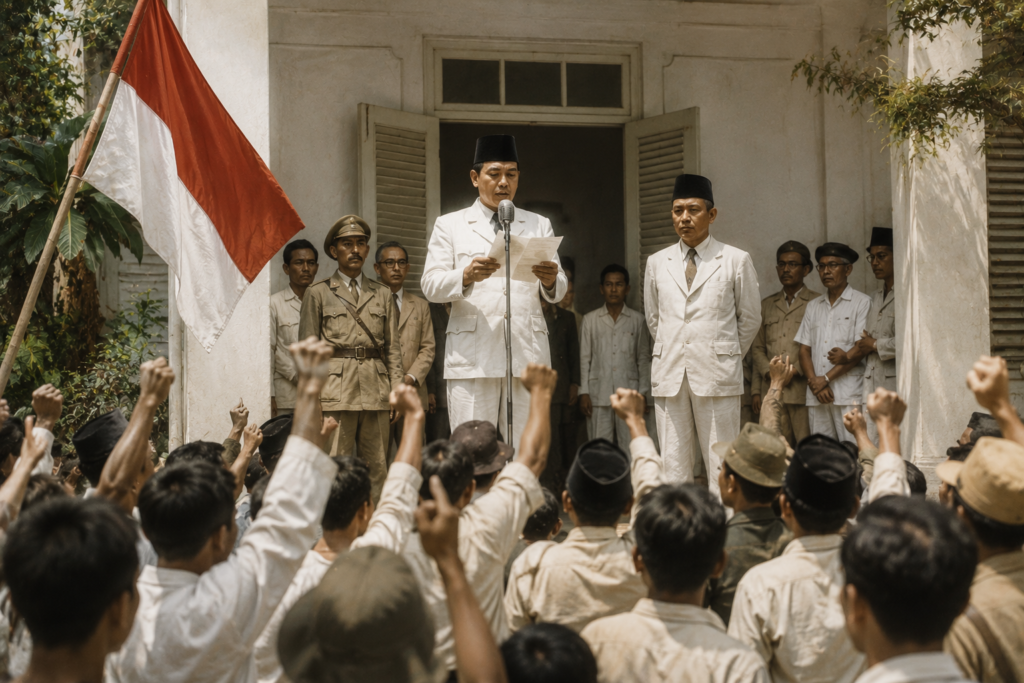
Image Credits: Today in History August 17, 1945: Indonesia Declares Independence from Dutch Colonial Rule. AI-generated illustration created by Open Chronicle using ChatGPT (OpenAI). August 2026. This image is illustrative and does not depict a real-world scene.
By Open Chronicle History Desk
On August 17, 1945, two days after Japan announced its surrender in the Second World War, Sukarno and Mohammad Hatta proclaimed the independence of Indonesia in Jakarta.
The declaration itself was remarkably brief. Yet behind those few lines stood centuries of colonial domination, decades of Indonesian nationalism, the disruption caused by Japanese occupation and an emerging struggle over the political future of one of the world’s largest archipelagos.
Independence was proclaimed that morning, but it was not immediately secured.
The Netherlands attempted to restore colonial authority after the war, beginning a bitter political and military confrontation that lasted more than four years. Indonesian nationalists fought to defend the republic they had declared, while international pressure increasingly challenged European attempts to re-establish colonial rule in Asia.
The events of August 17, 1945, therefore represented both an ending and a beginning.
Dutch colonial rule had been challenged by a new Indonesian state. The struggle to make that independence irreversible was only beginning.
The Dutch East Indies
European involvement in the Indonesian archipelago stretched back centuries.
Its strategic position between the Indian and Pacific Oceans made the region enormously important to international commerce. Spices such as cloves, nutmeg and mace attracted Portuguese, Dutch and other European merchants from the sixteenth century onward.
During the seventeenth century, the Dutch East India Company, the Vereenigde Oostindische Compagnie, commonly known as the VOC, became the dominant European commercial power in much of the archipelago.
The company established trading posts, constructed fortifications, intervened in local politics and used military force to secure profitable monopolies.
Batavia, present-day Jakarta, became the centre of Dutch power in Asia.
When the VOC collapsed at the end of the eighteenth century, its possessions gradually passed under direct Dutch government control.
During the nineteenth century, the Netherlands expanded its authority across the archipelago.
The result became the Dutch East Indies, one of Europe’s richest and most important colonial possessions.
Colonial Rule and Economic Exploitation
The colony produced commodities of enormous value.
Coffee, sugar, tobacco, rubber, tea, petroleum, and other products connected the islands to global markets.
Colonial economic systems generated considerable wealth for the Netherlands, but often imposed severe burdens on Indonesian communities.
One of the most controversial systems was the Cultivation System, introduced during the nineteenth century. Farmers in parts of Java were required to devote land or labour to crops intended for export.
The system generated significant revenue for the Dutch state.
Its human consequences helped provoke criticism both within the colony and in the Netherlands.
By the beginning of the twentieth century, Dutch authorities introduced what became known as the Ethical Policy, promising greater attention to education, irrigation and social development.
Ironically, expanded education contributed to the emergence of a new Indonesian political consciousness.
A generation capable of articulating modern nationalism was beginning to appear.
The Rise of Indonesian Nationalism
Indonesia was extraordinarily diverse.
Thousands of islands contained hundreds of ethnic groups and languages, together with Muslim, Christian, Hindu, Buddhist and traditional religious communities.
Creating a national movement across such diversity was a formidable political challenge.
Yet during the early twentieth century, organisations increasingly promoted the idea that the inhabitants of the Dutch East Indies belonged to a common political nation.
Budi Utomo, established in 1908, is often associated with the beginning of organised Indonesian nationalism.
Other organisations followed.
The Sarekat Islam developed into a major mass movement. Communist organisations also became influential, while secular nationalist groups argued increasingly for independence.
A particularly important moment came with the Youth Pledge of 1928.
Young nationalists declared allegiance to one motherland, one nation and one language, Indonesia.
The concept of Indonesia was becoming more powerful than the colonial geography from which it had emerged.
Sukarno
The most important political figure in this nationalist movement was Sukarno.
Born in Java in 1901, Sukarno combined powerful oratory with an ability to present Indonesian nationalism as a movement capable of transcending regional, ethnic and religious differences.
In 1927, he helped establish the Indonesian National Party.
Its objective was independence.
Dutch authorities regarded Sukarno as a dangerous opponent. He was arrested, imprisoned, and later exiled.
But repression did not eliminate Indonesian nationalism.
Another important nationalist leader was Mohammad Hatta, an economist and political activist who had studied in the Netherlands.
Hatta also faced imprisonment and exile for his political activities.
Together, Sukarno and Hatta would eventually become the central figures in Indonesia’s declaration of independence.
Before that could happen, however, the Second World War transformed the political landscape of Southeast Asia.
Japan Conquers the Dutch East Indies
In December 1941, Japan launched its great offensive across the Pacific and Southeast Asia.
The Dutch East Indies were a major strategic objective.
Japan needed access to the region’s oil and other natural resources, particularly after Western economic sanctions had restricted its access to essential supplies.
Japanese forces advanced rapidly.
The Allied defence collapsed.
In March 1942, Dutch forces surrendered.
More than three centuries of expanding Dutch presence in the archipelago had been swept aside in a matter of months.
For Indonesian nationalists, the collapse of Dutch authority demonstrated something previously difficult to imagine.
European colonial power was not invincible.
But Japanese occupation did not bring liberation.
Life Under Japanese Occupation
Japanese rule was harsh.
Resources were redirected toward the Japanese war effort.
Millions of Indonesians experienced severe economic disruption, food shortages, and forced labour.
Large numbers were recruited as romusha, labourers sent to work on military and infrastructure projects under extremely difficult conditions. Many died.
Political repression remained severe.
Yet Japanese authorities also sought Indonesian cooperation.
Sukarno and Hatta were permitted to participate in organisations mobilising the population.
Their decision to cooperate with the occupation authorities would later become controversial, but it also allowed nationalist leaders to address enormous audiences and develop organisational networks.
Japan also recruited and trained Indonesians in military formations.
These experiences would become important when Indonesians later fought Dutch forces attempting to return.
By 1945, Japan was losing the war.
The question of Indonesian independence suddenly became urgent.
Japan Moves Toward Defeat
During 1945, Japanese authorities began making increasingly explicit promises concerning Indonesian independence.
Committees were created to discuss the institutional foundations of a future state.
Sukarno articulated the principles that became known as Pancasila, which would become fundamental to the ideological foundation of Indonesia.
Then the international situation changed dramatically.
The United States dropped an atomic bomb on Hiroshima on August 6.
A second atomic bomb destroyed much of Nagasaki on August 9.
The Soviet Union entered the war against Japan.
On August 15, Emperor Hirohito announced Japan’s acceptance of Allied surrender terms.
Japanese rule across Southeast Asia was collapsing.
For Indonesian nationalists, a narrow political opportunity had opened.
Pressure for Immediate Independence
Younger nationalist activists wanted Sukarno and Hatta to declare independence immediately.
They feared that waiting could allow Allied forces, and eventually the Dutch, to return and restore colonial government.
Sukarno and Hatta were initially more cautious.
They wanted to avoid a premature confrontation and had been involved with Japanese-sponsored preparations for independence.
Young activists argued that independence had to be clearly presented as an Indonesian action rather than a gift from Japan.
The disagreement became intense.
On August 16, Sukarno and Hatta were taken to Rengasdengklok, outside Jakarta, where younger nationalists pressed them to act rapidly.
Eventually, an agreement emerged.
They returned to Jakarta.
During the night, the wording of an independence proclamation was prepared.
History was about to turn on a remarkably short document.
August 17, 1945
On the morning of August 17, people gathered outside Sukarno’s residence at 56 Jalan Pegangsaan Timur in Jakarta.
There was no enormous military parade.
No elaborate international ceremony had been organised.
Indonesia’s declaration of independence was a comparatively modest event.
At approximately 10 in the morning, Sukarno read the proclamation.
It declared that the Indonesian people were proclaiming their independence and that matters concerning the transfer of power would be carried out carefully and as quickly as possible.
Sukarno and Mohammad Hatta signed the document in the name of the Indonesian nation.
The Indonesian flag was raised.
Those present sang what would become the national anthem, Indonesia Raya.
The Republic of Indonesia had been proclaimed.
Sukarno and Hatta Lead the Republic
The following day, Sukarno was selected as President and Mohammad Hatta as Vice President.
The new republic also adopted a constitution.
But there was an enormous difference between declaring a state and controlling one.
Indonesia stretched across thousands of islands.
Communications were difficult.
Japanese forces remained present while awaiting Allied instructions.
Allied troops had not yet fully arrived.
Dutch colonial authorities intended to return.
The new government therefore had to spread news of independence while simultaneously building political institutions and establishing authority.
Radio broadcasts, newspapers and nationalist networks carried the proclamation across the archipelago.
Independence committees appeared in towns and cities.
Young Indonesians seized government buildings and attempted to take control of weapons.
The revolution was gathering momentum.
The Dutch Attempt to Return
The Netherlands did not recognise the proclamation.
Dutch leaders intended to restore authority over the East Indies after Japan’s defeat.
Initially, British forces were responsible for accepting Japanese surrenders and liberating prisoners of war in parts of Indonesia.
Their arrival created immediate tensions.
Dutch officials and troops accompanied Allied forces.
Indonesians feared that Allied operations were becoming the first stage of colonial restoration.
Violence escalated.
One of the most important confrontations occurred in Surabaya in late 1945.
The Battle of Surabaya
Surabaya became a centre of revolutionary resistance.
Tensions between Indonesian nationalists and Allied forces escalated during October.
After British Brigadier A. W. S. Mallaby was killed, British forces demanded that Indonesian fighters surrender their weapons.
They refused.
On November 10, British forces launched a major assault on Surabaya.
Aircraft, artillery, tanks, and naval gunfire were used against Indonesian positions.
Indonesian fighters resisted fiercely.
Thousands were killed during the battle and surrounding violence.
The British eventually captured the city, but the political effect was very different from a simple military victory.
Surabaya demonstrated the depth of Indonesian determination to defend independence.
November 10 is now commemorated in Indonesia as Heroes’ Day.
The Indonesian National Revolution
The conflict that followed became known as the Indonesian National Revolution.
From 1945 to 1949, the struggle combined conventional warfare, guerrilla resistance, diplomacy, and international pressure.
The Dutch referred to major military offensives as police actions, language intended to portray the conflict as an internal colonial security problem rather than a war between states.
Indonesians viewed the same operations as attempts to reconquer their country.
Dutch forces captured important cities and territories.
But defeating the republic politically proved much more difficult.
Indonesian guerrillas continued operating across large areas.
The government survived.
Meanwhile, the international environment was becoming increasingly hostile to colonial restoration.
Diplomacy and International Pressure
The Indonesian struggle unfolded during a period when colonial empires around the world were beginning to weaken.
India became independent in 1947.
Nationalist movements were gaining strength across Asia.
The newly created United Nations provided another arena in which colonial conflicts could attract international scrutiny.
Negotiations between Indonesia and the Netherlands repeatedly produced agreements and renewed conflict.
The Linggadjati Agreement and later the Renville Agreement attempted to establish political settlements.
Neither ended the confrontation.
In December 1948, Dutch forces launched another major offensive and captured Yogyakarta, then the republican capital.
Sukarno and Hatta were arrested.
Militarily, the operation appeared successful.
Politically, it proved costly.
Indonesian resistance continued, demonstrating that capturing the republican leadership had not destroyed the independence movement.
International criticism intensified.
The United States increasingly pressured the Netherlands to settle.
Sovereignty Recognised
Negotiations eventually led to the Dutch-Indonesian Round Table Conference at The Hague in 1949.
On December 27, the Netherlands formally transferred sovereignty to the United States of Indonesia, with the notable exception of western New Guinea, whose status remained disputed.
Indonesia had secured international recognition of the independence proclaimed more than four years earlier.
The federal structure created during negotiations was short-lived.
In 1950, Indonesia became a unitary republic.
The colonial era had effectively ended.
A New Nation with Enormous Challenges
Independence did not solve Indonesia’s political problems.
The new country had to unite an extraordinary collection of islands and communities into a functioning national state.
Regional rebellions, ideological conflict, and economic difficulties challenged successive governments.
Sukarno eventually moved away from parliamentary democracy toward what he called Guided Democracy.
Indonesia also became an important actor in the emerging postcolonial world.
In 1955, the city of Bandung hosted representatives from Asian and African countries for the Bandung Conference.
The meeting became a landmark in the development of Afro Asian cooperation and helped establish the intellectual foundations of the Non Aligned Movement.
A country that had recently been a European colony was now helping shape a new international order.
Indonesia and the End of European Empire
The Indonesian Revolution had consequences beyond the archipelago.
Before the Second World War, European colonial rule across Southeast Asia had often appeared permanent.
Japan’s wartime victories shattered that perception.
After 1945, European powers attempted to restore control in several former colonies, but nationalist movements had become dramatically stronger.
Indonesia demonstrated how difficult such restoration could be.
The Dutch possessed superior conventional military power.
But military superiority could not easily reverse the political transformation produced by nationalism, wartime upheaval, and changing international attitudes toward colonialism.
Similar struggles would reshape Vietnam, Malaya and other parts of Asia.
The age of European colonial empires was entering its final phase.
Why August 17 Matters
August 17 is celebrated annually as Indonesian Independence Day, known as Hari Kemerdekaan.
The date commemorates the moment Sukarno and Hatta publicly declared that sovereignty belonged to the Indonesian people.
The declaration did not immediately remove Dutch power.
It did something equally important.
It established the political principle around which millions of Indonesians could organise.
From that moment, the conflict was no longer simply about reforming colonial government.
It was about defending a republic that claimed to already exist.
Four years of warfare and diplomacy were required before the Netherlands formally transferred sovereignty.
But Indonesia continues to date its independence from August 17, 1945.
That distinction captures the historical importance of the proclamation.
Independence was not presented as something eventually granted by a colonial power.
It was declared by Indonesians themselves.
On a quiet morning in Jakarta, Sukarno read a brief statement before a modest gathering.
The ceremony lasted only a short time.
Its consequences transformed one of the world’s largest countries, accelerated the collapse of European colonialism in Asia, and helped shape the postcolonial international order.