
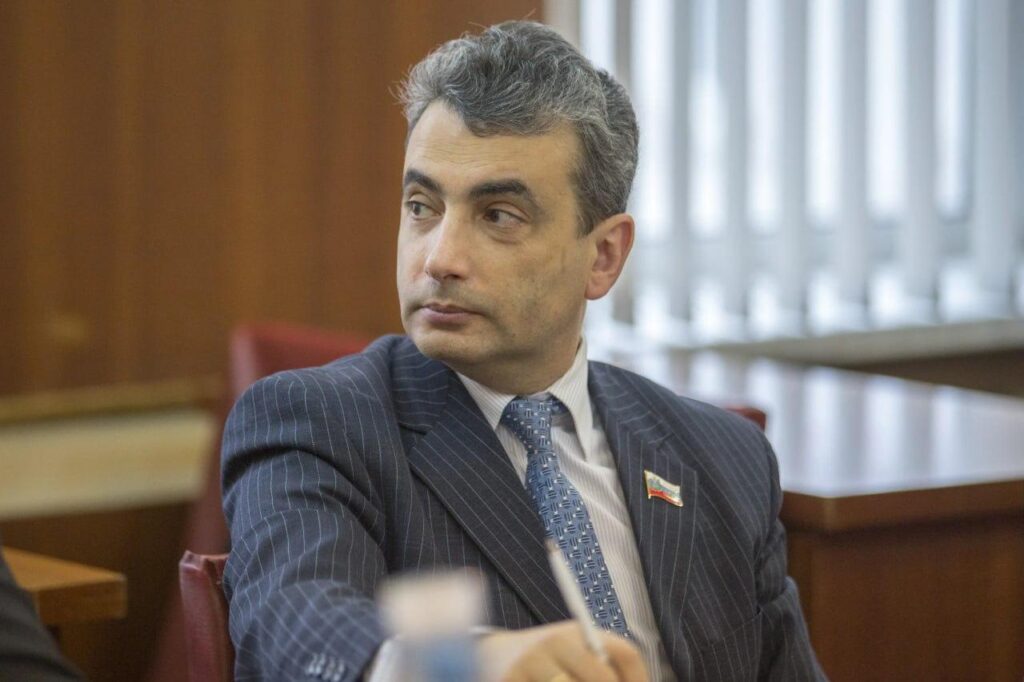
Image: From NEXTA X @nexta_tv
By Open Chronicle with agencies
Russian opposition politician Lev Shlosberg has been sentenced to 11 years in prison, prompting condemnation from critics of the Kremlin and renewed concern over the shrinking space for political opposition to Russia’s war in Ukraine.
Boris Nadezhdin, a veteran Russian politician who opposed the invasion of Ukraine and recently left Russia, described the imprisonment of Shlosberg, deputy chairman of the liberal Yabloko party, as “absolutely crazy”.
Speaking to Channel 4 News, Nadezhdin reacted strongly to the severity of the punishment imposed on a politician whose opposition to the war has placed him increasingly at odds with the Russian authorities.
The case is significant not simply because of the length of the sentence. Shlosberg belongs to a diminishing group of Russian political figures who have remained publicly associated with opposition to the war while attempting to operate through established political institutions.
🇷🇺Lev Shlosberg, deputy chairman of Russia’s Yabloko party, has been sentenced by a Pskov court to 11 years and 1 month in a penal colony for alleged “military fakes” and repeated “discrediting” of the Russian army.
The case stemmed from anti-war statements, including calls for… pic.twitter.com/x9qtnUpEdU
— Karl 12½1/4❾¾™ (@Carolus_XII_Rex) August 17, 2026
Eleven years in prison
Shlosberg has been one of the most recognisable figures within Yabloko, a liberal political party that has long advocated democratic reform, political pluralism and a negotiated end to the war in Ukraine.
His imprisonment represents another severe blow to Russia’s already weakened organised opposition.
An 11-year sentence would remove him from active political life for much of the next decade and send an unmistakable message to others considering public opposition to Kremlin policy.
For Nadezhdin, the punishment illustrates how dramatically Russian politics has changed since the beginning of the full-scale invasion of Ukraine.
His description of the sentence as “absolutely crazy” reflects the disbelief among Kremlin critics at the increasingly severe consequences faced by politicians who openly challenge the war.
Shlosberg represents a different form of opposition
Shlosberg’s political background makes his case particularly noteworthy.
Unlike opposition activists operating entirely outside Russia’s formal political system, he built his career within conventional party politics.
Yabloko has existed since the early post Soviet period and has historically positioned itself as a liberal, democratic alternative to both the Kremlin and more nationalist sections of Russian politics.
The party has opposed the war in Ukraine and called for a ceasefire and negotiations.
That position has become increasingly difficult to maintain as Russian authorities have tightened restrictions on public discussion of the conflict.
Shlosberg consequently represents something increasingly rare in contemporary Russia: a politician attempting to oppose the war from within the country’s remaining legal political structures.
Boris Nadezhdin knows the risks personally
Nadezhdin’s reaction carries additional significance because he has experienced the restrictions surrounding anti-war politics himself.
The longtime politician attempted to challenge Vladimir Putin in Russia’s 2024 presidential election on a platform that included opposition to the war.
His campaign unexpectedly became a focal point for Russians who wanted a political route to express dissatisfaction with the conflict.
Thousands of people queued to provide the signatures required for his candidacy.
Russia’s Central Election Commission ultimately prevented Nadezhdin from appearing on the ballot, saying too many of the signatures submitted by his campaign were invalid.
Nadezhdin disputed the decision.
His experience demonstrated the difficulty of translating anti-war sentiment into formal electoral competition.
He has since left Russia.
Political opposition has steadily narrowed
Shlosberg’s sentence comes after years of escalating pressure on opposition movements, independent journalists and civil society organisations.
The transformation accelerated dramatically after Russia launched its full-scale invasion of Ukraine in February 2022.
Legislation introduced shortly after the invasion established severe penalties for spreading what the government defines as false information about the Russian armed forces.
The authorities have also used laws concerning extremism, foreign agents and undesirable organisations against activists, journalists and political groups.
Critics argue that the cumulative effect has been to make meaningful public opposition to the war extraordinarily dangerous.
The Kremlin maintains that Russia needs strong laws to protect national security and prevent hostile foreign influence during wartime.
Navalny’s death transformed the opposition landscape
The imprisonment of Shlosberg also takes place within a Russian opposition landscape profoundly changed by the death of Alexei Navalny in an Arctic penal colony in February 2024.
Navalny had been the country’s most prominent opposition leader and one of Putin’s most persistent domestic critics.
His political organisations were designated extremist by Russian authorities, while many of his closest associates left the country.
Other opposition figures have been imprisoned, prosecuted or forced into exile.
That has gradually changed the nature of Russian opposition politics.
Much of the organised opposition now operates from abroad, creating an increasing divide between exiled political movements and the Russians who remain inside the country.
Shlosberg’s position was therefore unusual because he continued operating politically within Russia despite the risks.
Anti-war politics faces an extraordinary dilemma
Russia’s remaining opponents of the war face a fundamental strategic problem.
Operating inside Russia provides direct contact with voters and gives politicians greater legitimacy when claiming to represent Russian society.
But remaining inside the country also exposes them to prosecution.
Operating from exile provides greater freedom to criticise the Kremlin, organise internationally and speak to foreign media.
But exile makes it more difficult to maintain political organisations inside Russia.
Nadezhdin’s own departure illustrates this dilemma.
His reaction to Shlosberg’s imprisonment comes from outside the country, while Shlosberg now faces the consequences of remaining inside Russia’s political system.
The war has reshaped Russian domestic politics
The Ukraine conflict is often analysed primarily through territorial changes, military casualties, weapons production and relations between Russia and NATO.
But the war has also transformed Russia internally.
Political debate that existed before February 2022 has become considerably narrower.
The Kremlin increasingly presents the conflict not merely as a military campaign against Ukraine, but as part of a larger confrontation with the West.
Within that framework, opposition to the war can be portrayed not simply as disagreement with government policy, but as undermining Russia during an existential national struggle.
That distinction has enormous consequences for opposition politicians.
It changes the political cost of dissent from losing an election or parliamentary seat to potentially losing one’s freedom.
Yabloko occupies an increasingly difficult position
The future of Yabloko is particularly important in understanding what remains of legal opposition politics.
The party historically competed in Russian elections and once held seats in the State Duma.
Its influence declined significantly during Putin’s presidency as Russia’s political system became increasingly dominated by United Russia and parties broadly supportive of the Kremlin.
Yet Yabloko retained a distinctive political identity.
Its opposition to the Ukraine war separates it from much of the parliamentary opposition, where parties may criticise aspects of domestic government policy while supporting the Kremlin’s fundamental approach to the conflict.
The imprisonment of one of Yabloko’s senior figures therefore raises questions about whether even this limited form of institutional opposition can continue functioning.
The sentence sends a message beyond one politician
Political prosecutions have consequences beyond the person standing in court.
They influence the behaviour of everyone watching.
Local politicians may become less willing to criticise the war.
Activists may decide against organising demonstrations.
Ordinary citizens may avoid expressing political opinions publicly or online.
Potential candidates may conclude that participation in opposition politics carries unacceptable personal risks.
This chilling effect can be politically more significant than the imprisonment of any single individual.
A government does not need to prosecute every opponent if sufficiently prominent cases demonstrate what could happen to others.
Shlosberg’s 11-year sentence is therefore likely to resonate far beyond Yabloko.
A generation of Russian politicians is moving into exile
Nadezhdin’s departure also reflects another long-term consequence of Russia’s political transformation.
A substantial community of Russian politicians, journalists, academics, activists and cultural figures now lives outside the country.
Many are based in European states.
Others have relocated to countries including Georgia, Armenia, Serbia and Israel.
The emergence of this political diaspora creates an unusual situation.
Russia possesses an opposition community with significant intellectual and organisational resources, but much of that community has limited ability to operate directly within Russian territory.
History shows that political exile can sometimes preserve opposition movements for long periods.
It can also fragment them.
Different groups develop competing strategies, leadership structures and relationships with foreign governments.
Whether Russia’s exiled opposition can maintain meaningful connections with citizens inside the country will therefore become increasingly important.
What happens after the war?
There is also a longer term question behind Shlosberg’s case.
Whatever the eventual outcome of the Ukraine war, Russia will eventually confront the political consequences of years of wartime repression and social transformation.
The country will have to deal with returning soldiers, economic pressures, demographic challenges and relations with Europe.
It will also have to determine whether the political restrictions imposed during wartime become permanent features of the Russian state.
For figures such as Shlosberg and Nadezhdin, the possibility of a different political future depends partly on whether space for peaceful opposition can eventually reopen.
At present, the direction appears to be moving the other way.
A symbol of Russia’s shrinking political space
Lev Shlosberg’s imprisonment is ultimately about more than the fate of one politician.
It illustrates how difficult organised opposition to the Ukraine war has become inside Russia.
Nadezhdin’s description of the sentence as “absolutely crazy” captures the reaction among those who believe political disagreement should remain possible even during war.
The Kremlin views the situation through a fundamentally different lens, emphasising national security, wartime unity and the need to confront what it considers attempts to destabilise Russia.
Between those two positions lies the rapidly disappearing space for conventional political dissent.
Five years into the wider confrontation surrounding Ukraine, the battlefield has transformed European security.
Inside Russia, it has also transformed politics.
The imprisonment of a senior anti war politician for 11 years is another indication of how far that transformation has gone.