
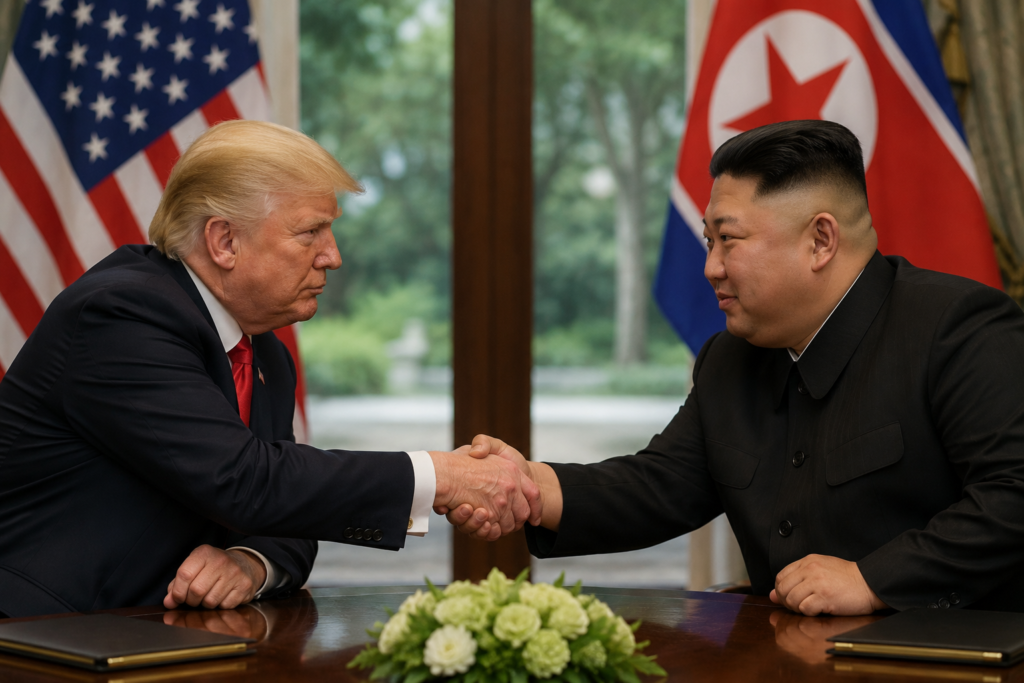
Image Credits: Trump Says Kim Jong Un Responded to His Request for Talks as US Policy Toward Korea Shifts. AI-generated illustration created by Open Chronicle using ChatGPT (OpenAI). August 2026. This image is illustrative and does not depict a real-world scene.
By Open Chronicle with agencies
US President Donald Trump says North Korean leader Kim Jong Un has responded to his request for talks, raising the possibility of renewed personal diplomacy between Washington and Pyongyang as the White House simultaneously reassesses aspects of its military relationship with South Korea.
Trump disclosed in Washington on Monday, August 17, after a reporter suggested that Kim had not replied to his efforts to establish contact.
Asked directly whether the North Korean leader had responded, Trump answered: “Yeah, yes.”
The president did not disclose what Kim had communicated, whether direct contact had taken place or whether preparations were under way for a meeting. Nevertheless, his comments represent the clearest indication that communication may have reopened between the two leaders.
Trump revives his personal diplomacy with Kim
Trump again emphasised the unusual personal relationship he developed with Kim during his earlier presidency.
“Kim Jong Un has always treated me with great respect,” Trump said, adding that the two leaders had met and spent considerable time together.
“I understand him. He understands me,” Trump said.
That language echoes Trump’s approach during his previous negotiations with North Korea, when he relied heavily on leader-to-leader diplomacy in an attempt to break decades of hostility between Washington and Pyongyang.
The relationship produced extraordinary scenes between 2018 and 2019, including summits in Singapore and Hanoi and Trump’s meeting with Kim at the Korean Demilitarized Zone.
Those encounters dramatically reduced the level of rhetoric between the two governments for a period, but they ultimately failed to produce a comprehensive agreement eliminating North Korea’s nuclear arsenal.
Trump now appears interested in reopening that diplomatic channel.
What did Kim tell Trump?
That remains unclear.
Trump confirmed only that Kim had responded.
He provided no information about the substance of the response and did not say whether North Korea had accepted an invitation to hold formal negotiations.
Pyongyang has also not publicly announced a new summit or diplomatic process.
That distinction is important.
Communication between the two leaders would represent a potentially significant diplomatic development, but it would not necessarily mean negotiations over North Korea’s nuclear programme are about to resume.
Much would depend on what Washington is prepared to offer and what Pyongyang expects from a new round of diplomacy.
US scales back planned exercises with South Korea
Trump’s remarks came one day after he ordered the Pentagon to “substantially reduce” planned joint military exercises with South Korea.
The president cited both the financial cost of the exercises and his relationship with Kim.
Military exercises involving American and South Korean forces have long been one of the most contentious issues in relations with North Korea.
Washington and Seoul describe the drills as necessary for maintaining military readiness and ensuring that their forces can operate together in the event of a crisis.
Pyongyang routinely condemns them as rehearsals for invasion.
Reducing the exercises could therefore provide Trump with a diplomatic signal to North Korea.
It could also create concerns in Seoul about the credibility and readiness of the US-South Korean military alliance.
Trump questions the cost of defending South Korea
The president went considerably further than discussing military exercises.
Trump publicly questioned why the United States should continue spending billions of dollars defending South Korea after Seoul declined to participate in American efforts against Iran.
According to Trump, he recently asked South Korean President Lee Jae Myung whether Seoul would join Washington in efforts to “denuclearize Iran”.
Trump said Lee’s response was: “No thanks.”
The US president then connected that refusal directly to America’s defence commitments on the Korean Peninsula.
Trump said the United States has approximately 39,000 military personnel stationed in South Korea to protect the country from North Korea and questioned why Seoul would not assist Washington in what he characterised as a comparatively straightforward military operation involving Iran.
“Then why are we involved with helping you?” Trump asked.
The remarks introduce a potentially significant element of uncertainty into one of America’s oldest Asian alliances.
Washington and Seoul have very different calculations
South Korea’s reluctance to become involved in another Middle Eastern conflict is not difficult to understand strategically.
Seoul’s immediate security priorities remain concentrated on the Korean Peninsula.
North Korea possesses nuclear weapons, ballistic missiles and substantial conventional forces positioned close to South Korea.
Any deterioration in relations between Washington and Pyongyang can therefore have direct consequences for South Korean security.
The United States has much broader global military commitments.
Trump’s argument effectively connects America’s security guarantee in Northeast Asia with South Korea’s willingness to support US operations elsewhere.
That transactional approach could generate significant debate inside South Korea.
The American military presence remains central to deterrence
US forces have been stationed in South Korea for decades.
Their mission is not simply to provide additional combat power during a potential war.
Their presence also serves as a powerful political guarantee that any major North Korean attack would immediately involve the United States.
American and South Korean forces regularly train together to maintain interoperability across air, ground, naval and command operations.
Reducing exercises does not necessarily mean reducing the number of American personnel deployed in the country.
However, military readiness depends heavily on training.
A substantial or prolonged reduction in exercises could therefore become strategically significant if it affects the ability of allied forces to conduct complex operations together.
North Korea may see an opportunity
From Pyongyang’s perspective, the latest developments could be encouraging.
North Korea has spent years demanding an end to large scale US South Korean exercises and criticising America’s military presence on the peninsula.
Trump’s willingness to reduce exercises while simultaneously questioning the cost of defending South Korea potentially allows Kim to test how far Washington is prepared to go.
The North Korean leader may calculate that direct engagement with Trump could produce concessions unavailable through conventional diplomacy.
That was one of the attractions of the earlier summit process.
Kim gained direct access to an American president and unprecedented international visibility.
Trump, meanwhile, presented the meetings as evidence that unconventional diplomacy could prevent confrontation.
But the nuclear problem remains
Any renewed dialogue would eventually encounter the same fundamental obstacle that undermined previous negotiations.
North Korea possesses nuclear weapons.
Washington has historically sought denuclearisation.
Pyongyang increasingly treats its nuclear arsenal as a permanent element of national defence.
Bridging those positions proved impossible during Trump’s earlier negotiations with Kim.
The February 2019 Hanoi summit ended without an agreement after the two governments failed to reconcile North Korea’s demands for sanctions relief with American demands concerning denuclearisation.
Since then, North Korea has continued developing its missile and nuclear capabilities.
A new diplomatic process would therefore begin from an even more complicated strategic position.
Personal diplomacy has advantages and risks
Trump’s approach to North Korea has always placed exceptional emphasis on his personal relationship with Kim.
That can have advantages.
Direct communication between national leaders can sometimes break bureaucratic deadlocks and reduce the risk of miscalculation.
The extraordinary escalation in rhetoric between Washington and Pyongyang during 2017 was followed by direct diplomacy that substantially reduced immediate tensions.
But personal diplomacy also has limitations.
Nuclear agreements require detailed negotiations involving sanctions, verification, inspections, weapons inventories, missile programmes and security guarantees.
Those issues cannot be resolved through personal rapport alone.
Even if Trump and Kim meet again, officials from both governments would eventually need to negotiate the technical architecture of any lasting agreement.
Seoul will watch the process closely
Perhaps the most important immediate question concerns South Korea.
A renewed Trump-Kim diplomatic initiative would directly affect Seoul’s national security.
South Korean officials would want to know whether reductions in military exercises are temporary confidence-building measures or part of a broader reassessment of America’s military commitment.
Trump’s public criticism of South Korea adds another layer of uncertainty.
If Washington increasingly treats defence guarantees as conditional on allies supporting unrelated American military operations elsewhere, Seoul may begin reconsidering assumptions that have underpinned its security strategy for decades.
That debate could have consequences extending far beyond Korea.
Other American allies in Asia will also be watching how Washington manages the relationship.
China will also be watching
Any renewed US North Korean diplomacy would attract intense attention in Beijing.
China remains North Korea’s most important economic and strategic partner and shares a long border with the country.
Beijing’s overriding interest is stability.
A war on the Korean Peninsula would create enormous security, economic and humanitarian risks for China.
But Beijing also does not want the United States dramatically strengthening its military presence near Chinese territory.
A reduction in US South Korean exercises could therefore be welcomed by China, particularly if it reduces regional tensions.
At the same time, a direct Trump Kim relationship that sidelines Beijing would introduce another element of uncertainty into China’s regional calculations.
A diplomatic opening, but many unanswered questions
Trump’s disclosure is significant precisely because communication with Kim has been so politically consequential in the past.
But much remains unknown.
The White House has not disclosed what Kim said.
There is no confirmed summit.
There is no announced negotiating framework.
There is no indication that Pyongyang has changed its position on nuclear weapons.
What has changed is the political atmosphere.
Trump is once again speaking positively about Kim.
The Pentagon has been instructed to reduce planned exercises with South Korea.
And the president is openly questioning the financial and strategic basis of America’s defence commitment to Seoul.
Together, those developments suggest that Washington’s approach to the Korean Peninsula may be entering another period of significant change.
Whether that produces a new Trump Kim summit, a broader nuclear negotiation or deeper tension between Washington and Seoul remains uncertain.
For now, the most consequential detail may also be the simplest: according to Trump, Kim Jong Un has answered.