
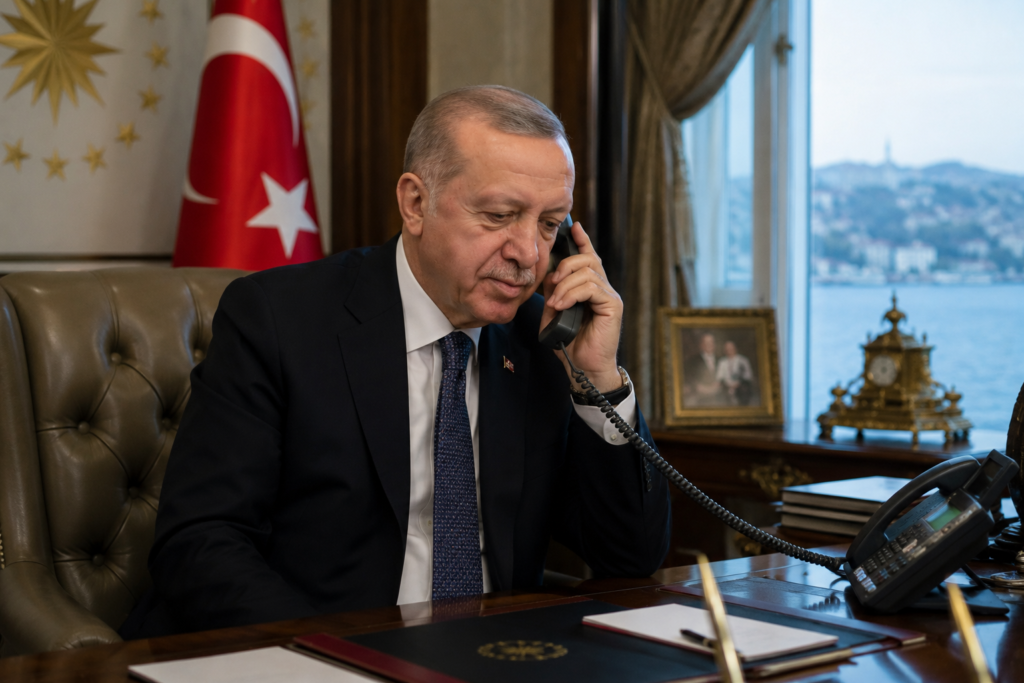
Image Credits: Erdoğan Congratulates New UK Prime Minister Andy Burnham as Türkiye and Britain Seek Deeper Strategic Ties. AI-generated illustration created by Open Chronicle using ChatGPT (OpenAI). August 2026. This image is illustrative and does not depict a real-world scene.
By Open Chronicle with agencies
Turkish President Recep Tayyip Erdoğan has congratulated Britain’s new prime minister, Andy Burnham, during a telephone conversation in which the two leaders pledged to strengthen relations between Türkiye and the United Kingdom, with defence cooperation, trade and investment emerging as key priorities.
The call on Monday, August 17, was the first publicly reported conversation between Erdoğan and Burnham since the British leader took office. According to Türkiye’s Communications Directorate, the two leaders discussed bilateral relations alongside regional and international developments.
Erdoğan told Burnham that he expected relations between Ankara and London to reach a higher level in the coming period, highlighting recent progress in defence and security cooperation as evidence of an increasingly important strategic partnership.
Erdoğan congratulates Burnham
During the conversation, Erdoğan formally congratulated Burnham on becoming Britain’s new prime minister.
The Turkish president expressed confidence that cooperation between the two countries could continue expanding across multiple sectors.
The message signals Ankara’s intention to establish an early working relationship with Britain’s new government rather than allowing the political transition in London to slow the growing bilateral partnership.
For Türkiye, the United Kingdom has become an increasingly important European partner in areas extending from defence procurement to trade and regional diplomacy.
For Britain, Türkiye occupies a strategically important position linking Europe, the Black Sea, the Middle East and the eastern Mediterranean.
Both countries are also members of NATO.
Defence cooperation takes centre stage
Defence was one of the most important subjects highlighted by Erdoğan.
The Turkish president said the two countries had achieved significant progress across their relationship, particularly in the defence industry.
That cooperation has expanded considerably in recent years.
Before Britain’s latest change of government, London and Ankara had already been working on a major agreement involving the Eurofighter Typhoon combat aircraft.
A British government account of an August 2025 conversation between Erdoğan and then prime minister Keir Starmer said the leaders had discussed progress toward an export agreement for UK-built Typhoons for Türkiye.
The relationship therefore gives Burnham’s government an established defence partnership to develop rather than one it must build from the beginning.
Strategic agreements provide the framework
Erdoğan specifically highlighted two documents underpinning the relationship: the Strategic Partnership Framework Document and the Security and Defense Partnership Document.
According to the Turkish Communications Directorate, the president emphasised the importance of both agreements during his conversation with Burnham.
Together, they point toward a relationship extending beyond individual arms contracts.
Security cooperation between London and Ankara has potential relevance to NATO planning, the Black Sea, Ukraine, the Middle East, counterterrorism and defence industrial production.
That wider strategic architecture could become increasingly important as European countries attempt to strengthen their military capabilities while maintaining partnerships with major NATO states outside the European Union.
Türkiye has become an important defence industrial partner
Türkiye’s defence industry has undergone a substantial transformation over the past two decades.
The country now produces a growing range of domestically designed military equipment, including drones, armoured vehicles, missiles, naval platforms and electronic warfare systems.
Its aerospace ambitions have also expanded significantly.
Ankara is developing the KAAN combat aircraft while simultaneously seeking additional Western fighters to modernise the Turkish Air Force.
Britain possesses complementary strengths in aerospace, propulsion, sensors and advanced defence engineering.
That creates opportunities for cooperation extending beyond straightforward buyer and seller relationships.
Joint development, technology partnerships and industrial cooperation could become an increasingly important component of the relationship.
Trade and investment are another priority
Defence was not the only focus of the conversation.
Erdoğan said Türkiye and Britain would continue working to increase bilateral trade and achieve their investment objectives.
Economic relations have particular significance because Britain and Türkiye maintained substantial commercial ties after the UK departed from the European Union.
A deeper economic relationship could include manufacturing, energy, technology, financial services and infrastructure alongside traditional trade.
For Ankara, attracting international investment remains important to its broader economic strategy.
For London, Türkiye represents a large market positioned between several economically and strategically important regions.
The two governments therefore have incentives to deepen economic cooperation regardless of changes in political leadership.
A relationship extending beyond Europe
Türkiye’s importance to British foreign policy also comes from geography.
The country controls access between the Black Sea and the Mediterranean through the Bosporus and Dardanelles.
It borders Syria, Iraq, Iran, Georgia, Armenia, Greece and Bulgaria.
It maintains relationships with Russia and Ukraine while remaining a NATO member.
It is also deeply involved in developments across the Middle East, the Caucasus and the eastern Mediterranean.
This gives Ankara influence over several of the major security questions confronting Europe.
Britain, meanwhile, remains one of NATO’s most significant military powers and a permanent member of the United Nations Security Council.
A close relationship between the two therefore carries implications beyond bilateral trade.
NATO provides the central security connection
Both countries occupy important positions within NATO.
Türkiye possesses one of the alliance’s largest armed forces and controls strategically important territory on NATO’s southeastern flank.
Britain maintains nuclear weapons, advanced air and naval forces, and a significant military presence across Europe.
The security relationship has become more consequential as NATO confronts a more unstable strategic environment.
Russia’s war against Ukraine has transformed European defence planning.
Instability in the Middle East continues to affect European security.
The Black Sea has become a major military theatre.
Drone warfare, missile proliferation and attacks against critical infrastructure are creating additional challenges.
British and Turkish defence cooperation can therefore contribute to a wider allied effort to adapt to those threats.
Ukraine remains an area of shared strategic interest
Türkiye and Britain have each played significant, although different, roles in relation to Ukraine.
Britain has been one of Kyiv’s major military supporters.
Türkiye has maintained relations with both Kyiv and Moscow while supplying Ukraine with military equipment and supporting Ukrainian sovereignty.
Ankara’s control of the Turkish Straits also gives it a particularly important role in Black Sea security.
Türkiye has attempted, at various stages of the war, to serve as an intermediary between Russia and Ukraine.
That combination of NATO membership and diplomatic access to Moscow gives Ankara a distinctive position.
For the new British government, maintaining close communication with Erdoğan could consequently be valuable as European powers continue managing the security consequences of the conflict.
The Middle East adds another layer
The two countries also have substantial interests in the Middle East.
Türkiye is directly affected by developments in Syria and Iraq and has become an important diplomatic actor across the region.
Britain retains significant political, military and economic relationships with Gulf states and other Middle Eastern governments.
Recent British Turkish discussions have already demonstrated this overlap.
In August 2025, Erdoğan and Starmer discussed the humanitarian crisis in Gaza and Iran, with the British government publicly welcoming Türkiye’s role in hosting diplomatic talks concerning Tehran.
The relationship therefore provides London with an important channel to a regional power capable of communicating with actors that Western governments may find more difficult to reach directly.
Burnham inherits an expanding partnership
The significance of Monday’s conversation lies partly in continuity.
Burnham is entering office at a time when British-Turkish relations already possess considerable momentum.
Defence cooperation is expanding.
Strategic and security frameworks are in place.
Trade and investment remain priorities.
Both governments share membership of NATO while maintaining extensive interests across Europe and the Middle East.
Erdoğan’s early contact with the new British prime minister suggests Ankara wants that trajectory to continue.
For Burnham, the relationship offers a partnership with a country whose importance increasingly extends across several of Britain’s major foreign policy challenges.
A pragmatic strategic partnership
Türkiye and Britain do not necessarily agree on every international question.
Their foreign policies emerge from different regional priorities, domestic political systems and economic interests.
Yet the relationship has increasingly been shaped by practical areas where those interests overlap.
Defence is perhaps the clearest example.
Trade provides another.
NATO creates an institutional connection.
Regional crises provide repeated reasons for diplomatic coordination.
The telephone conversation between Erdoğan and Burnham therefore represents more than a routine exchange of congratulations following a change of government.
It signals continuity in a bilateral relationship that has gradually acquired greater strategic importance.
As Britain’s new government begins to define its foreign policy, Ankara is making it clear that it wants Türkiye to remain one of London’s principal security and economic partners beyond the European Union.
Erdoğan’s message to Burnham was consequently straightforward: the foundations have already been established, and Ankara now wants the partnership to go further.