
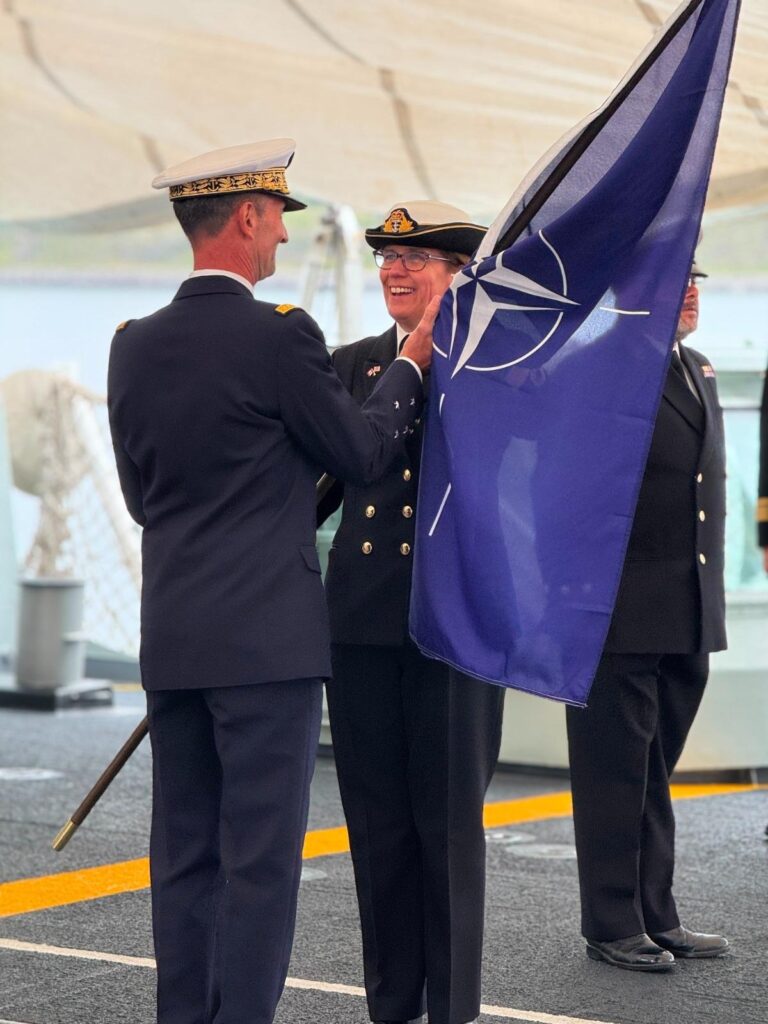
Image: During a ceremony held in Reykjavík, Iceland, the Command of Standing NATO Maritime Group One (SNMG1) was transferred from Royal Navy Commodore Maryla Ingham to French Navy Rear Admiral Nicolas Molitor. (NATO)
By Open Chronicle Defence with agencies
France has assumed command of one of NATO’s principal standing naval formations, taking responsibility for Standing NATO Maritime Group One from the United Kingdom during a formal ceremony in Reykjavík, Iceland.
The command of Standing NATO Maritime Group One, SNMG1, was transferred on August 19 from the British-led battle staff commanded by Royal Navy Commodore Maryla Ingham to a French-led staff under Rear Admiral Nicolas Molitor.
The handover concludes a wide-ranging British command period that saw NATO warships operate from the Baltic Sea and Arctic to the eastern coast of the United States, conducting exercises, maritime security operations, anti-submarine warfare and missions intended to protect critical infrastructure.
France now inherits command at a time when NATO’s northern maritime regions have assumed growing strategic importance, particularly because of Russian military activity, the security of undersea infrastructure and the increasing importance of the Arctic and North Atlantic to Alliance defence.
France assumes command in Iceland
The choice of Reykjavík for the handover carries strategic significance.
Iceland occupies a crucial position in the North Atlantic between continental Europe, Greenland and North America. Its location has historically made it important for monitoring naval movements between the Arctic and Atlantic.
Under Rear Admiral Nicolas Molitor, the French-led command will now take responsibility for maintaining SNMG1’s readiness and coordinating the multinational warships assigned to the group.
Standing naval forces differ from formations assembled temporarily for individual exercises.
They provide NATO with a continuously available maritime capability that can conduct routine patrols and exercises while also responding rapidly to a crisis.
SNMG1 is one of four Standing NATO Naval Forces maintained at high readiness.
Its missions include maritime security, deterrence, reassurance of Allied countries, maintaining freedom of navigation and responding to emerging threats.
Britain concludes a multinational deployment
Although commanded by the Royal Navy, the outgoing battle staff was itself multinational.
Personnel from Belgium, Germany, Poland, Portugal and Spain served alongside British personnel during the deployment.
That arrangement reflects one of the defining characteristics of NATO maritime operations.
Ships from different countries must be able to communicate, manoeuvre, share tactical information and conduct combat operations as a single force despite differences in equipment, language and national procedures.
Repeated deployments and exercises are intended to make that cooperation routine.
Commodore Ingham described leading SNMG1 as a privilege and emphasised the importance of Allied unity.
“Throughout my tenure, we have shown that our strength at sea comes not from any one nation, but from the unity, trust and professionalism that bind us together as Allies,” she said.
Ingham described that solidarity as NATO’s greatest strategic advantage in an increasingly complicated security environment.
Royal Navy commanded from German and Canadian warships
One of the most unusual aspects of the British deployment was the location of its command staff.
Rather than operating exclusively from a Royal Navy vessel, the British led headquarters initially embarked aboard the German frigate FGS Sachsen.
The staff subsequently transferred to the Canadian warship HMCS Ville de Québec.
According to NATO, this represented the first time a Royal Navy-led task group had commanded operations successively from warships belonging to two Allied countries.
The arrangement provides a practical demonstration of interoperability.
A multinational naval headquarters must be able to transfer its personnel, communications and command systems between different platforms while continuing to direct operations.
Doing so aboard German and Canadian vessels also illustrates the degree to which NATO’s maritime forces are intended to function as an integrated fleet rather than separate national formations merely operating alongside one another.
From the Baltic to the Arctic and North America
SNMG1 operated across an exceptionally broad geographical area during the British command period.
The formation deployed in the Baltic Sea, Arctic and High North, North Atlantic and along the eastern seaboard of the United States.
Ships from Belgium, Canada, Denmark, France, Germany, the Netherlands, Norway, Portugal, Spain, Türkiye, the United Kingdom and United States contributed to the task group at different stages.
The geographical scope demonstrates the strategic role assigned to SNMG1.
Its operations connect several increasingly important NATO maritime theatres.
The Baltic has become a central focus following the accession of Finland and Sweden to NATO and growing concern over Russian military activity and critical infrastructure.
The Arctic is becoming strategically more important as military activity and geopolitical competition increase across the High North.
The North Atlantic remains the essential maritime connection between North America and Europe.
In a major European conflict, protecting those routes would be fundamental to moving American and Canadian forces and equipment toward Europe.
Baltic Sentry and protection of critical infrastructure
Among the group’s operational activities was Baltic Sentry, NATO’s effort to strengthen the security of critical infrastructure in the Baltic Sea.
Undersea cables and pipelines have become an increasingly important security concern for European governments.
Modern economies depend heavily on subsea infrastructure carrying electricity, communications and energy.
Damage to such systems can have consequences far beyond the immediate maritime area.
Navies are consequently being asked to perform missions extending beyond traditional fleet warfare.
They must monitor shipping, investigate suspicious activity, maintain maritime awareness and contribute to the protection of infrastructure spread across enormous areas of seabed.
This requires close cooperation between naval forces, intelligence organisations, civilian authorities and commercial operators.
Arctic Sentry reflects growing northern focus
The task group also participated in Arctic Sentry, reflecting NATO’s increasing attention to the High North.
The Arctic has historically been a strategically important military region because it provides the shortest routes between Russia and North America.
Russia’s Northern Fleet and strategic submarine forces make the region particularly significant.
Climate change and evolving patterns of maritime activity are adding further strategic considerations.
For NATO, maintaining awareness across northern waters requires surface ships, submarines, maritime patrol aircraft, satellites and other surveillance systems operating as part of an integrated network.
France’s assumption of SNMG1 command therefore places a French admiral at the head of a formation operating within one of the Alliance’s most consequential maritime environments.
Anti-submarine warfare remains fundamental
The British-led task group also participated in Exercise Dynamic Mongoose, one of NATO’s important anti-submarine warfare exercises.
Finding a modern submarine remains among the most technically demanding tasks in naval warfare.
Submarines can threaten surface warships, merchant shipping and strategic sea lines while remaining extremely difficult to detect.
The North Atlantic and Nordic maritime environment makes anti-submarine warfare especially important because Russian submarines must operate through or near areas monitored by NATO forces when moving between northern bases and the wider Atlantic.
Exercises such as Dynamic Mongoose allow Allied surface ships, submarines and maritime aircraft to practise locating and tracking underwater targets.
The skills involved require extensive training.
Sonar operators, helicopter crews, submarine commanders and surface warfare teams must all exchange information quickly enough to build an accurate picture of what is happening beneath the ocean.
British Wildcat strengthened the group
While the British staff operated from FGS Sachsen, the Royal Navy also contributed a Wildcat HMA2 helicopter from 815 Naval Air Squadron.
The helicopter supported surveillance, reconnaissance and force protection missions.
Naval helicopters significantly extend the reach of surface warships.
They can investigate contacts far beyond the visual horizon, provide surveillance and contribute to anti-surface and anti-submarine operations.
Their sensors allow a task group commander to build a more detailed picture of the surrounding maritime environment.
Operating a British helicopter from within a multinational task group also requires extensive integration between aviation crews, ships and command personnel.
Gunnery, boarding operations and casualty evacuation
The deployment included much more than major multinational exercises.
SNMG1 repeatedly conducted the routine training necessary to ensure its ships could operate together during a crisis.
Activities included manoeuvring exercises, boarding operations, gunnery, anti-submarine warfare, casualty evacuation drills and cross-deck integration.
The task group also trained for the protection of critical national infrastructure.
These operations may appear less dramatic than major naval exercises, but they are essential to maintaining combat readiness.
Ships joining a NATO formation can come from different naval traditions and use different equipment.
Regular training allows crews to establish common procedures before they are required during an actual emergency.
Command links across NATO
The British battle staff also worked with senior commanders elsewhere in NATO’s maritime structure.
Visitors included Commander Task Force Baltic, German Rear Admiral Stephan Haisch, and Royal Navy Fleet Commander Vice Admiral Sir Steve Moorhouse.
The formation also worked closely with US Navy Vice Admiral Douglas Perry, commander of NATO’s Joint Force Command Norfolk.
Norfolk has particular importance because of its responsibility for the North Atlantic and the maritime connection between North America and Europe.
Those relationships demonstrate that SNMG1 is not an isolated naval formation.
Its ships operate within a much larger NATO command network connecting national navies, regional headquarters and Allied Maritime Command.
Why the North Atlantic matters again
During the decades following the Cold War, NATO naval forces frequently concentrated on maritime security, counter-piracy and operations outside the traditional Euro-Atlantic theatre.
Russia’s war against Ukraine has shifted attention back toward collective defence.
The North Atlantic has consequently regained some of the strategic importance it possessed during the Cold War.
If NATO ever needed to reinforce Europe during a major confrontation, enormous quantities of equipment would have to cross the Atlantic.
Aircraft could move rapidly between continents.
Heavy equipment, ammunition, fuel, and supplies would depend heavily on ships.
Protecting those sea lines would become a fundamental military requirement.
Russian submarines and long-range weapons could potentially threaten those routes.
Standing formations such as SNMG1 consequently provide NATO with forces already accustomed to operating together before a crisis begins.
France inherits a demanding mission
France brings substantial naval capabilities to the role.
The French Navy operates nuclear-powered attack and ballistic missile submarines, advanced frigates, maritime patrol aircraft and the nuclear-powered aircraft carrier Charles de Gaulle.
France is also both a nuclear power and one of NATO’s largest European military contributors.
Rear Admiral Molitor’s command will nevertheless remain fundamentally multinational.
The purpose of SNMG1 is not to operate as a French naval formation simply because its commander is French.
France provides the leadership structure, while Allied countries contribute the ships and personnel that create the task group.
Command rotations reinforce the principle that responsibility for NATO’s maritime security is shared across the Alliance.
A visible expression of collective defence
Standing NATO Maritime Group One performs a military mission, but its presence also carries political meaning.
A multinational task group sailing through northern European waters demonstrates that maritime security in the region is not the responsibility of any single country.
A Norwegian, Danish, German, British or Baltic security concern can rapidly involve ships and personnel from across NATO.
That is the maritime expression of collective defence.
Commodore Ingham’s British-led staff demonstrated that principle by commanding from German and Canadian warships while working with personnel and vessels from across Europe and North America.
France now assumes responsibility for maintaining that integration.
The flag at the top of the command structure has changed in Reykjavík, but the underlying mission remains the same.
NATO intends to maintain naval forces permanently available across the Atlantic, Baltic and High North, ready to protect maritime routes, monitor potential threats and respond rapidly if deterrence fails.
As strategic competition returns to Europe’s northern waters, SNMG1 has once again become an important component of the Alliance’s frontline maritime posture.