
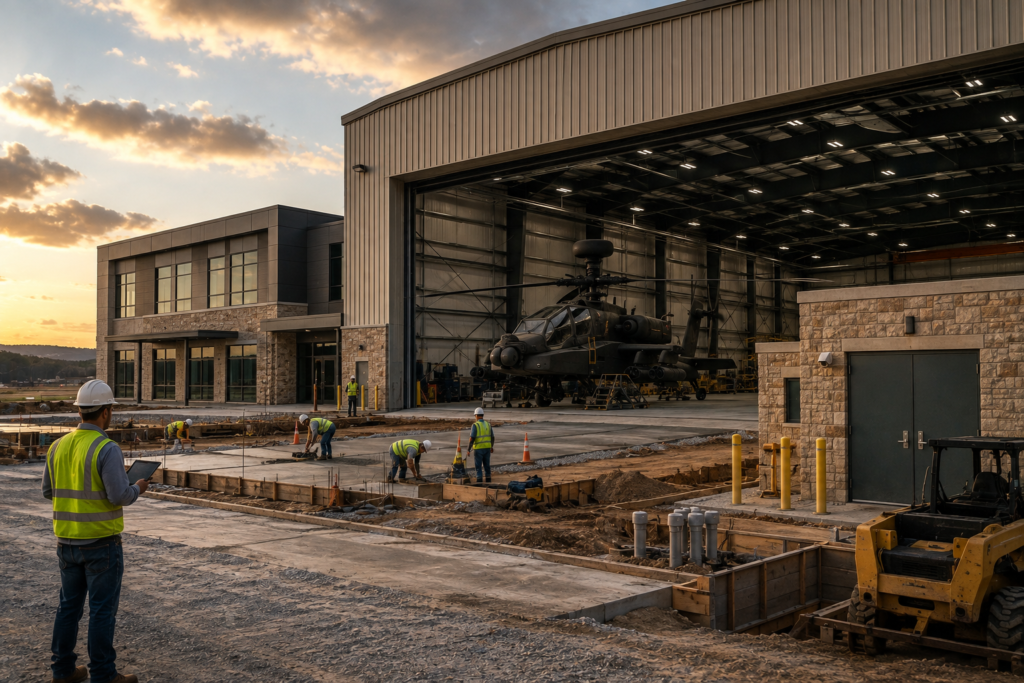
Image Credits: U.S. Army Builds $83 Million Apache Aviation Complex at Fort Riley. AI-generated illustration created by Open Chronicle using ChatGPT (OpenAI). August 2026. This image is illustrative and does not depict a real-world scene.
By Open Chronicle Defence with agencies
The U.S. Army is expanding its attack aviation infrastructure at Fort Riley, Kansas, with construction of a new $83 million complex designed to support Apache attack helicopters, maintenance operations, and the personnel responsible for keeping the aircraft combat-ready.
The U.S. Army Corps of Engineers is overseeing construction of the 119,000-square-foot Attack Aviation Battalion Complex at Marshall Army Airfield. The project is intended to significantly increase the maintenance and aircraft storage capacity available to Fort Riley’s Apache helicopter squadron.
Construction is already well advanced, with approximately 60 to 70 percent of the main building’s structural work completed. The complex is currently scheduled to be finished in August 2027, although modifications to the construction contract could affect that timetable.
New infrastructure for the Apache fleet
The central component of the project is a large maintenance hangar designed around the requirements of Army attack aviation.
Fort Riley’s Apache unit currently operates from an adjacent hangar constructed more than a decade ago. The new facility will provide space for six additional helicopters under normal operating conditions.
Its capacity can also be increased during severe weather, allowing additional aircraft to be moved indoors when necessary.
That flexibility is particularly useful at a base in Kansas, where thunderstorms, hail, strong winds and other severe weather can create risks for aircraft positioned outside.
Protecting helicopters is only part of the mission, however.
The complex is being designed as an integrated operational facility capable of supporting maintenance, administration, weapons storage, security and emergency response.
More than a helicopter hangar
The project includes a two-storey administrative facility connected directly to the maintenance hangar.
Additional infrastructure includes parking areas, support facilities, specialised fire suppression equipment and secure storage areas for weapons and ammunition used by both the helicopter unit and security forces.
Nathan Mccarn, senior construction control representative for the project, described heavily reinforced storage vaults with concrete walls approximately two to three feet thick and double vault doors.
These areas reflect the security requirements associated with operating an armed helicopter unit.
The exterior of the complex will combine concrete masonry construction with split face stone and metal panel reinforcement in selected areas.
The result is intended to provide both durability and the security expected from a modern military aviation facility.
Construction enters major structural phase
The Kansas City District’s Fort Riley Resident Office is leading the project, while Walsh Group serves as the prime contractor.
Construction has reached the structural stage.
According to Bodie Richardson, quality assurance lead for the district’s Kansas Area Office, between 60 and 70 percent of the principal building’s structural work has been completed.
Much of that progress involves the exterior concrete masonry walls. Foundation slabs are already in place, while portions of the steel structure supporting the hangar have also been erected.
As the project advances, additional contractors will install plumbing, electrical infrastructure, telecommunications systems, heating and cooling equipment, insulation, drywall and windows.
Coordinating those different systems is an important part of constructing a modern military aviation facility.
Quality assurance throughout construction
Army Corps of Engineers personnel are conducting continuous inspections as construction progresses.
Quality assurance teams test concrete temperature and air pressure while also examining the moisture and density of soil used to backfill construction areas.
Recent work included inspections ahead of a concrete placement on a second-floor slab and density testing near an underground 30,000-gallon water storage tank.
That tank forms part of the complex’s firefighting infrastructure.
Aviation hangars present particular fire protection challenges because they contain aircraft, fuel-related systems, maintenance equipment and potentially hazardous materials.
Specialised suppression systems are therefore an important component of the overall design.
Richardson explained that virtually every part of the construction process operates within established engineering tolerances.
When something falls outside those specifications, engineers must determine how it will be corrected before work progresses.
Apache maintenance requires substantial infrastructure
The construction project also illustrates the enormous support system behind a modern attack helicopter.
The Boeing AH 64 Apache is one of the most capable attack helicopters in the world, combining sensors, communications, precision weapons and advanced targeting systems.
But keeping those aircraft available for operations requires much more than pilots and helicopters.
Maintainers need protected working areas.
Components require storage and inspection.
Weapons must be secured.
Electronic systems need diagnostic equipment.
Aircraft need access to power and specialised maintenance infrastructure.
Personnel require administrative and planning spaces.
Aviation facilities therefore become an important component of military readiness.
An additional six indoor aircraft positions can provide commanders with substantially more flexibility for maintenance scheduling and fleet management.
Fort Riley’s strategic importance
Fort Riley is one of the U.S. Army’s major installations and is home to the 1st Infantry Division, the “Big Red One.”
Located in northeastern Kansas, the installation supports large-scale training and deployable combat forces.
Marshall Army Airfield provides aviation support to those operations.
Attack helicopters can work closely with ground forces by conducting reconnaissance, providing armed overwatch and engaging enemy armour, vehicles and fortified positions.
Modern Apache units are also increasingly integrated into wider networks involving unmanned aircraft, artillery, intelligence systems and other battlefield sensors.
Infrastructure capable of maintaining those helicopters is therefore part of the Army’s wider effort to sustain combined arms combat power.
The Apache remains central to Army aviation
Despite rapid advances in drones and autonomous systems, the Apache continues to occupy an important position within American land warfare.
Modern variants possess sophisticated sensors that allow crews to identify and engage targets at considerable distances.
The helicopter can carry combinations of Hellfire missiles, Hydra rockets and a 30mm chain gun, depending on mission requirements.
Apaches can also exchange battlefield information with other platforms.
The changing character of warfare, particularly the proliferation of drones, electronic warfare and increasingly dense air defences, is forcing the Army to reconsider how crewed attack helicopters should operate.
That does not necessarily make the Apache obsolete.
Instead, it increases the importance of integrating helicopters with unmanned systems, long-range fires and battlefield intelligence.
Infrastructure is part of military readiness
Military modernisation is often measured by new weapons programmes.
Hangars and maintenance facilities receive considerably less attention.
Yet the effectiveness of a combat aircraft depends heavily on the infrastructure behind it.
A helicopter unavailable because of maintenance problems provides no combat capability regardless of how sophisticated its weapons are.
Purpose-built facilities can improve maintenance efficiency, protect aircraft from weather and provide technicians with the equipment and working environment necessary to return helicopters to service.
The Fort Riley project should therefore be understood as a readiness investment as much as a construction programme.
Army Corps manages major military projects
The Kansas City District has experience managing substantial military and federal infrastructure programmes across the region.
Its previous projects include the General Leonard Wood Army Community Hospital in southern Missouri and the National Geospatial Intelligence Agency’s western campus in St. Louis, which opened in 2025.
The Fort Riley aviation complex represents another major addition to that portfolio.
Military construction projects of this scale involve extensive coordination between engineers, contractors, installation commanders and the units that will ultimately occupy the facilities.
They must also satisfy requirements covering physical security, communications, fire protection, environmental systems and military operations.
Completion targeted for August 2027
The current construction schedule calls for the Attack Aviation Battalion Complex to be completed in August 2027.
That date could change if contract modifications become necessary as construction progresses.
For now, however, the structural work indicates that the project is moving steadily toward the next phases of construction.
Once completed, Fort Riley will gain significantly expanded capacity to house, maintain, and support its Apache helicopters.
The investment comes at a time when the U.S. Army is adapting to a battlefield increasingly shaped by drones, long-range precision weapons, electronic warfare and rapidly evolving reconnaissance systems.
Those technological changes may alter how attack aviation operates, but they do not eliminate one of the oldest realities of military power.
Combat forces require infrastructure.
For Fort Riley’s Apache crews and maintainers, the new $83 million complex will become part of the physical foundation that keeps Army aviation ready to fly.