
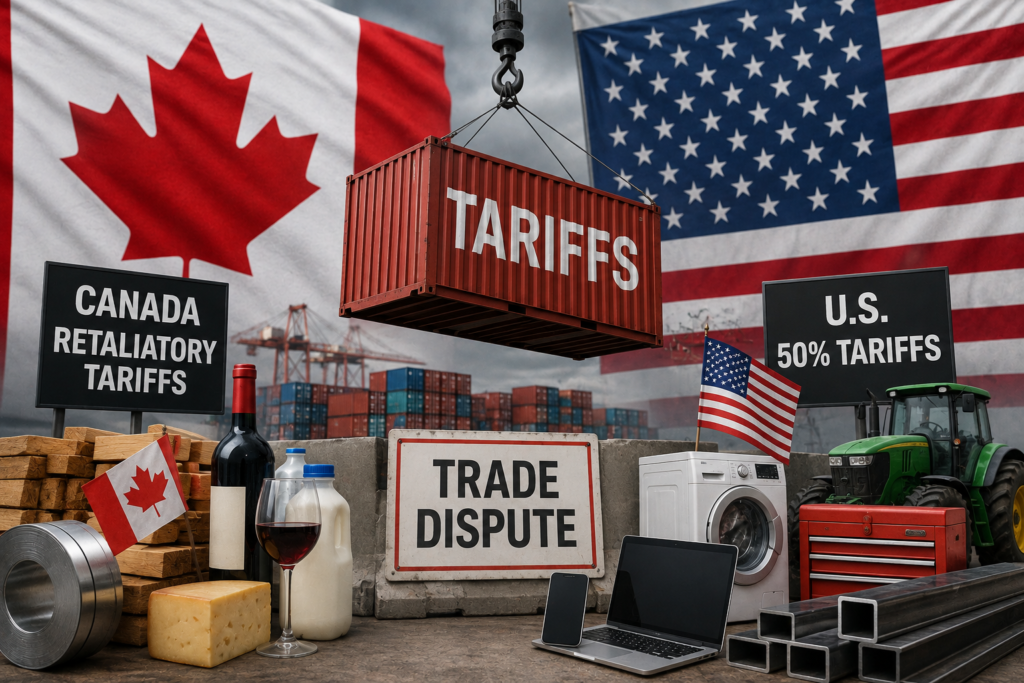
Image Credits: Canada Announces Retaliatory Tariffs as Trade Dispute With Trump Administration Escalates. AI-generated illustration created by Open Chronicle using ChatGPT (OpenAI). August 2026. This image is illustrative and does not depict a real-world scene.
By Open Chronicle with agencies
Canada will impose retaliatory tariffs on a range of American products beginning September 8 after negotiations with the United States failed to prevent President Donald Trump’s new 50 percent tariffs on selected Canadian exports.
Prime Minister Mark Carney announced the countermeasures in Ottawa, saying Canada would match the value of Washington’s new duties “dollar for dollar” as the increasingly serious trade confrontation between the two longtime allies threatens businesses, jobs and the future stability of North American economic integration.
Canadian tariffs will target American products across several strategically important industries, including steel, dairy, household appliances, agricultural equipment, pulp and paper and electronics.
“We cannot accept what they have offered, and we will not give what they have asked,” Carney said.
The Canadian government is expected to publish the detailed list of affected American products over the coming days.
Trump’s 50 percent tariffs take effect
The latest American tariffs took effect at midnight after several days of intensive negotiations failed to produce an agreement.
The measures cover approximately $20 billion in Canadian exports to the United States and affect products including wine, furniture, dairy products, cement, clothing, fishing equipment and hockey gear.
Although the affected trade represents only about five percent of Canada’s total exports to the United States, the impact could be concentrated heavily in particular industries and communities.
One especially significant aspect of the American measures is that the affected products are not exempted simply because they comply with the United States Mexico Canada Agreement, USMCA.
The continental trade agreement has protected most Canadian exports from tariffs during the recent period of trade tensions.
Extending tariffs to products otherwise covered by the USMCA raises broader questions about the future reliability of the agreement.
Canada promises dollar-for-dollar retaliation
Carney said Ottawa had decided that retaliation was necessary to protect Canadian workers and businesses.
“Canada will match Washington’s new tariffs dollar for dollar to protect Canadian workers, farmers, families and businesses,” the prime minister said.
The Canadian response is deliberately spread across several American economic sectors.
Steel will be targeted, along with dairy products, appliances, agricultural machinery, pulp and paper and electronics.
Some of the countermeasures will also affect sectors similar to those Washington has targeted in Canada.
The approach is intended to impose economic costs on the United States while demonstrating that Ottawa will not accept unilateral changes to the bilateral trading relationship without responding.
Negotiations collapsed over last-minute US demands
Trump had indicated that an agreement with Canada remained possible on Friday.
According to Carney, however, new American demands introduced late in the negotiations made a deal unacceptable to Ottawa.
“In recent days, the US proposed new terms that were uneconomic, unfair and undermined the net benefits to Canada, calling into question the reliability of any deal,” Carney said.
Among the demands described by the Canadian prime minister were restrictions that would have limited Canada’s ability to negotiate future trade agreements with other countries.
For Ottawa, accepting such conditions could have implications extending far beyond the immediate tariff dispute.
Canada is seeking to diversify its international trade relationships precisely because of growing uncertainty surrounding access to the American market.
Restrictions on Canada’s ability to negotiate independently with other trading partners would therefore potentially constrain one of Ottawa’s principal responses to US protectionism.
USMCA faces a serious test
The confrontation also creates uncertainty surrounding the future of the USMCA.
The agreement replaced the North American Free Trade Agreement and forms the legal foundation for much of the enormous trade relationship connecting the United States, Canada and Mexico.
Automotive production provides perhaps the clearest example of that integration.
Components can cross national borders multiple times during the manufacturing of a single vehicle.
Agriculture, energy, machinery and other industries have developed similarly interconnected supply chains.
Tariffs consequently do not always affect only the country against which they are imposed.
American companies using Canadian inputs can face higher costs.
Canadian companies relying on American machinery can face similar problems when Ottawa retaliates.
As each side adds new duties, those costs can spread through the continental economy.
Vulnerable Canadian industries face significant risks
Although the new American tariffs affect a relatively limited share of overall Canadian exports, some industries could suffer substantial disruption.
Softwood lumber and wine are among the sectors considered particularly vulnerable.
Companies heavily dependent on American customers may have few alternative markets capable of replacing lost sales quickly.
For smaller businesses, a 50 percent tariff can make products effectively uncompetitive in the US market.
That could result in reduced production, layoffs or business closures if the dispute continues for an extended period.
Carney said the government would announce additional support measures next week for Canadian industries affected by the American tariffs.
Those measures will accompany the retaliatory duties.
Canadian businesses prepare for impact
The Canadian Chamber of Commerce warned companies across the country to prepare for the consequences.
“We will be mobilising our network of businesses in all regions and all sectors to brace for impact and make the best of a bad situation,” CEO Candace Laing said.
The comment reflects growing concern within Canadian industry about the cumulative effects of repeated trade disputes with the United States.
America is by far Canada’s most important trading partner.
The geographical proximity of the two economies and decades of continental economic integration mean Canadian businesses cannot quickly replace the United States with another market.
That gives Washington considerable leverage.
But the dependence runs in both directions in several strategically important industries.
Ontario backs Carney’s decision
Ontario Premier Doug Ford, one of Canada’s most outspoken critics of Trump’s tariff policies, supported the federal government’s decision not to accept Washington’s proposed agreement.
“I’m glad he didn’t sign that deal because it was a bad deal,” Ford said.
“It was a bad deal for Ontario. It was a bad deal for the auto sector, the steel sector and manufacturing sector.”
Ontario has particularly high exposure to US trade because of its enormous automotive and manufacturing industries.
Vehicle manufacturing across Ontario, Michigan and neighbouring US states has evolved into a deeply integrated production system.
A prolonged trade conflict could therefore create substantial disruption on both sides of the border.
Ford has consistently advocated a forceful Canadian response to American tariffs.
Washington says no new talks are planned
The immediate prospects for renewed negotiations appear limited.
US Trade Representative Jamieson Greer said on Saturday that no additional talks with Canada were currently planned.
“We’re moving forward with measures that respond to Canadian retaliation,” Greer told Fox News.
“They’ve always had the best deal, and they still would have an even better deal, but they didn’t want that.”
The statement raises the possibility of another escalation.
If Washington responds to Canadian retaliation with additional tariffs, Ottawa could face pressure to introduce further countermeasures.
Such a cycle can rapidly transform a limited tariff dispute into a broader trade war.
The economic consequences could cross the border
Tariffs are taxes imposed on imported goods, meaning their immediate cost is generally paid by importers rather than foreign governments.
Companies can absorb those costs, reduce purchases from foreign suppliers, or pass some of the increase to consumers.
That means American tariffs on Canadian goods can ultimately raise costs for American companies and consumers purchasing those products.
Canadian retaliation can produce the same effect inside Canada.
Governments imposing tariffs therefore face an important political calculation.
The measures may protect some domestic producers from foreign competition while increasing costs elsewhere in the economy.
The longer a tariff confrontation lasts, the more visible those trade-offs can become.
Canada seeks greater economic independence
The dispute is also likely to accelerate Canada’s attempts to diversify its trade.
Ottawa has increasingly sought stronger economic relationships beyond the United States as repeated tariff disputes demonstrate the risks of excessive dependence on a single market.
Europe and the Indo-Pacific are particularly important to that strategy.
Canada already has a comprehensive trade agreement with the European Union and has pursued deeper commercial relationships with Asian economies.
Infrastructure is another part of the challenge.
Much of Canada’s existing transport and energy network was built around north-south trade with the United States.
Diversifying exports therefore requires not simply signing trade agreements, but expanding ports, railways, pipelines and other infrastructure capable of connecting Canadian production with global markets.
A political dispute between close allies
The economic confrontation is particularly striking because Canada and the United States are not strategic adversaries.
They are NATO allies.
Their militaries cooperate extensively.
They share one of the world’s longest international borders.
Their economies have been integrated for generations.
Canada and the United States also jointly operate the North American Aerospace Defense Command, NORAD, making their defence relationship unusually close.
That makes the increasingly confrontational trade relationship politically significant.
Economic disputes do not automatically undermine military alliances, but sustained conflict can affect public opinion and broader diplomatic trust.
Carney’s comment that the latest US demands raised questions about “the reliability of any deal” suggests the dispute is already extending beyond individual tariff rates.
September 8 becomes the next major deadline
Canada’s retaliatory tariffs are scheduled to begin on September 8.
That leaves a limited period during which either government could potentially return to negotiations.
For now, neither side appears prepared to retreat.
Trump’s administration argues that its tariff strategy protects American industries and strengthens Washington’s negotiating position.
Carney argues that Canada cannot accept economic terms it considers unfair or surrender control over its independent trade policy.
The result is an increasingly serious confrontation between two countries whose economies were built around the assumption that goods could move relatively freely across their shared border.
The immediate dispute concerns approximately $20 billion in Canadian exports.
The larger issue is considerably more important.
If Washington increasingly applies tariffs even to trade previously protected by the USMCA, Canadian policymakers and businesses may have to reconsider how much confidence they can place in the traditional North American economic model.
Canada’s September retaliation therefore represents more than another round of tariffs.
It signals that Ottawa is increasingly prepared to absorb economic costs in order to resist American demands and defend greater control over its trade policy.
Whether that produces another negotiation or another escalation will now depend largely on what Washington does next.