
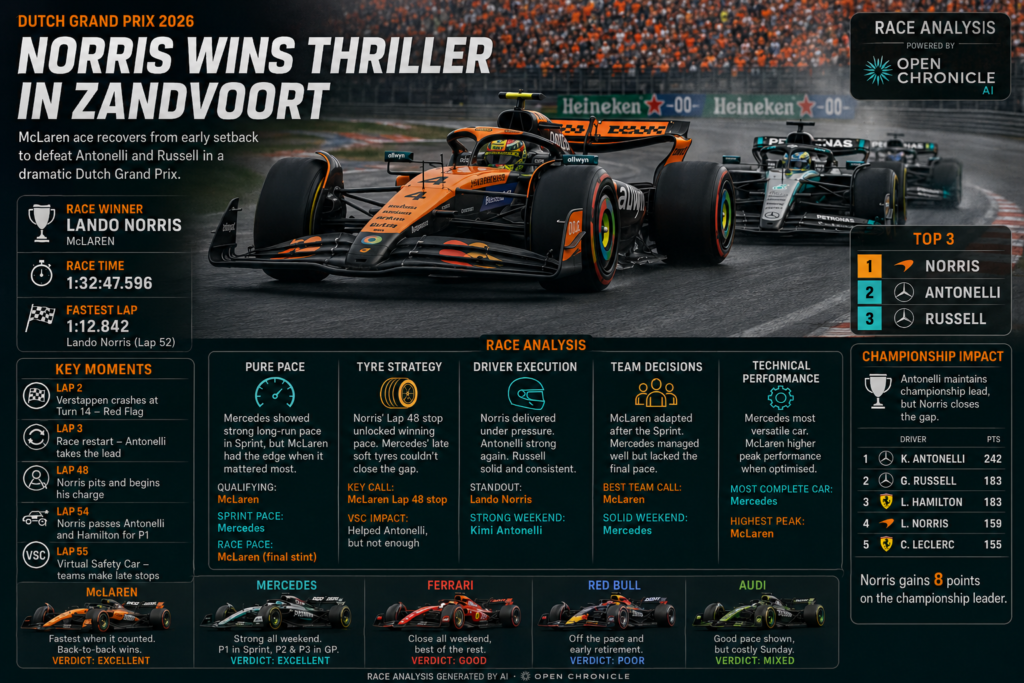
Image Credits: Dutch Grand Prix 2026 Race Analysis: How McLaren Turned Mercedes’ Strength Into a Norris Victory. AI-generated illustration created by Open Chronicle using ChatGPT (OpenAI). August 2026. This image is illustrative and does not depict a real-world scene.
Zandvoort was not decided by one dominant car or a single strategic masterstroke. Mercedes appeared stronger over sustained race running, McLaren held the advantage when outright qualifying performance mattered, Ferrari remained close enough to influence the battle, and rapidly changing conditions repeatedly reset the tactical picture. Lando Norris ultimately won because McLaren combined track position with a decisive late phase in which the world champion produced the pace required to overturn Kimi Antonelli’s advantage.
By Open Chronicle Formula One Magazine
The final classification of the 2026 Dutch Grand Prix says Lando Norris first, Kimi Antonelli second and George Russell third.
That does not explain what happened at Zandvoort.
Across the entire weekend, Mercedes arguably produced the most convincing body of performance. Antonelli led the only practice session. Russell took Sprint pole and controlled the 24 lap Sprint. Mercedes then qualified second and third for the Grand Prix and placed both cars on Sunday’s podium.
Yet McLaren left the Netherlands with the result that mattered most.
Norris produced a 1:11.163 to take Grand Prix pole, just 0.102 seconds ahead of Russell and 0.133 ahead of Antonelli. On Sunday, after the race was interrupted by Max Verstappen’s heavy early accident, Antonelli took the lead following the restart and appeared capable of turning Mercedes’ strong long run performance into another victory. Norris instead recovered the deficit, retook first place during the decisive phase and eventually won by 11.536 seconds.
The Dutch Grand Prix was therefore a race in which the fastest package depended heavily on the phase of the weekend being examined.
For one lap, McLaren had the edge.
Across the Sprint, Mercedes looked stronger.
During the Grand Prix, Mercedes initially appeared to possess the more comfortable race platform.
But when victory was decided, Norris and McLaren had the combination of pace, strategy and execution that mattered.
Pure Pace
McLaren Had the Fastest Car When the Track Was at Its Quickest
The first indication of how closely matched Mercedes and McLaren were came during Friday practice.
Antonelli led with a 1:12.949, Norris was only 0.121 seconds behind and Russell only 0.125 seconds away. Hamilton and Leclerc were also within three tenths, meaning Formula One returned from the summer break with Mercedes, McLaren and Ferrari essentially occupying the same performance window.
Sprint Qualifying initially tilted that balance towards Mercedes.
Russell’s 1:11.567 defeated Norris by only 0.041 seconds, with Leclerc another 0.014 seconds behind the McLaren. Four drivers were separated by less than one tenth.
That was already evidence that there was no dominant package at Zandvoort.
Saturday’s Sprint suggested something slightly different.
Russell controlled the race from pole and managed his tyres extremely well. Norris initially remained within range but began struggling for rear grip as his medium tyres aged. That deterioration allowed Leclerc, running the soft compound, to close and pass the McLaren on lap 18.
Antonelli then finished only three tenths behind Norris despite having spent much of the Sprint in traffic. Mercedes therefore appeared to possess superior sustained pace and tyre consistency.
Had Sunday’s Grand Prix been judged purely from the Sprint evidence, Mercedes would have been the logical favourite.
Then McLaren changed the picture.
McLaren Found Something Before Grand Prix Qualifying
Between the Sprint and qualifying, McLaren adjusted its car.
The improvement was visible immediately.
Norris went on to take pole with the 1:11.163, while Piastri qualified fourth. Mercedes remained extremely close, but the McLaren had gained enough performance through Zandvoort’s single lap demands to reverse the Sprint hierarchy.
Norris later acknowledged that McLaren had struggled particularly with rear grip and slow speed performance in the Sprint, but changes before qualifying improved the car sufficiently for him to attack the decisive lap with confidence.
That distinction matters.
McLaren did not arrive on Friday with an obvious advantage.
It developed one.
The engineering progression from Friday’s Sprint configuration to Saturday afternoon’s qualifying package was one of the most important technical stories of the weekend.
Norris Was Not Simply Winning Through Track Position
Sunday provided the more important evidence.
After Antonelli gained the lead following the red flag restart, Mercedes initially appeared capable of controlling the Grand Prix. The Italian opened a margin and possessed the same underlying long run strength seen during the Sprint.
But Norris’ pace in the final third fundamentally changed the contest.
After his lap 48 stop, he emerged approximately four seconds behind Antonelli.
The gap disappeared astonishingly quickly.
According to the race sequence, Norris gained roughly 1.5 seconds on lap 50 and another 1.6 seconds one lap later.
That was not simply an undercut or a fortunate Safety Car intervention.
That was raw race pace.
Once Norris reached Antonelli, Hamilton’s presence complicated the battle, but the McLaren driver executed the opportunity, passed the Mercedes and then cleared the Ferrari to regain control of the race.
By the chequered flag, Norris was 11.536 seconds ahead of Antonelli.
Pure Pace Verdict
Qualifying advantage: McLaren
Sprint race pace advantage: Mercedes
Grand Prix decisive stint: McLaren and Norris
The more nuanced conclusion is that Mercedes probably possessed the most consistently competitive car across every session, but McLaren produced the highest peak when it was needed most.
That distinction won the race.
Tyre Strategy
Zandvoort created a difficult strategic environment before the race had even begun.
The track remained damp in places, but every driver committed to slick tyres.
Norris, Russell, Antonelli, Piastri, Gasly, Colapinto and Ocon began on mediums. Bottas and Pérez chose hards, while much of the remaining field started on softs.
Those differences could have produced radically different opening stints.
Verstappen’s lap two accident effectively erased much of that initial strategic divergence.
The Early Red Flag Reduced the Value of the Opening Tyre Choice
Verstappen lost the rear of his Red Bull through the damp conditions at Turn 14 and hit the barrier heavily.
The resulting red flag reset the Grand Prix.
This was strategically significant because teams that had attempted to exploit the softer or harder starting compounds no longer enjoyed the same opportunity to create an offset.
The race was transformed from a conventional opening stint into a restart scenario.
Antonelli capitalised immediately and took the lead from Norris after the restart.
From that point onwards, strategy became less about the original tyre choice and more about positioning each driver for the final third.
Mercedes Created the Stronger First Strategic Position
Russell stopped on lap 18 for hard tyres.
Piastri followed one lap later.
Hülkenberg stopped on lap 20.
Antonelli, Norris and Leclerc eventually stopped around lap 22, leaving Hamilton temporarily in the lead.
That sequence placed Mercedes in an advantageous tactical position.
Antonelli retained the effective lead once the cycle settled, while Norris remained close enough to keep McLaren’s options open.
The decisive difference emerged later.
Lap 48 Changed the Race
McLaren stopped Norris on lap 48.
The stop surrendered track position and placed him roughly four seconds behind Antonelli, but it gave Norris the tyre performance required to attack.
This is one of the most important moments of the Grand Prix.
A strategy should not be evaluated simply by whether a driver exits the pits ahead or behind.
The important question is whether the stop places the driver in a faster race state.
Norris emerged behind.
But he emerged fast.
Within only a few laps, he had eliminated Antonelli’s advantage.
McLaren’s decision effectively converted a track position deficit into a tyre performance advantage that Norris was capable of exploiting.
The VSC Gave Mercedes One Final Chance
Esteban Ocon’s retirement triggered a Virtual Safety Car on lap 55.
The neutralisation created another cheap pit window.
Ferrari reacted with Hamilton and Leclerc.
Antonelli stopped on lap 57 and received fresh soft tyres.
Mercedes therefore created what appeared to be the ideal final attack scenario.
Norris remained on hard tyres.
Antonelli had fresh softs.
Approximately 12 seconds separated them.
Russell was positioned between the two Mercedes drivers on track.
Mercedes subsequently inverted its cars to release Antonelli into second and give the championship leader the clearest possible opportunity to attack Norris.
On paper, it was logical.
In practice, it changed nothing.
Why the Soft Tyre Attack Failed
Antonelli never generated the expected closing rate.
Norris responded immediately on the hard compound and stabilised the gap.
With around 14 laps remaining, the margin remained approximately 12.5 seconds.
Several factors probably contributed.
First, Zandvoort is extremely sensitive to track position and turbulent air.
Second, Norris had shown exceptional pace before the VSC and was clearly comfortable on the hard tyre.
Third, the theoretical compound advantage does not automatically translate into a large lap time advantage when the leading driver has tyres operating inside a stable thermal window.
Fourth, Antonelli had already spent much of the race operating at high intensity.
Mercedes’ strategy was therefore defensible.
McLaren simply had enough underlying pace to neutralise it.
Tyre Strategy Verdict
McLaren’s most important call was not necessarily the timing of the final VSC.
It was the decision that created Norris’ decisive charge earlier.
Mercedes reacted correctly to the VSC and gave Antonelli the faster tyre, but by then Norris had already demonstrated that his hard tyre pace was strong enough to protect the lead.
Driver Execution
Norris: The Complete Recovery Drive
Norris’ victory was not a lights to flag demonstration.
That makes it more significant.
He took pole under enormous pressure on Saturday, producing what he described as one of the strongest laps he had driven.
Sunday required a different skill set.
He survived a difficult and unpredictable opening phase.
He remained composed after Antonelli took the lead at the restart.
He managed the strategy.
Then, when McLaren gave him the tyre opportunity, he produced the fastest phase of his race.
The defining characteristic was not one overtaking move.
It was his ability to increase performance precisely when the race required it.
That is championship calibre execution.
Antonelli: Fast, Mature, but Ultimately Beaten on the Decisive Stint
Antonelli’s weekend contained almost every type of challenge.
He led Friday practice.
He damaged the floor during Sprint Qualifying, later explaining that the gravel excursion had left holes in the floor and cost significant performance.
He recovered from fifth to fourth in the Sprint.
He qualified third for the Grand Prix.
Then he attacked at the restart and took the lead.
For much of Sunday, Antonelli looked capable of winning.
The important distinction is that he did not throw the race away.
There was no major mistake that handed Norris victory.
He was simply unable to match the McLaren during the decisive phase.
Second place therefore represents a strong championship performance rather than a failure.
Russell: Excellent Weekend, Slightly Less Convincing Sunday
Russell was arguably the strongest driver on Friday and Saturday morning.
Sprint pole.
Sprint victory.
Exceptional tyre management.
Then second in Grand Prix qualifying, just 0.102 seconds behind Norris.
Sunday was less complete.
Antonelli immediately took position from him, removing Russell from the direct victory battle.
He nevertheless remained competitive enough to secure third and defended successfully against the Ferraris late in the race.
Russell’s final weekend score was substantial even if the Grand Prix never developed into the victory challenge his Sprint performance had suggested.
Hamilton and Leclerc: Ferrari Maximised Its Available Performance
Hamilton and Leclerc finished fourth and fifth.
That accurately represented Ferrari’s position in the Grand Prix hierarchy.
Ferrari was close.
It was rarely far enough away to disappear from Mercedes’ mirrors.
But it did not possess the decisive pace required to control the race.
Leclerc’s Sprint provided the team’s standout moment. Ferrari was one of only two teams to start a driver on soft tyres, and the strategy allowed him to remain competitive long enough to pass Norris for second.
It was an intelligent gamble supported by unexpectedly manageable degradation.
Sunday produced a more conventional Ferrari result.
Leclerc passed Piastri.
Hamilton followed.
Both remained close to Russell late in the race.
But Ferrari could influence the podium battle rather than dictate it.
Verstappen: The Weekend That Never Became His
Verstappen qualified only seventh at his home Grand Prix.
His race lasted little more than a lap.
The Dutchman lost control through the damp section at Turn 14 and hit the barrier, causing the red flag.
There was no strategic recovery available from that point.
Red Bull had already spent much of the weekend outside the Mercedes, McLaren and Ferrari battle, and Verstappen’s retirement turned an underwhelming home weekend into a disastrous one.
Bortoleto: Qualifying Promise Lost on Sunday
Gabriel Bortoleto’s weekend showed both Audi’s improving potential and how quickly Zandvoort can punish a compromised opening phase.
He qualified ninth, reaching Q3 for the second consecutive competitive qualifying session of the weekend.
Sunday immediately became more difficult.
Bortoleto dropped from ninth to the midfield at the start, spun during the damp opening phase and later faced investigation concerning the pit exit signal.
Multiple strategy changes helped him recover positions, but once the early track position had been lost, scoring points became extremely difficult.
He eventually finished 13th.
The contrast with Hülkenberg’s eighth place is important.
Audi had genuine points potential.
Bortoleto simply lost access to it during the opening phase of the race.
Team Decisions
McLaren: Adaptation Was the Key Strength
The strongest aspect of McLaren’s weekend was not that the team arrived with the fastest car.
It did not.
Its strength was adapting.
The Sprint exposed rear grip weakness.
McLaren changed the car before qualifying.
Norris took pole.
Mercedes controlled the early Grand Prix.
McLaren changed the strategic picture.
Norris hunted down Antonelli.
That sequence demonstrates a team operating effectively across engineering and strategy.
McLaren learned from the Sprint instead of merely accepting its limitations.
Mercedes: Almost Everything Was Right
Mercedes should not view Zandvoort as a strategic defeat.
Russell won the Sprint.
Antonelli and Russell finished second and third on Sunday.
The team reacted to the late VSC by putting Antonelli onto soft tyres.
It then moved Russell aside to maximise Antonelli’s chance of catching Norris.
Operationally, that was sensible.
The only problem was that the McLaren was too fast.
Mercedes also leaves the weekend knowing its car worked across dramatically different conditions.
Wet Friday morning.
Dry Sprint Qualifying.
Sprint race.
Qualifying.
Long Grand Prix.
That versatility is extremely important for a championship campaign.
Ferrari: Creative on Saturday, Limited by Track Position on Sunday
Ferrari deserves particular credit for Leclerc’s Sprint strategy.
Choosing softs when almost the entire grid selected mediums looked risky.
It worked.
Leclerc preserved the compound far better than expected and passed Norris for second.
Grand Prix qualifying then placed Ferrari only fifth and sixth.
At Zandvoort, that is a serious limitation.
The circuit rewards track position heavily.
Hamilton and Leclerc both progressed on Sunday, but starting behind McLaren and Mercedes meant Ferrari spent much of the race reacting rather than controlling.
Audi: Genuine Midfield Pace, Uneven Conversion
Audi’s pace throughout the weekend was credible.
Hülkenberg and Bortoleto both appeared inside the top ten during practice.
Bortoleto reached Q3.
Hülkenberg recovered from his Sprint power issue to finish eighth in the Grand Prix.
The concern is reliability.
Hülkenberg lost much of the Sprint because of a power problem.
Bortoleto also reported a possible power concern during Sunday’s race, although Audi initially saw nothing abnormal in its telemetry.
The performance level has clearly improved.
The next requirement is converting that performance consistently.
Technical Performance
Mercedes: The Most Versatile Package
If one car had to be selected as the most complete across the entire Zandvoort weekend, Mercedes has the strongest argument.
Antonelli was fastest in practice.
Russell took Sprint pole.
Russell won the Sprint.
The pair qualified second and third for the Grand Prix.
Both finished on Sunday’s podium.
That is outstanding operating range.
The car demonstrated strong tyre management and particularly convincing long run consistency.
Antonelli’s Sprint Qualifying problems were also revealing.
His gravel excursion damaged the floor enough to create visible performance loss, yet the underlying package remained competitive once repaired.
McLaren: More Sensitive, Higher Peak
McLaren looked less comfortable during the Sprint.
Norris specifically struggled with rear grip as the mediums aged, and the car appeared less convincing in slow speed sections.
The response was impressive.
Setup changes transformed the car into the Grand Prix pole sitter.
Sunday then demonstrated that McLaren had retained enough tyre performance for Norris to attack aggressively late in the race.
The MCL40 therefore looked slightly more sensitive than Mercedes around Zandvoort, but when placed inside its preferred operating window, its ultimate performance was exceptional.
Ferrari: Competitive but Still Missing the Final Margin
Ferrari brought development to Zandvoort and remained close throughout the weekend.
Hamilton and Leclerc were fourth and fifth in sole practice.
Leclerc finished second in the Sprint.
The two Ferraris qualified fifth and sixth.
They finished fourth and fifth on Sunday.
The consistency is notable.
The missing element is peak performance.
Ferrari could pressure the leaders.
It could exploit tyre strategy.
It could overtake Piastri.
But it could not produce the lap time necessary to control qualifying or the sustained pace required to win the Grand Prix.
Red Bull: Zandvoort Exposed a Performance Deficit
The most striking technical story at Red Bull was not Verstappen’s accident.
It was the performance before it.
Verstappen was only 11th in practice.
He qualified sixth for the Sprint and seventh for the Grand Prix.
Lawson qualified eighth.
The car simply did not appear to possess the peak performance of Mercedes, McLaren or Ferrari.
Verstappen’s crash prevented a proper assessment of Sunday’s race pace, but nothing earlier in the weekend suggested Red Bull possessed a victory capable package.
Championship Impact
This is where the Dutch Grand Prix becomes particularly interesting.
Antonelli leaves Zandvoort still comfortably ahead.
The official standings after the race show:
| Pos. | Driver | Points |
|---|---|---|
| 1 | Kimi Antonelli | 242 |
| 2 | George Russell | 183 |
| 3 | Lewis Hamilton | 183 |
| 4 | Lando Norris | 159 |
| 5 | Charles Leclerc | 155 |
Antonelli therefore holds a 59 point advantage over Russell, with Hamilton level on points with the Mercedes driver. Norris is fourth, 83 points behind the championship leader.
Russell Did Not Actually Reduce Antonelli’s Weekend Advantage
The Sprint created the impression that Russell was cutting into Antonelli’s championship lead.
He was.
For one day.
Russell scored eight Sprint points.
Antonelli scored five.
Russell gained three.
Sunday reversed exactly that difference.
Antonelli scored 18 points for second.
Russell scored 15 for third.
Across the complete Zandvoort weekend:
Antonelli: 23 points
Russell: 23 points
The championship gap between the Mercedes teammates therefore ended exactly where it began.
That is an important analytical distinction.
Russell won the Sprint battle.
Antonelli neutralised the championship consequence on Sunday.
Norris Was the Biggest Championship Winner
Norris scored six points in the Sprint and 25 for the Grand Prix victory.
31 points across the weekend.
Antonelli scored 23.
Norris therefore gained eight points on the championship leader at Zandvoort.
His deficit remains substantial, but two consecutive Grand Prix victories have fundamentally changed his trajectory.
Before the summer break, Hungary gave McLaren its first Grand Prix victory of the season.
Zandvoort proved it was not an isolated result.
Momentum is now moving towards McLaren.
Antonelli’s Bigger Concern Comes Next
Antonelli’s second place was exactly the type of result required from a championship leader.
There is, however, another strategic complication ahead.
Mercedes has confirmed that Antonelli is expected to take a significant grid penalty at the Italian Grand Prix after exceeding his permitted power unit allocation.
That makes his Zandvoort result even more valuable.
The championship leader leaves the Netherlands with a 59 point cushion over his nearest rivals before entering a home race where his starting position is expected to be compromised.
What Really Decided the Dutch Grand Prix?
The temptation is to say strategy.
That is only partially correct.
The decisive factor was the interaction between strategy and usable pace.
McLaren gave Norris the opportunity.
Norris supplied the lap time.
Had Norris emerged four seconds behind Antonelli and remained there, McLaren’s lap 48 decision would have looked ordinary.
Instead, he removed more than three seconds in approximately two laps.
From that moment, the race changed.
Mercedes responded logically with soft tyres during the later VSC.
But strategic flexibility means little when the leading car can match the pursuing car’s pace on the supposedly slower compound.
That is why Norris won.
Open Chronicle Race Analysis Verdict
Pure Pace
Advantage: McLaren at peak performance, Mercedes across the complete weekend
Mercedes was the more consistently fast package. McLaren produced the fastest qualifying lap and the strongest decisive Grand Prix stint.
Tyre Strategy
Advantage: McLaren
The late middle race stop gave Norris exactly the performance offset he needed. Mercedes’ subsequent soft tyre gamble was logical but ineffective.
Driver Execution
Advantage: Lando Norris
Pole position, patience when the race moved away from him and devastating pace when the opportunity appeared.
Team Decisions
Advantage: McLaren
The engineering response after the Sprint and the strategic execution on Sunday were decisive.
Technical Performance
Advantage: Mercedes for versatility
Mercedes was competitive in virtually every condition and session. McLaren’s operating window appeared narrower, but its ceiling was higher when optimised.
Championship Impact
Biggest winner: Lando Norris
Antonelli remains firmly in control of the standings, while Russell leaves with the same championship deficit with which he entered the weekend. Norris gained eight points on Antonelli and leaves Europe with consecutive victories.
The Bigger Picture
Zandvoort may prove more important than a single McLaren victory.
Mercedes remains the championship benchmark.
Antonelli continues to lead comfortably.
Russell remains consistently dangerous.
Ferrari is close enough to punish mistakes.
But McLaren has now won Hungary and the Netherlands consecutively.
That changes the competitive narrative.
Before Hungary, the question was whether McLaren could turn isolated flashes of pace into victories.
After Zandvoort, the question is different.
How many more races can Norris win before Mercedes finds an answer?
The Dutch Grand Prix demonstrated that outright speed alone no longer defines the competitive hierarchy.
Mercedes may possess the most complete package.
Ferrari may remain within striking distance.
Antonelli may still control the championship.
But in the final phase at Zandvoort, when strategy, tyre performance, driver execution and pressure all converged, the fastest combination was Lando Norris and McLaren.
And that is ultimately why they won.