
By Open Chronicle History Desk
On August 23, 1939, representatives of Nazi Germany and the Soviet Union signed one of the most extraordinary and consequential diplomatic agreements of the twentieth century.
The two regimes appeared to be ideological enemies.
Adolf Hitler had built the Nazi movement around militant anti communism, racial ideology and the destruction of what he called “Judeo Bolshevism.” Joseph Stalin presided over the world’s largest Communist state, whose propaganda portrayed fascism as a mortal enemy of socialism.
Yet in Moscow that evening, German Foreign Minister Joachim von Ribbentrop and Soviet Foreign Minister Vyacheslav Molotov, with Stalin present, signed the German Soviet Non Aggression Pact, better known as the Molotov Ribbentrop Pact.
Publicly, Germany and the Soviet Union promised not to attack one another.
Secretly, they went much further.
A confidential protocol divided much of Eastern Europe into German and Soviet spheres of influence.
Poland stood at the centre of the arrangement.
Within nine days, Germany invaded Poland from the west.
Sixteen days after that, Soviet forces entered Poland from the east.
Britain and France declared war on Germany, and Europe descended into the Second World War.
The pact of August 23 did not by itself cause the war. Hitler had already decided to destroy the existing European order through expansion and conquest.
But the agreement transformed the strategic situation.
It removed Hitler’s immediate fear of fighting the Soviet Union while attacking Poland, gave Stalin an opportunity to expand Soviet influence westward and effectively condemned several countries caught between the two dictatorships to invasion, occupation and partition.
For nearly two years, Nazi Germany and the Soviet Union would maintain a remarkable and deeply uneasy relationship.
Then, on June 22, 1941, Hitler shattered the agreement by launching Operation Barbarossa, the largest invasion in military history.
Two Ideological Enemies
The agreement seemed astonishing because Nazism and Soviet communism had spent years defining themselves partly through opposition to each other.
Hitler’s hostility toward Marxism stretched back to the beginnings of his political career.
In Mein Kampf, he described the Soviet territories to Germany’s east as the principal arena for future German expansion.
The Nazi concept of Lebensraum, or living space, envisaged German conquest and colonisation across Eastern Europe.
That expansion would ultimately require war against the Soviet Union.
The Nazis also presented communism through a racial and antisemitic conspiracy theory that associated Bolshevism with Jews.
Stalin’s Soviet Union, meanwhile, regarded Nazi Germany as a major threat.
After Hitler came to power in 1933, German communists were arrested, imprisoned and driven underground.
Relations between Berlin and Moscow deteriorated dramatically.
During the Spanish Civil War, Germany supported Francisco Franco’s Nationalist forces while the Soviet Union supported the Spanish Republic.
German and Soviet weapons, aircraft and advisers were already appearing on opposing sides of a European conflict.
Yet ideology was about to collide with strategic necessity.
Hitler Dismantles the European Order
By 1939, Hitler had already transformed the political map of Europe.
Germany remilitarised the Rhineland in 1936.
In March 1938, Austria was absorbed into Nazi Germany through the Anschluss.
Later that year, Hitler demanded the Sudetenland, the predominantly German speaking border regions of Czechoslovakia.
Britain and France attempted to avoid another European war.
At the Munich Conference in September 1938, they accepted the transfer of the Sudetenland to Germany without Czechoslovakia participating directly in the decision.
British Prime Minister Neville Chamberlain returned from Munich hoping the settlement had preserved peace.
It had not.
In March 1939, German forces occupied Prague.
The Czech lands became the Protectorate of Bohemia and Moravia, while Slovakia emerged as a German dependent state.
Hitler had demonstrated that his ambitions extended beyond simply incorporating ethnic Germans into the Reich.
Poland was next.
The Polish Question
Germany demanded the return of the Free City of Danzig, today Gdańsk, and sought transportation links across the Polish Corridor connecting Germany with East Prussia.
Poland refused to accept demands that threatened its sovereignty.
Britain and France now recognised that another concession might simply encourage further German expansion.
On March 31, 1939, Britain guaranteed Polish independence.
France was already allied with Poland.
If Hitler invaded, he risked war with both Western powers.
But another strategic problem concerned him even more.
Germany had experienced the dangers of a two front war during the First World War.
If Germany attacked Poland and the Soviet Union intervened from the east while Britain and France attacked from the west, Hitler could face precisely the strategic nightmare German planners wanted to avoid.
Neutralising the Soviet Union became essential.
Stalin’s Dilemma
Stalin faced his own strategic problem.
The Soviet Union distrusted Nazi Germany, but it also distrusted Britain and France.
Moscow had attempted during the 1930s to promote a policy of collective security against fascist aggression.
The Soviet Union joined the League of Nations in 1934.
It concluded agreements with France and Czechoslovakia.
But Soviet leaders increasingly questioned whether the Western democracies were genuinely prepared to confront Hitler.
The Munich Agreement intensified those suspicions.
The Soviet Union had not been invited to the conference.
From Moscow’s perspective, Britain and France had permitted Germany to dismantle Czechoslovakia, a country with which the Soviet Union had maintained security arrangements.
Stalin could interpret Munich as evidence that Western governments might prefer to redirect German expansion eastward.
The Soviet leader therefore began considering alternatives.
The Failure of Collective Security
During the spring and summer of 1939, Britain, France and the Soviet Union negotiated over a possible military alliance against Germany.
The negotiations progressed slowly.
There were profound disagreements.
One central problem concerned Poland and Romania.
If Germany attacked either country, Soviet forces might need to cross their territory to fight the Wehrmacht.
The Polish government strongly opposed allowing the Red Army onto Polish soil.
That fear had deep historical roots.
Poland had regained independence only in 1918 after more than a century of partition among Russia, Prussia and Austria.
Poland and Soviet Russia had then fought a major war between 1919 and 1921.
Warsaw therefore feared both Nazi Germany and the Soviet Union.
Negotiations with Moscow continued, but mutual suspicion prevented a decisive agreement.
Meanwhile, Germany opened its own channel to Stalin.
Stalin Changes Foreign Ministers
An important signal came in May 1939.
Soviet Foreign Minister Maxim Litvinov was removed from office.
Litvinov had been closely associated with collective security and cooperation with the Western democracies.
He was replaced by Vyacheslav Molotov, one of Stalin’s most trusted associates.
The change did not automatically mean that an agreement with Germany was inevitable.
But it gave Stalin greater flexibility.
German Soviet economic discussions accelerated.
Then political negotiations followed.
Hitler wanted an agreement quickly.
His timetable for war against Poland was approaching.
Ribbentrop Flies to Moscow
On August 21, Hitler personally wrote to Stalin urging him to receive Ribbentrop.
Stalin agreed.
The speed of events was extraordinary.
On August 23, Joachim von Ribbentrop flew to Moscow.
That evening, negotiations took place inside the Kremlin.
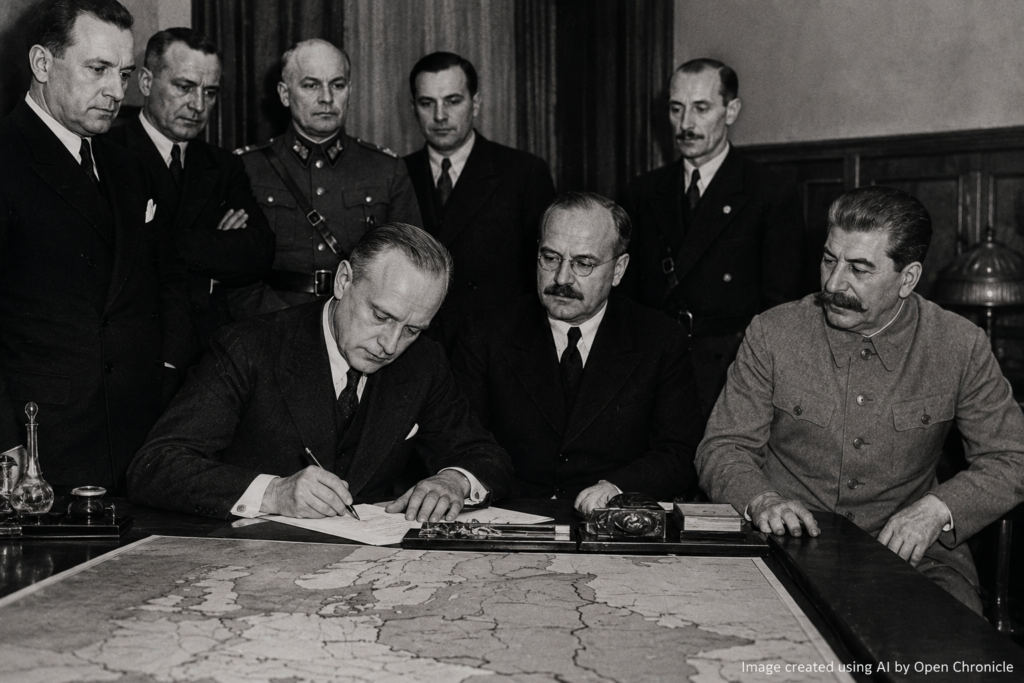
Photographs from the meeting captured one of history’s strangest diplomatic scenes.
Stalin smiled alongside representatives of Nazi Germany.
Ribbentrop spoke with Soviet leaders whose political system his own government publicly despised.
Glasses were raised.
Toasts were exchanged.
The ideological gulf had not disappeared.
For the moment, strategic interests mattered more.
Before the night ended, the agreement had been signed.
The Public Pact
The published agreement was relatively straightforward.
Germany and the Soviet Union promised not to attack one another.
If either became involved in conflict with a third power, the other would not support that power.
The two governments agreed to consult on matters of common interest and resolve disputes peacefully.
The agreement was intended to last ten years.
To the outside world, the announcement was shocking.
Governments across Europe immediately understood the strategic implications.
Hitler had apparently neutralised the Soviet Union.
But the most consequential part of the agreement was not made public.
The Secret Protocol
Attached to the pact was a secret additional protocol.
It divided territories between Germany and the Soviet Union into respective spheres of influence.
Finland, Estonia and Latvia were assigned to the Soviet sphere.
Lithuania was initially largely associated with the German sphere, although subsequent agreements altered the arrangement.
The Soviet Union also asserted its interest in Bessarabia, then part of Romania.
Most importantly, the two powers discussed the partition of Poland.
The secret protocol established a line separating German and Soviet spheres through Polish territory.
This was not simply an agreement to remain neutral.
It was a geopolitical arrangement between two authoritarian powers concerning countries that had not consented to having their futures negotiated.
Millions of people were being assigned to potential occupation without knowing that the agreement existed.
Poland Between Hitler and Stalin
Poland’s geographical position had long made it vulnerable to the ambitions of neighbouring powers.
During the late eighteenth century, Russia, Prussia and Austria had partitioned the Polish Lithuanian Commonwealth until Poland disappeared from the European map.
Independent Poland returned after the First World War.
Only twenty one years later, another partition was being secretly prepared.
Hitler’s immediate objective was military.
The pact meant he could invade Poland without expecting Soviet military intervention against Germany.
Stalin’s calculations were different.
The agreement offered the Soviet Union territorial opportunities and time.
The Soviet military had been badly affected by Stalin’s purges of the officer corps.
Delaying direct war with Germany could therefore appear strategically valuable.
Stalin may also have expected Germany and the Western powers to exhaust one another in a prolonged conflict.
Neither dictator trusted the other.
Each believed the agreement served his own purposes.
Hitler Gives the Order
Hitler had already been preparing for war.
The German invasion of Poland was initially scheduled for August 26.
The agreement with Stalin removed a major obstacle.
But one development briefly complicated Hitler’s calculations.
Britain strengthened its commitment to Poland by signing the Anglo Polish Agreement of Mutual Assistance on August 25.
Hitler temporarily postponed the attack.
Diplomatic manoeuvring continued for several more days.
There would be no settlement.
The invasion was rescheduled for September 1.
September 1, 1939
Before dawn on September 1, German forces crossed the Polish frontier.
The battleship Schleswig Holstein opened fire on the Polish military depot at Westerplatte near Danzig.
German aircraft attacked targets across Poland.
Armoured and mechanised formations advanced rapidly.
The Second World War in Europe had begun.
Hitler hoped Britain and France might once again avoid war.
This time they did not.
On September 3, Britain declared war on Germany.
France followed.
The conflict Hitler had sought to localise had become a European war.
But Poland was still fighting alone on the ground.
Then came the second invasion.
September 17: The Soviet Union Invades Poland
On September 17, 1939, the Red Army crossed Poland’s eastern frontier.
The Soviet government claimed that the Polish state had effectively ceased to exist and that Soviet intervention was necessary to protect Ukrainians and Belarusians living in eastern Poland.
The secret agreement with Germany revealed the broader geopolitical context.
Poland was now being invaded from both directions.
Its military position became hopeless.
German and Soviet forces eventually met along the agreed zones of occupation.
At Brest Litovsk, German and Soviet troops participated in a ceremonial transfer of control that has often been described as a joint parade, although historians debate the precise character of the event.
The larger reality was unmistakable.
Poland had been partitioned.
Again.
A Country Divided
Germany occupied western and central Polish territories.
Some regions were directly annexed to the Reich.
Other areas became the General Government, administered under brutal German occupation.
The Soviet Union absorbed large territories in eastern Poland.
Both occupying regimes carried out repression.
But their ideological objectives and methods differed.
Nazi Germany launched policies of racial domination, mass murder, forced labour and eventually systematic genocide.
Polish Jews were confined in ghettos before the implementation of the Holocaust.
Polish political, intellectual and cultural elites were targeted.
The Soviet authorities arrested, deported and executed people regarded as potential enemies of Soviet power.
Hundreds of thousands of Polish citizens were deported into the Soviet interior.
One atrocity became particularly symbolic.
Katyn
In the spring of 1940, Soviet security forces executed thousands of Polish military officers, police, officials and members of the intelligentsia.
The killings occurred at several locations.
The best known was the Katyn Forest near Smolensk.
For decades, the Soviet government denied responsibility and blamed Nazi Germany.
Only in 1990 did Moscow formally acknowledge Soviet responsibility.
Katyn became one of the most powerful symbols of the suffering Poland experienced under Soviet occupation.
The Molotov Ribbentrop Pact had not merely altered diplomatic alignments.
For millions of people, its secret clauses had immediate human consequences.
The Baltic States
The secret protocol also transformed the fate of Estonia, Latvia and Lithuania.
Under pressure from Moscow, the Baltic states were forced to accept Soviet military bases during the autumn of 1939.
In June 1940, as Germany’s victories in Western Europe distracted international attention, the Soviet Union occupied the three countries.
New governments controlled by Moscow were installed.
Estonia, Latvia and Lithuania were subsequently incorporated into the Soviet Union.
Arrests, executions and deportations followed.
Thousands were sent to prisons and labour camps.
The Baltic states would not recover internationally recognised independence until the collapse of the Soviet Union in 1991.
The memory of the 1939 pact therefore remained central to their twentieth century histories.
Finland Refuses
Finland was also placed within the Soviet sphere of influence.
But unlike the Baltic states, Finland refused Soviet territorial demands.
On November 30, 1939, the Soviet Union invaded.
The Winter War began.
The Red Army possessed overwhelming numerical superiority.
Yet Finnish forces mounted an extraordinary defence, exploiting terrain, winter conditions and mobility.
Soviet casualties were enormous.
Finland eventually accepted peace in March 1940 and surrendered territory to the Soviet Union.
But it preserved its independence.
The unexpectedly poor performance of the Red Army was closely observed in Berlin.
Hitler would later underestimate Soviet military capabilities partly because of what he believed the Winter War had revealed.
Bessarabia
The secret protocol also acknowledged Soviet interest in Bessarabia.
In June 1940, Moscow issued an ultimatum to Romania.
Romania surrendered Bessarabia and Northern Bukovina to the Soviet Union.
The territorial loss destabilised Romanian politics and contributed to the country’s subsequent alignment with Nazi Germany.
Once again, the secret arrangements of August 1939 were reshaping borders far beyond Poland.
Germany and the Soviet Union Become Economic Partners
The relationship between Berlin and Moscow was not limited to territorial arrangements.
The two countries developed substantial economic cooperation.
Germany needed raw materials.
The Soviet Union supplied grain, oil, phosphates, manganese and other resources.
Germany provided machinery, industrial equipment and technology.
This trade became strategically important because Britain had imposed a naval blockade against Germany.
Soviet resources therefore helped Germany mitigate some effects of that blockade.
The contradiction was extraordinary.
Hitler was preparing ultimately to invade the Soviet Union.
Meanwhile, Soviet trains were delivering resources that supported the German war economy.
Stalin’s Calculation
Why did Stalin sign?
The question remains central to historical debate.
One explanation emphasises time.
Stalin knew the Soviet armed forces had been weakened by purges and believed delaying war with Germany was essential.
Another emphasises territorial security.
Moving Soviet borders westward created additional strategic depth between Germany and the Soviet heartland.
Another interpretation focuses on Stalin’s distrust of Britain and France.
After Munich and the failed negotiations of 1939, he may have concluded that cooperation with the Western democracies offered fewer immediate benefits than an agreement with Hitler.
There was also an opportunity to recover territories once associated with the Russian Empire.
The pact offered expansion without immediate war against Germany.
But the strategic success would prove temporary.
The additional territory gained in 1939 and 1940 did create geographic depth.
At the same time, Stalin’s confidence in the agreement contributed to catastrophic miscalculations when Hitler eventually attacked.
Hitler Never Abandoned His Eastern War
For Hitler, the pact was always tactical.
His ideological goals remained unchanged.
He wanted to destroy the Soviet Union.
He wanted German control over vast territories in Eastern Europe.
He wanted to eliminate what Nazi ideology regarded as the racial and political enemies of the Reich.
After Germany defeated Poland, Denmark, Norway, the Netherlands, Belgium and France, Hitler’s attention increasingly returned eastward.
Britain remained at war.
But Hitler believed the Soviet Union could be defeated rapidly.
In December 1940, he issued Directive No. 21.
The codename was Operation Barbarossa.
Germany was preparing to invade its supposed partner.
Warning Signs
During the first half of 1941, enormous German forces moved eastward.
Intelligence warnings reached Moscow from multiple sources.
Britain warned Stalin.
Soviet intelligence officers reported German preparations.
Military deployments became increasingly difficult to conceal.
Yet Stalin remained reluctant to believe that Hitler would attack while Britain was still undefeated.
He feared provocations might be designed to trigger a premature Soviet German war.
The non aggression pact had bought the Soviet Union time.
Now Stalin’s confidence that Hitler would continue respecting it, at least temporarily, became dangerous.
June 22, 1941
At approximately 3:15 in the morning on June 22, 1941, German forces attacked the Soviet Union.
Operation Barbarossa had begun.
More than three million Axis troops eventually participated in the invasion.
The Molotov Ribbentrop Pact was dead.
German forces achieved enormous initial victories.
Millions of Soviet soldiers were killed or captured during the opening months.
Entire Soviet armies were surrounded.
The Wehrmacht advanced toward Leningrad, Moscow and Ukraine.
But the Soviet Union did not collapse.
The conflict became the largest and bloodiest theatre of the Second World War.
Germany and the Soviet Union, partners of convenience in August 1939, were now locked in a war of annihilation.
The Pact Becomes a Political Problem
After Germany invaded the Soviet Union, Moscow joined the Allied coalition.
Public discussion of the secret protocol became politically inconvenient.
The Soviet government denied for decades that the secret agreement dividing Eastern Europe had existed.
Western copies of the documents became known after the war.
Soviet authorities dismissed them as falsifications.
Inside the USSR, challenging the official narrative was extremely difficult.
But in the Baltic states especially, the memory of the pact remained politically explosive.
That memory would return dramatically half a century after it was signed.
The Baltic Way
On August 23, 1989, exactly fifty years after the Molotov Ribbentrop Pact, approximately two million people joined hands across Estonia, Latvia and Lithuania.
They formed a human chain stretching roughly 600 kilometres from Tallinn through Riga to Vilnius.
The demonstration became known as the Baltic Way.
Participants demanded recognition of the historical consequences of the 1939 pact and greater national freedom.
The symbolism was extraordinary.
An agreement secretly dividing Eastern Europe had been signed in Moscow fifty years earlier.
Now millions of people living in territories affected by that agreement were publicly rejecting its legacy.
Within two years, all three Baltic states restored their independence.
Soviet Recognition of the Secret Protocol
During Mikhail Gorbachev’s period of glasnost, Soviet society became increasingly willing to confront previously suppressed episodes of history.
In December 1989, the Congress of People’s Deputies of the Soviet Union formally condemned the secret protocols and declared them legally invalid from the moment they were signed.
It was a major acknowledgement.
For decades, Soviet authorities had denied their existence.
Now the Soviet state itself recognised that the secret agreement had violated the sovereignty of other countries.
Less than two years later, the Soviet Union ceased to exist.
Was the Pact an Alliance?
The Molotov Ribbentrop Pact is sometimes described simply as an alliance between Hitler and Stalin.
The reality requires more precision.
Germany and the Soviet Union did not establish a conventional ideological or military alliance comparable to the Axis partnership between Germany and Italy.
They remained deeply suspicious of one another.
Their ultimate strategic objectives were incompatible.
But describing the relationship merely as neutrality is equally misleading.
The two governments coordinated spheres of influence.
They partitioned Poland.
They conducted substantial economic trade.
Additional agreements adjusted territorial arrangements.
For nearly two years, each dictatorship benefited strategically from the temporary cooperation of the other.
It was a partnership of convenience between regimes that expected eventually to become enemies.
The Debate Over Responsibility for the War
The pact occupies an important place in modern debates about the origins of the Second World War.
Nazi Germany bears primary responsibility for launching the European war through its invasion of Poland and for the broader expansionist project that drove Hitler’s foreign policy.
The Soviet Union did not order Germany to invade Poland.
But Stalin’s agreement with Hitler fundamentally altered the strategic environment in which the invasion occurred.
The secret protocol enabled the partition of sovereign states and gave both dictatorships freedom to pursue territorial expansion within agreed spheres.
Understanding this distinction matters.
History becomes distorted when the actions of different regimes are treated as identical.
It also becomes distorted when the Soviet role in the destruction and occupation of Poland is ignored.
The events of 1939 require both realities to be confronted.
The Human Meaning of a Secret Map
Diplomatic history often appears to consist of negotiations, signatures and lines drawn across maps.
The secret protocol demonstrates what those lines can mean in human terms.
Behind every territorial arrangement were communities.
Poles.
Ukrainians.
Belarusians.
Lithuanians.
Latvians.
Estonians.
Finns.
Romanians.
Jews and members of many other communities.
Governments negotiated their futures without their participation.
Borders moved.
Armies arrived.
People were arrested.
Families were deported.
Political systems disappeared.
Millions would ultimately experience occupation, war, ethnic persecution and mass murder.
The Molotov Ribbentrop Pact therefore cannot be understood only as a diplomatic manoeuvre.
Its consequences were lived by entire societies.
Why August 23 Matters
August 23, 1939, was one of the decisive diplomatic turning points of the twentieth century.
Two regimes that publicly represented themselves as mortal ideological enemies temporarily placed strategy above ideology.
Hitler gained freedom to attack Poland without immediate fear of Soviet intervention against Germany.
Stalin gained time, territory and a sphere of influence across parts of Eastern Europe.
Both believed they had outmanoeuvred the other.
Nine days later, German troops invaded Poland.
On September 17, Soviet troops entered from the east.
Poland was partitioned.
The Baltic states were subsequently occupied by the Soviet Union.
Finland was invaded.
Romania lost territory.
Europe’s political map was transformed.
Yet the agreement contained its own fatal contradiction.
Hitler had never abandoned his ambition to conquer the Soviet Union.
Stalin had never transformed Nazi Germany into a genuine friend.
The handshake in Moscow therefore represented not reconciliation but postponement.
For twenty two months, the two dictatorships cooperated where their interests overlapped.
Then more than three million Axis soldiers crossed the Soviet frontier.
The pact that had helped open the way to war in Poland gave way to an even greater war in the east.
The photographs from Moscow on August 23, 1939, remain extraordinary.
Ribbentrop signs.
Molotov watches.
Stalin smiles.
On the table lies a diplomatic agreement.
Behind it lies a secret map of Eastern Europe.
Within days, the borders drawn on that map would begin turning into battlefields.
And the world would enter the most destructive war in human history.