
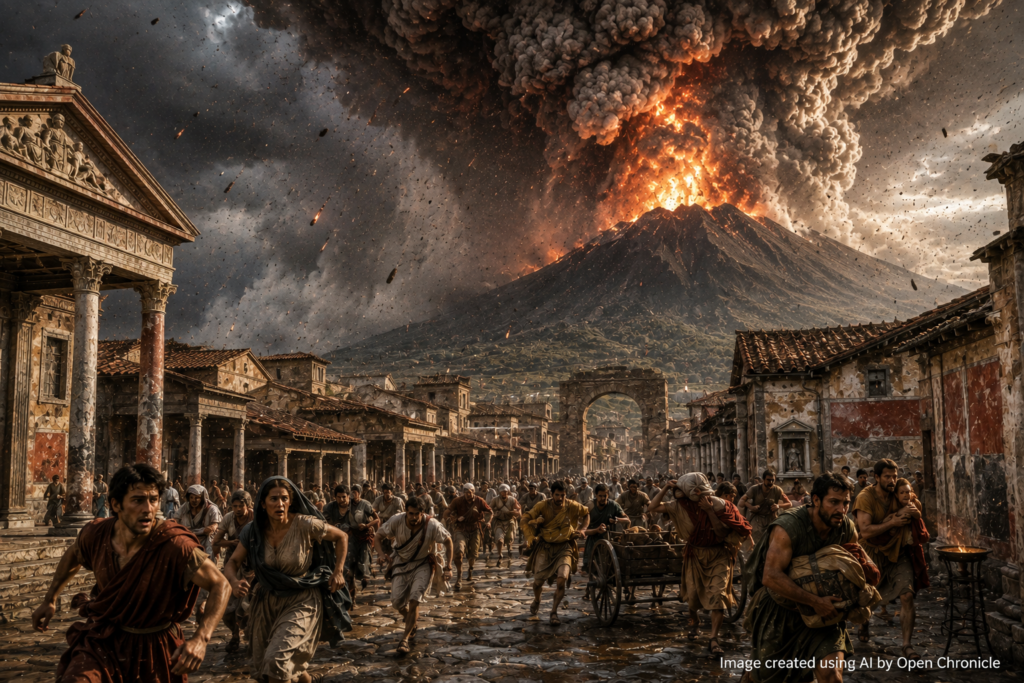
By Open Chronicle History Desk
For centuries, August 24, AD 79, has been remembered as the day Mount Vesuvius erupted with catastrophic force, burying Pompeii, devastating Herculaneum and destroying communities around the Bay of Naples.
It was one of the most famous natural disasters of the ancient world.
Within a remarkably short period, prosperous Roman towns disappeared beneath volcanic material. Houses, temples, shops, streets, gardens and public buildings were abandoned as inhabitants attempted to escape. Thousands of lives were transformed or extinguished.
Yet destruction produced an extraordinary historical paradox.
The volcanic material that overwhelmed these communities also preserved them.
Walls survived. Frescoes remained visible. Everyday objects were trapped inside houses. Food was preserved in shops and kitchens. Political slogans and advertisements remained on walls. The forms of victims were eventually recovered from cavities left in hardened ash.
Pompeii became something extraordinarily rare in archaeology: not simply the ruins of an ancient city, but a remarkably detailed record of ordinary urban life in the Roman world.
Much of what we know about the catastrophe itself comes from another extraordinary source.
A young Roman named Pliny the Younger watched the eruption from across the Bay of Naples.
Years later, he described what he had witnessed.
His uncle, the scholar and naval commander Pliny the Elder, sailed toward the disaster.
He never returned.
A Note About the Date
The traditional date of the eruption is August 24, AD 79.
That date derives from surviving manuscript traditions of letters written by Pliny the Younger to the Roman historian Tacitus.
Modern archaeological discoveries, however, have raised serious questions about whether the eruption actually occurred in August.
Evidence discovered at Pompeii includes autumnal produce, clothing that may be more consistent with cooler weather and, most importantly, a charcoal inscription apparently dating from October of AD 79.
Many scholars therefore consider an eruption later in the year, possibly in October, increasingly plausible.
The precise date remains a subject of historical and archaeological discussion.
August 24 nevertheless remains the traditional date associated with the catastrophe and one of the most famous dates in the history of ancient Rome.
Vesuvius Before the Disaster
To the inhabitants of the region, Vesuvius dominated the landscape.
The area surrounding the Bay of Naples was one of the most attractive and prosperous parts of Roman Italy.
Its volcanic soils were exceptionally fertile.
Vineyards covered the countryside.
Olives, fruit and other agricultural products flourished.
Wealthy Romans built villas overlooking the sea.
Commercial towns prospered.
Pompeii stood southeast of Vesuvius and functioned as a thriving urban centre with markets, temples, workshops, baths, taverns, theatres and an amphitheatre.
Herculaneum, closer to the coast and west of Pompeii, was smaller but prosperous.
Other settlements and villas were scattered throughout the region.
People lived beneath the volcano because the landscape it had created supported them.
They did not understand the geological processes occurring beneath their feet.
The Warning of AD 62
The eruption was not the first major natural disaster experienced by Pompeii during the first century.
In AD 62, a powerful earthquake struck the region.
Buildings were damaged throughout Pompeii and neighbouring communities.
The Roman philosopher Seneca wrote about the earthquake and noted that Campania had suffered severe destruction.
Reconstruction began.
When Vesuvius erupted seventeen years later, some buildings in Pompeii were apparently still undergoing repairs.
Earthquakes probably continued intermittently during the years before the eruption.
To modern volcanologists, such seismic activity can indicate movement beneath a volcano.
The Romans had no scientific framework capable of connecting these events to an approaching volcanic catastrophe.
Earthquakes were part of life in Campania.
When tremors occurred again before the eruption, many inhabitants may not have recognised them as a warning of something far greater.
Pompeii Before the Eruption
Pompeii was not a frozen museum waiting for disaster.
It was a living Roman town.
Its streets were busy with commerce.
Bakers produced bread in large ovens.
Wine merchants conducted business.
Craftsmen worked in workshops.
People ate and drank in establishments often described today as thermopolia.
Political candidates sought public office.
Graffiti covered walls.
Advertisements promoted businesses and entertainment.
Religious shrines occupied homes and public spaces.
The wealthy lived in houses decorated with mosaics, sculptures and elaborate frescoes.
Others occupied much more modest accommodation.
Enslaved people formed an essential part of the social and economic structure.
The city contained temples, public baths, theatres, an amphitheatre and a forum.
Pompeii was therefore valuable to archaeology not because it was exceptional.
Its greatest value is almost the opposite.
It preserves extraordinary evidence of the ordinary.
The Mountain Explodes
The eruption began violently.
Pressure had accumulated beneath Vesuvius as magma and volcanic gases moved upward.
When the system ruptured, the mountain expelled an enormous column of volcanic material into the atmosphere.
Pliny the Younger later described the cloud in a letter to Tacitus.
He compared its shape to a pine tree.
The column rose upward like a trunk before spreading outward into branches.
The description became so important to volcanology that explosive eruptions producing towering columns are now described as Plinian eruptions.
Pumice and ash began falling across the region.
The direction of the wind would prove crucial.
Pompeii lay directly in the path of enormous quantities of falling material.
The disaster had begun.
Day Becomes Darkness
At first, the greatest danger in Pompeii came from material falling from the eruption column.
Pumice accumulated on streets and rooftops.
People attempted to protect themselves.
Some fled immediately.
Others remained.
Their reasons were probably as varied as the people themselves.
Some may have believed the eruption would end.
Some may have stayed to protect property.
Others may have waited for relatives.
The elderly, sick, children and enslaved people may have faced particular difficulties escaping.
As pumice accumulated, roofs began collapsing under its weight.
Ash filled the atmosphere.
Visibility deteriorated.
The familiar city became increasingly difficult to navigate.
The eruption transformed daylight into darkness.
Pliny the Younger would later describe a darkness unlike an ordinary moonless night.
For those close to Vesuvius, the world itself must have seemed to be disappearing.
Pliny the Younger Watches
Across the Bay of Naples at Misenum was seventeen year old Pliny the Younger.
He was living with his mother and his uncle, Gaius Plinius Secundus, known to history as Pliny the Elder.
Pliny the Elder was one of the Roman world’s great intellectual figures.
His enormous Natural History attempted to compile knowledge about astronomy, geography, animals, plants, minerals, medicine and many other subjects.
He was also commander of the Roman fleet stationed at Misenum.
When the unusual cloud appeared over Vesuvius, his intellectual curiosity was immediately aroused.
According to his nephew, Pliny initially ordered a vessel prepared so that he could investigate the phenomenon more closely.
Then a message arrived.
The scientific expedition became a rescue mission.
Rectina’s Appeal
According to Pliny the Younger’s account, a woman named Rectina sent a message asking for help.
Her villa lay near the threatened area, and escape by land had become difficult.
Pliny the Elder changed his plans.
He ordered naval vessels to sea.
His famous decision has often been remembered through the phrase that he hurried toward a place from which everyone else was fleeing.
The Roman fleet crossed the bay toward the disaster.
Ash and pumice fell onto the ships.
The coastline became increasingly dangerous.
Pliny nevertheless continued.
His actions provide one of antiquity’s most remarkable accounts of organised disaster response.
Toward Stabiae
Conditions prevented Pliny from reaching every threatened location.
He eventually arrived at Stabiae, where his friend Pomponianus was staying.
Pliny attempted to reassure those around him.
The younger Pliny’s account presents his uncle maintaining remarkable calm.
He bathed.
He ate.
He rested.
Outside, the eruption continued.
Flames appeared around the mountain.
Ash accumulated.
Buildings shook.
The group eventually concluded that remaining indoors had become too dangerous because structures might collapse.
They went outside.
People placed pillows over their heads and tied them in place as protection against falling material.
It was a simple response to an incomprehensible catastrophe.
The Death of Pliny the Elder
The group moved toward the shore, hoping to escape by sea.
Conditions made departure impossible.
Pliny the Elder sat or lay down.
He then collapsed.
When daylight eventually returned, his body was found.
He was approximately fifty five years old.
The precise medical cause of his death cannot be established with certainty.
Pliny the Younger suggested that his uncle’s breathing may have been affected by the atmosphere and noted that he had respiratory difficulties.
Whatever the immediate cause, Pliny the Elder became the most famous named victim associated with the eruption.
His nephew survived.
And because he survived, the world inherited one of the most important eyewitness descriptions of a volcanic eruption ever written.
Pompeii Under Pumice
While Pliny attempted his rescue mission, conditions in Pompeii worsened.
Pumice continued accumulating.
Some residents escaped across the material.
Others sheltered inside buildings.
Roofs collapsed.
Streets became increasingly difficult to traverse.
Archaeological evidence indicates that many people did successfully flee the city.
This matters because popular representations can create the impression that the entire population remained trapped.
Pompeii probably contained many thousands of inhabitants, and the number of bodies recovered represents only a portion of that population.
The disaster was catastrophic, but it was also an evacuation.
Some escaped.
Others waited too long.
Then the character of the eruption changed.
The Pyroclastic Surges
The collapse of parts of the eruption column generated fast moving currents of hot gas, ash and volcanic material.
These pyroclastic density currents were vastly more dangerous than the falling pumice.
They swept down the slopes of Vesuvius.
Herculaneum was struck particularly severely.
Later surges reached Pompeii.
For people caught in their path, survival was extremely unlikely.
The exact mechanisms responsible for individual deaths continue to be studied, but exposure to extreme heat, ash and rapidly moving volcanic currents made these events devastating.
The eruption was no longer simply burying the cities.
It was killing those who remained.
Herculaneum
Herculaneum experienced the catastrophe differently from Pompeii.
Because of its position relative to the volcano and prevailing winds, it initially received less pumice fall.
This may have encouraged some inhabitants to believe they had more time.
But pyroclastic currents eventually struck the town with extraordinary violence.
Herculaneum was buried beneath deep layers of volcanic deposits.
The manner of burial produced exceptional preservation.
Wooden structures survived in carbonised form.
Doors, furniture and architectural elements provide evidence rarely preserved at Roman archaeological sites.
Food was preserved.
Upper floors of buildings survived in some places.
The town offers a different but complementary window into Roman life.
The Victims at the Shore
For many years, archaeologists believed much of Herculaneum’s population had successfully escaped because relatively few human remains had been found.
Excavations near the ancient shoreline changed that interpretation.
Hundreds of skeletons were discovered in and around vaulted structures near the waterfront.
Men, women and children had apparently gathered there, perhaps waiting for rescue by sea.
They never escaped.
Their remains have allowed researchers to study health, diet, social conditions and the biological lives of people living nearly two thousand years ago.
They also make the disaster intensely human.
Archaeology does not reveal only buildings.
It reveals people who were waiting for help that never arrived.
The Final Hours of Pompeii
As pyroclastic surges reached Pompeii, the remaining population faced conditions from which escape was increasingly impossible.
People died inside houses.
Others collapsed in streets.
Some carried valuables.
Coins, jewellery and keys have been found with victims.
Such objects suggest people were attempting to preserve what mattered or what they believed they might need after escaping.
Families appear to have remained together.
Some victims covered their faces.
Others sought shelter.
The archaeological evidence captures individual decisions made during the final hours of a city.
That is part of what makes Pompeii so powerful.
The disaster is enormous.
The evidence is intimate.
A City Disappears
When the eruption finally subsided, the landscape had been transformed.
Pompeii lay beneath metres of volcanic material.
Herculaneum was buried even more deeply.
Other settlements and villas had been destroyed or abandoned.
The coastline itself had changed.
Vesuvius had reshaped the geography of the region.
Survivors returned to some areas.
Roman authorities were aware of the catastrophe.
The cities were not instantly forgotten in an absolute sense.
People searched through ruins and recovered valuable materials.
But rebuilding Pompeii as a functioning city was impractical.
Gradually, the buried settlement disappeared from ordinary human experience.
Centuries passed.
The Roman Empire changed.
Christianity became dominant.
The Western Roman Empire collapsed.
Kingdoms rose and fell.
Pompeii remained underground.
Seventeen Centuries Beneath the Earth
The location of Pompeii was never entirely erased from memory, but knowledge of the ancient city became fragmentary.
Herculaneum was encountered accidentally during well digging in the early eighteenth century.
Systematic excavation began there under Bourbon patronage.
Pompeii followed.
In 1748, excavations began at the site.
At first, the objective was not archaeology in the modern sense.
Excavators searched for sculptures, paintings and valuable antiquities that could decorate royal collections.
Methods were often destructive.
Objects were removed from their original contexts.
But gradually the extraordinary nature of the site became apparent.
An entire Roman city was emerging from the volcanic deposits.
Pompeii Changes Archaeology
Pompeii became enormously influential in the development of archaeology and European understanding of antiquity.
Visitors participating in the Grand Tour came to see the excavations.
Artists studied the frescoes.
Architects examined Roman houses.
Designers incorporated Pompeian motifs into European interiors.
The discoveries contributed to the development of Neoclassicism.
But the site’s importance extended beyond art.
Ancient literature often focuses on emperors, generals, politicians and wars.
Pompeii revealed ordinary spaces.
Kitchens.
Bedrooms.
Shops.
Taverns.
Gardens.
Latrines.
Workshops.
Street fountains.
Brothels.
Bakeries.
The city allowed historians to ask questions about how Romans actually lived.
Giuseppe Fiorelli and the Human Forms
One of the most famous developments in Pompeian archaeology came during the nineteenth century.
Archaeologist Giuseppe Fiorelli recognised that cavities found within hardened volcanic material represented spaces where human bodies had decomposed.
The ash had hardened around the victims.
Organic material disappeared over time, leaving voids.
Fiorelli developed a method of pouring plaster into those cavities.
When surrounding material was removed, human forms appeared.
The results were extraordinary.
Bodies seemed to emerge from the earth.
Faces.
Hands.
Clothing.
Sandals.
The folds of garments.
The casts became among the most emotionally powerful archaeological objects ever created.
Modern techniques, including scanning and improved casting materials, have allowed researchers to investigate the victims while preserving the remains contained inside.
Graffiti and the Voices of Ordinary Romans
One of Pompeii’s greatest historical treasures is written directly on its walls.
Thousands of inscriptions and graffiti have been documented.
Some announce political candidates.
Others advertise entertainment.
Some record business transactions.
Some contain jokes, insults, romantic declarations and sexual comments.
Others simply record that somebody was there.
These inscriptions give historians access to voices rarely preserved in formal Roman literature.
The Roman world was not populated only by senators, philosophers and emperors.
It contained shopkeepers, workers, enslaved people, innkeepers, soldiers, travellers, lovers, gamblers and political enthusiasts.
Pompeii allows some of them to speak again.
Bread Still in the Ovens
The preservation of everyday material can be astonishing.
Carbonised loaves of bread have been recovered.
Food remains have been found in kitchens and shops.
Amphorae preserve evidence of wine, oil and other products.
Grinding mills survive inside bakeries.
Cooking vessels remain in houses.
These objects allow researchers to reconstruct Roman diet and commercial life.
Archaeobotanical evidence reveals what people cultivated and consumed.
Animal remains provide further evidence about food and the urban environment.
The catastrophe preserved details that ordinary archaeological processes often destroy.
A loaf of bread can sometimes tell us more about daily Roman life than an imperial monument.
Houses and Inequality
Pompeii also reveals profound differences in wealth.
Some houses were enormous.
The House of the Faun, for example, occupied a vast area and contained elaborate mosaics, including the famous Alexander Mosaic depicting a battle between Alexander the Great and Darius III of Persia.
Other inhabitants lived in much smaller spaces.
Shops could be integrated into houses.
Commercial and domestic life overlapped.
Enslaved people lived and worked alongside free inhabitants but occupied radically different social positions.
Recent archaeological discoveries continue to illuminate the lives of people at the lower end of Roman society.
Small rooms, simple furniture and evidence of labour complicate the glamorous image of Roman villas and frescoes.
Pompeii preserves beauty.
It also preserves inequality.
Religion in the City
Religion was everywhere.
Public temples honoured Roman gods.
Household shrines known as lararia connected religion with domestic life.
Images of deities appeared in homes and businesses.
Cult practices reflected both traditional Roman religion and influences from across the Mediterranean.
The Temple of Isis demonstrates the popularity of Egyptian religious traditions within Roman society.
Pompeii existed within an empire that connected cultures from Britain to North Africa and from Iberia to the eastern Mediterranean.
Its religious landscape reflected that interconnected world.
Entertainment and Spectacle
Pompeii possessed an amphitheatre capable of accommodating large crowds.
Gladiatorial contests were immensely popular.
In AD 59, a violent confrontation erupted between spectators from Pompeii and neighbouring Nuceria during games at the amphitheatre.
The historian Tacitus recorded the incident.
The violence became serious enough for Rome to intervene and restrict games at Pompeii for a period.
The episode reveals something striking.
Pompeii was not merely a provincial archaeological site.
It was a living community with rivalries, politics, entertainment and collective identities.
Its people cared passionately about their city.
New Discoveries Continue
Pompeii is not a finished archaeological story.
Excavations continue to produce important discoveries.
New frescoes emerge.
Rooms are uncovered.
Human remains are studied.
Inscriptions alter interpretations.
Scientific techniques allow researchers to analyse food residues, pigments, DNA, architecture and volcanic deposits with levels of precision earlier archaeologists could not imagine.
The site therefore continues evolving.
Each generation asks different questions.
Early excavators searched for beautiful objects.
Modern archaeologists increasingly investigate social structures, diet, migration, slavery, gender, labour, environment and the lives of ordinary inhabitants.
Pompeii continues to answer questions its original residents could never have imagined being asked.
Pliny’s Letters
Our understanding of the eruption would be far poorer without Pliny the Younger.
Years after the disaster, the historian Tacitus asked him for information about the death of Pliny the Elder.
Pliny responded with letters describing both his uncle’s final journey and his own experience at Misenum.
The accounts are among the most important eyewitness descriptions of natural catastrophe from antiquity.
They connect archaeological evidence with human observation.
We can read about earthquakes, darkness, falling ash and terrified crowds from someone who experienced them.
Few ancient disasters are documented with such immediacy.
Pliny was writing literature as well as testimony, and his account must therefore be read critically.
But nearly two thousand years later, his description remains foundational.
The Date Problem
The letters also created the famous chronological problem surrounding the eruption.
The traditional manuscript reading places the disaster on the ninth day before the Kalends of September, conventionally interpreted as August 24.
Yet manuscript transmission across centuries can introduce errors.
Archaeological evidence increasingly points toward autumn.
Some victims appear to have worn heavier clothing.
Autumn fruits and crops have been identified.
Coins have contributed to chronological discussions.
Most strikingly, archaeologists announced in 2018 the discovery of a charcoal inscription apparently dated to October 17.
Because charcoal writing is fragile and unlikely to have survived long exposure, the inscription strongly suggests that the building was occupied in October of AD 79.
If that interpretation is correct, Vesuvius could not have erupted in August.
A date later in October has consequently gained substantial scholarly support.
The traditional August 24 date remains culturally famous.
Historical accuracy requires acknowledging that it is not certain.
What Killed Pompeii Also Preserved It
The greatest paradox of Pompeii lies at the centre of its historical importance.
Vesuvius destroyed the city.
But without Vesuvius, much of Pompeii would probably have disappeared through normal processes of urban change.
Buildings would have been demolished.
Materials would have been reused.
Paintings would have deteriorated.
Wood would have decayed.
Political graffiti would have vanished.
Shops would have been rebuilt.
Streets would have changed.
Instead, catastrophe interrupted ordinary time.
The city was buried.
That burial preserved an extraordinary archaeological record.
Pompeii is therefore not literally a perfectly frozen moment. Excavation has revealed a complex city that had changed repeatedly before AD 79, and the processes of destruction and recovery altered the evidence.
Yet few places allow us to approach ancient urban life with comparable detail.
Vesuvius Is Still Active
The story did not end in AD 79.
Vesuvius remains an active volcano.
It has erupted many times since antiquity.
A major eruption occurred in 1631 and killed thousands of people.
The most recent eruption occurred in 1944 during the Second World War.
Today, millions of people live in the wider Naples metropolitan region.
Modern volcanologists therefore monitor Vesuvius closely.
Seismic activity, ground deformation and volcanic gases are studied for signs of change.
Emergency planning attempts to prepare for a future eruption.
The volcano that destroyed Pompeii is not extinct.
It is sleeping.
Why the Eruption of AD 79 Matters
The eruption of Vesuvius is remembered because it joins two kinds of history that rarely survive together.
There is the history of catastrophe.
A mountain erupted.
Cities were destroyed.
Families fled.
People died.
A Roman admiral sailed toward danger and never returned.
But there is also the history of everyday life.
A baker prepared bread.
A merchant stored wine.
A citizen painted support for a political candidate.
A family decorated a dining room.
Someone scratched a joke into plaster.
Someone repaired a house damaged by an earlier earthquake.
Someone placed food on a table.
Then Vesuvius erupted.
For centuries, emperors rose and fell above the buried city.
Rome’s western empire disappeared.
Languages changed.
Religions transformed Europe.
Kingdoms and nations emerged.
Pompeii remained beneath the volcanic earth.
When archaeologists finally opened its streets again, they discovered something more valuable than another ruined Roman city.
They discovered ordinary lives.
That is why Pompeii continues to fascinate.
The great monuments of Rome tell us what emperors wanted the world to remember.
Pompeii tells us how people lived.
And nearly two thousand years after Vesuvius buried their city, we can still walk their streets, enter their houses, read their walls and encounter traces of people who never imagined that their ordinary world would one day become one of history’s most extraordinary archives.
The eruption destroyed Pompeii.
The eruption also preserved it.
And in that terrible paradox, a Roman city achieved a form of immortality.