
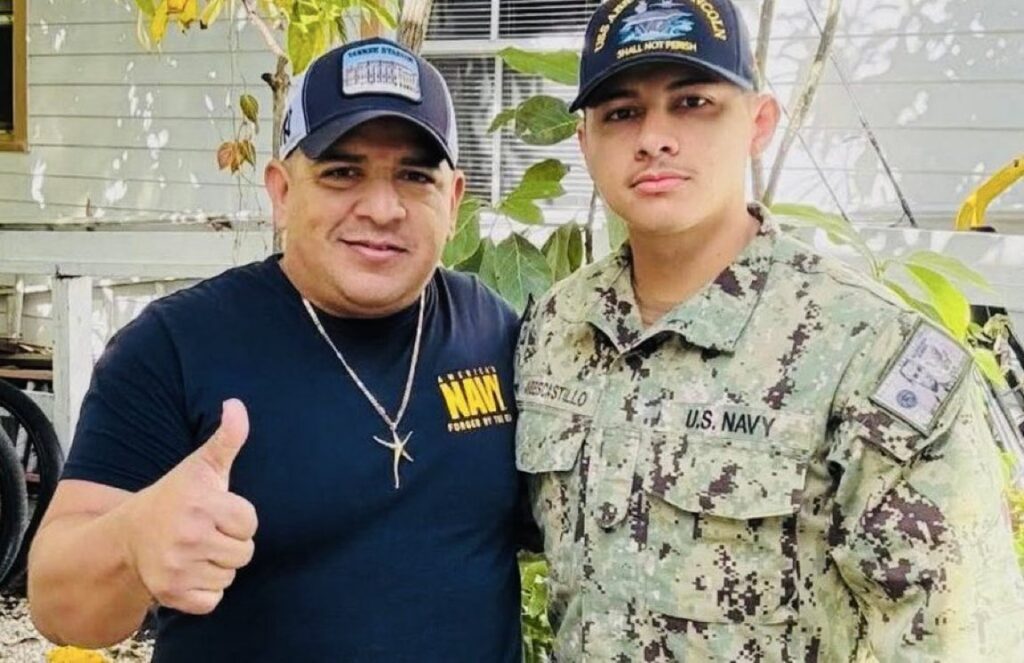
Image: from Dr.Sam Youssef Ph.D.,Ph.D.,DPT. X @drhossamsamy65
By Open Chronicle with agencies
The father of a US Navy sailor serving aboard the aircraft carrier USS Abraham Lincoln has been taken into federal immigration custody, creating an unusually personal intersection between the Trump administration’s immigration crackdown and the military personnel serving overseas.
Luis Manuel Aviles Roa, originally from Nicaragua, was arrested by US Border Patrol following a vehicle stop in Key West, Florida, according to the Department of Homeland Security. His son, Joshua Aviles, disclosed the detention publicly while serving aboard the Abraham Lincoln, which had been deployed to the Middle East during the Iran war.
The case has attracted attention partly because Joshua has spent more than nine months deployed, including an exceptionally long period at sea, while serving the United States thousands of miles from home.
Sailor learns of father’s detention while deployed
Joshua said in a Facebook post that he learned of his father’s detention while still serving aboard the carrier.
He described having spent more than nine months deployed in the Middle East and said he had been working long days aboard the ship when he received the news.
According to Joshua, his father possessed a driver’s licence, Social Security card and work permit. He also said the family had been working through the immigration process to obtain permanent residency and was waiting for a decision on a green card application.
The detention left the sailor questioning how he could continue performing demanding duties while worrying about his father’s circumstances in federal custody.
His comments illustrate the emotional consequences immigration enforcement can have beyond the person detained, particularly when relatives are serving in the US armed forces.
ICE detain dad of active duty sailor in U.S. Navy—fighting past 6 months in war with Iran.
Deployed on USS Abraham Lincoln—the same ship plagued by food shortages & broken toilets.
Family not even told where dad is being detained.
So they can't send him his lifesaving medicine… pic.twitter.com/2UHSP8VfgU
— LongTime🤓FirstTime👨💻 (@LongTimeHistory) August 24, 2026
DHS says Aviles entered the United States illegally
The Department of Homeland Security offered a different perspective on the case.
According to DHS, Aviles entered the United States illegally and will remain in Immigration and Customs Enforcement custody while removal proceedings continue.
The department also made clear that having a close relative serving in the American military does not provide immunity from immigration enforcement.
“Having a family member in the military is not a free pass to violate our nation’s laws,” DHS said.
The government’s position therefore separates Joshua’s military service from his father’s immigration status.
The case does not establish from the available reporting whether Aviles will ultimately be removed from the country. That question will depend on the immigration proceedings and any legal avenues available to him.
A case with powerful political symbolism
The circumstances have given the detention significance beyond an individual immigration case.
Joshua is serving aboard one of the US Navy’s most important warships at a time of heightened American military commitments in the Middle East.
His father, meanwhile, is being held by the same federal government his son serves in uniform.
There is no legal contradiction between those two circumstances. Military service by a relative does not automatically create lawful immigration status for another family member.
Politically and emotionally, however, the contrast is striking.
Military families frequently endure lengthy separations, demanding deployments and considerable uncertainty. Immigration enforcement involving the relatives of active duty personnel adds another layer of pressure.
USS Abraham Lincoln endured an extraordinary deployment
The detention also comes after an exceptionally demanding period for the crew of the USS Abraham Lincoln.
The carrier had been supporting US military operations associated with the Iran war and spent more than 200 consecutive days without making a port call, a modern record according to Democratic lawmakers cited by Reuters.
The extended deployment had already generated political scrutiny.
Families of sailors raised concerns about deteriorating conditions aboard the ship, while lawmakers sought explanations from Navy leadership.
The carrier finally departed the Middle East on August 22.
For sailors such as Joshua, the length and intensity of the deployment meant that serious developments involving their families occurred while they were thousands of miles away and unable to intervene directly.
Trump’s immigration crackdown continues
Aviles’ detention comes amid a much wider immigration enforcement campaign under President Donald Trump’s second administration.
Trump has argued that stronger enforcement is necessary to restore compliance with immigration law and improve domestic security.
The administration has expanded arrests and deportation efforts while tightening several aspects of the legal immigration and visa systems.
Civil liberties and immigrant rights organisations have challenged elements of the crackdown, arguing that some policies have threatened due process and other constitutional protections. Concerns about racial profiling have also been raised.
The administration maintains that immigration laws should be enforced regardless of an individual’s family relationships or circumstances.
Military service and immigration have long intersected
The American armed forces have historically included large numbers of immigrants and Americans from immigrant families.
That creates complicated situations when military service intersects with immigration enforcement.
Serving in the military can provide certain immigration benefits for eligible service members and, under specific circumstances, their relatives. But military service by one member of a family does not automatically regularise the immigration status of every relative.
The Aviles case demonstrates that distinction vividly.
Joshua’s service aboard an aircraft carrier during wartime does not itself resolve his father’s legal status.
At the same time, the practical consequences of detention extend directly to an active duty sailor expected to continue performing demanding military duties.
A family crisis unfolding during military service
For Joshua Aviles, the issue is considerably more immediate than the wider political debate.
He has spent months aboard a carrier deployed thousands of miles from the United States, working extended shifts as part of an American military operation.
His father is now in federal custody while immigration proceedings continue.
The government argues that military family connections cannot override immigration law.
Joshua’s account highlights another reality: immigration enforcement can have direct consequences for American service members who may have little ability to assist their families while deployed.
That tension is likely to ensure that the case receives attention well beyond Key West.
It comes as the Trump administration expands immigration enforcement across the United States and as the Navy faces separate questions about the burden placed on sailors during increasingly long deployments.
For one sailor aboard the USS Abraham Lincoln, those two national debates have now become a single family crisis.