
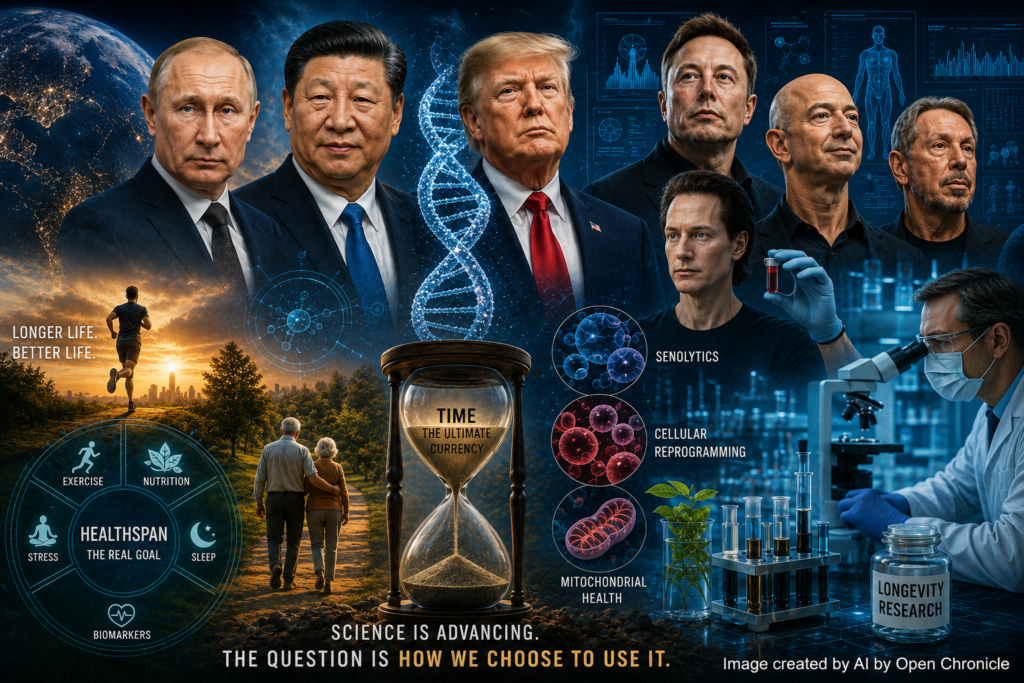
By Open Chronicle Science
For most of human history, ageing was treated as an unavoidable fact of existence. Medicine could prevent premature death, cure infections, replace damaged joints and increasingly control chronic disease, but the biological process of ageing itself remained beyond meaningful intervention.
That assumption is beginning to change.
Across biotechnology laboratories, universities and heavily funded private companies, researchers are asking a radically different question: rather than treating cancer, cardiovascular disease, dementia and frailty separately, could medicine intervene in some of the underlying biological mechanisms that make all of them more likely as humans grow older?
The question has attracted some of the world’s wealthiest entrepreneurs and most powerful political figures.
Silicon Valley investors have poured billions into longevity biotechnology. Entrepreneurs subject themselves to intensive biomarker monitoring. Researchers are experimenting with cellular reprogramming, senescent cell removal and other approaches intended to preserve youthful biological function.
And in one extraordinary unscripted moment, Russian President Vladimir Putin and Chinese President Xi Jinping were overheard discussing organ replacement, biotechnology and the possibility that humans might eventually live to 150.
The science is real.
The promise is enormous.
But so is the hype.
As of 2026, there is no clinically proven treatment capable of making humans biologically young again, producing immortality or extending normal human lifespan to 150 years. A recent Nature Medicine editorial stressed that evidence for clinical benefits from anti ageing interventions in humans remains sparse.
What is happening, however, may still represent the beginning of one of medicine’s most consequential transformations.
The conversation the world was never supposed to hear
The relationship between longevity and political power became unexpectedly visible in September 2025.
Putin and Xi were walking together in Beijing during commemorations marking the 80th anniversary of the end of the Second World War when a live microphone captured part of their conversation.
Putin’s interpreter could be heard discussing the continuing development of biotechnology and the possibility of repeated organ replacement.
Xi responded that some forecasts suggested humans might live to 150 during this century.
Putin later confirmed that the conversation about longevity had occurred, telling reporters that advances in medicine and organ replacement created the possibility that human life expectancy could increase significantly.
The exchange immediately attracted international attention.
It should not, however, be interpreted as evidence that either leader is personally receiving secret longevity treatments.
There is no credible public evidence establishing that.
What the conversation demonstrates is something different and arguably more important: extreme human longevity has entered the imagination of people exercising power at the highest levels of government.
Russia is genuinely researching longevity
Putin’s interest is particularly notable because Russia has also pursued state backed research associated with healthy ageing.
Reporting in 2025 described a Russian initiative focused on technologies addressing cellular ageing, neurotechnology and longevity.
That places Russia within a much larger international scientific movement.
The ambition is not necessarily to discover a single “immortality drug”.
Ageing is extraordinarily complicated.
Cells accumulate mutations. Epigenetic regulation changes. Mitochondrial performance deteriorates. Damaged proteins accumulate. Chronic inflammation increases. Stem cell function declines. Some damaged cells enter senescence instead of dying.
Scientists increasingly describe these interconnected phenomena as hallmarks or mechanisms of ageing.
The emerging idea is that manipulating some of those processes might delay several age related diseases simultaneously.
That field is known broadly as geroscience.
Xi Jinping and the 150 year question
Xi’s remark about humans potentially reaching 150 attracted attention because such a lifespan would be extraordinary.
The longest verified human lifespan remains that of Frenchwoman Jeanne Calment, who died in 1997 at 122 years and 164 days.
Reaching 150 would therefore require extending maximum human lifespan by almost three decades beyond the verified record.
There is currently no evidence that medicine can accomplish this.
But longevity science does not necessarily need to reach 150 to transform civilisation.
Imagine instead that medical intervention could postpone several diseases associated with ageing by ten or fifteen years.
A person reaching 80 might retain cardiovascular, muscular and cognitive function closer to what we currently associate with someone considerably younger.
That would constitute an enormous medical achievement even if maximum human lifespan barely changed.
This distinction separates two concepts frequently confused in popular discussion.
Lifespan means how long someone lives.
Healthspan means how long someone remains reasonably healthy and functional.
Most serious longevity researchers are primarily interested in extending healthspan.
Donald Trump and the longevity of political leadership
Donald Trump belongs in this discussion for a different reason.
There is no credible public evidence that Trump is undergoing experimental rejuvenation therapy.
He therefore should not be placed alongside people who openly experiment with longevity interventions.
His relevance is political.
Modern medicine has already changed the relationship between ageing and leadership.
Heads of state receive extraordinary medical surveillance and rapid access to specialists, diagnostic imaging, pharmaceuticals and emergency treatment.
As populations live longer and political careers extend into increasingly advanced ages, questions about presidential health, cognitive capacity and longevity inevitably become questions about governance.
The important distinction is that elite medical access already exists, while true biological rejuvenation does not.
The arrival of effective longevity therapies would dramatically magnify that distinction.
Silicon Valley has gone considerably further
While political leaders discuss longevity, parts of the technology industry are investing directly in it.
The sums involved are substantial.
A new generation of biotechnology companies has emerged around the proposition that aspects of biological ageing can eventually be manipulated.
One of the most prominent is Altos Labs, which launched with approximately $3 billion in funding and recruited leading researchers to investigate cellular rejuvenation and resilience.
Other companies including Retro Biosciences, NewLimit and Cambrian Biopharma are exploring different approaches to age related biological decline.
The important development is not that billionaires have discovered how to defeat ageing.
They have not.
It is that enormous private fortunes can finance scientific programmes whose payoff may be decades away.
Why billionaires are interested
The economics are easy to understand.
Ageing is effectively the largest risk factor for many of the diseases that consume enormous portions of healthcare expenditure.
Cancer becomes dramatically more common with age.
So does cardiovascular disease.
So does dementia.
So does frailty.
A biotechnology capable of delaying several of these simultaneously would potentially address one of the largest markets imaginable.
And for wealthy individuals, there is another calculation.
Money can purchase almost everything except additional time.
For someone possessing billions of dollars, extending healthy life may ultimately have greater value than acquiring another property, aircraft or company.
Longevity is therefore simultaneously a scientific project, a potentially enormous industry and an intensely personal ambition.
The human experiment: Bryan Johnson
Perhaps no individual illustrates modern longevity culture more vividly than entrepreneur Bryan Johnson.
Johnson has become internationally known for pursuing an extremely intensive programme intended to measure and influence his biological ageing.
His approach has involved extensive blood testing, imaging, sleep monitoring, exercise, dietary control and continuous measurement of physiological biomarkers.
He has also experimented with interventions considerably beyond normal preventive medicine.
The important point is not whether Johnson has discovered how to reverse ageing.
There is no evidence that he has.
Rather, he represents a new philosophy:
the human body as a continuously measurable engineering system.
Blood pressure becomes data.
Sleep becomes data.
Glucose becomes data.
Hormones become data.
Cardiovascular performance becomes data.
Organ function becomes data.
The hope is that enough measurements will allow interventions to be continuously optimised.
Whether this ultimately translates into exceptional longevity remains unknown.
The drug researchers cannot ignore: rapamycin
Among the most discussed substances in longevity research is rapamycin.
The drug affects a biological pathway called mTOR, which helps regulate cellular growth and metabolism.
In several animal models, manipulating this pathway has produced striking effects on longevity.
That has made rapamycin one of geroscience’s most intriguing candidates.
But animal longevity is not human longevity.
A treatment capable of extending lifespan in mice cannot automatically be assumed to extend lifespan safely in humans.
Dosage, immune effects, metabolism and long term adverse consequences all matter.
Rapamycin therefore illustrates both the excitement and danger surrounding the longevity movement.
There is enough science to justify serious investigation.
There is not enough evidence to justify declaring ageing solved.
Senolytics: removing ageing cells
Another major research avenue involves cellular senescence.
Cells sometimes become damaged without dying.
Instead, they enter a state in which they stop dividing while remaining metabolically active.
These senescent cells can accumulate with age and release inflammatory signals affecting surrounding tissue.
The concept behind senolytic drugs is deceptively simple:
find these dysfunctional cells and eliminate them.
Animal studies have generated considerable interest in the approach.
Whether safe removal of senescent cells can produce substantial clinical benefits in humans remains an open question.
It is one of several areas where experimental biology has moved faster than clinical proof.
The extraordinary possibility of cellular reprogramming
Perhaps the most radical area of longevity research concerns epigenetic reprogramming.
Every cell contains essentially the same genetic instruction book, but cells use different sections of that book depending on their identity and state.
Ageing alters some of these regulatory patterns.
Scientists discovered that introducing specific molecular factors can reset cellular identity dramatically, turning mature cells back toward an embryonic like state.
The revolutionary question followed:
Could researchers reset some aspects of cellular ageing without erasing the cell’s identity?
This is known as partial reprogramming.
If it can eventually be controlled safely inside humans, the implications could be profound.
Instead of simply slowing biological deterioration, medicine might theoretically restore some characteristics associated with younger cells.
But enormous problems remain.
Push reprogramming too far and cells can lose their identity.
Uncontrolled cellular growth also raises obvious concerns about cancer.
The distance between rejuvenating cultured cells and safely rejuvenating an entire human being is immense.
Yet this is precisely the type of high risk science attracting major investment.
Replacement organs could change the equation
The Putin and Xi conversation focused partly on another path: organ replacement.
Modern transplantation already demonstrates that replacing a failing organ can dramatically extend life.
The fundamental limitations are donor availability, immune rejection and the enormous complexity of transplantation.
Regenerative medicine could potentially change this.
Scientists are investigating organoids, tissue engineering, genetically modified donor organs and eventually organs constructed partly from a patient’s own cells.
If replacement organs became routinely available without severe rejection problems, one major constraint on human longevity would weaken.
But another would remain.
Humans do not age one organ at a time.
Replacing a heart does not rejuvenate the brain.
Replacing kidneys does not eliminate accumulated mutations elsewhere.
Replacing the liver does not restore an ageing immune system.
True systemic longevity therefore requires something much more sophisticated than periodically exchanging biological components.
Artificial intelligence enters the longevity race
AI may accelerate the field significantly.
Ageing generates enormous amounts of biological data involving genes, proteins, metabolites, immune responses and cellular behaviour.
Humans cannot intuitively analyse interactions across all those systems.
Machine learning can.
AI systems are increasingly being used for drug discovery, protein analysis, biological modelling and identification of potential therapeutic targets.
This creates the possibility of an accelerating feedback loop:
AI identifies targets.
Biotechnology tests them.
Biomarkers measure the response.
AI analyses the results.
New therapies are designed.
The combination of artificial intelligence and biotechnology may ultimately matter more to longevity research than any individual drug currently receiving attention.
Biological clocks present another problem
How would we know whether someone had actually become biologically younger?
Chronological age is easy.
Biological age is not.
Researchers have developed several proposed ageing clocks using epigenetic markers and other biomarkers.
Some interventions appear capable of changing these measurements.
But improving an ageing biomarker is not necessarily equivalent to extending someone’s life.
A therapy could make a laboratory measurement look younger without meaningfully reducing mortality.
This is one reason researchers urgently need validated biomarkers capable of predicting meaningful clinical outcomes.
Nature Medicine recently warned that the field requires stronger biomarkers and far better evidence for both safety and efficacy.
The uncomfortable truth about longevity medicine
Despite spectacular headlines, billions of dollars and genuine scientific advances, the central fact remains remarkably simple:
No existing treatment has been demonstrated to make healthy humans dramatically younger or extend normal human lifespan by decades.
There is no proven immortality treatment.
There is no validated injection that reverses ageing.
There is no established therapy allowing humans to live to 150.
There is also no evidence that Putin, Xi, Trump or other world leaders possess access to a secret technology capable of doing so.
And expensive does not mean effective.
The longevity boom has created a commercial ecosystem offering supplements, hormone programmes, plasma interventions, stem cell procedures and other treatments whose marketing claims can run far ahead of clinical evidence.
The scientific revolution may be real while much of the surrounding marketplace remains speculative.
Both statements can be true simultaneously.
But something fundamental has changed
The mistake would be dismissing the entire field because immortality remains science fiction.
For centuries medicine primarily reacted to ageing.
The heart fails, treat the heart.
Cancer develops, attack the tumour.
Memory deteriorates, attempt to slow the decline.
Bones weaken, treat osteoporosis.
Geroscience proposes a different strategy.
Intervene earlier in the biological processes that make all these conditions more likely.
If that strategy succeeds even partially, its effects could be enormous.
Adding twenty years to maximum human lifespan would be spectacular.
Adding ten healthy years to average human healthspan might have an even greater effect on civilisation.
And then comes the question of inequality
This may ultimately become the most difficult question of all.
Suppose rejuvenation technology actually works.
Suppose a treatment costing €2 million can reduce someone’s biological age by fifteen years.
Who receives it?
Initially, almost certainly, the wealthy.
That would create something historically unprecedented.
Wealth has always purchased better nutrition, safer housing and superior healthcare.
Consequently, rich populations already tend to live longer than poor ones.
But genuine rejuvenation would introduce a fundamentally different inequality.
For the first time, money might directly purchase additional biological time.
A billionaire could conceivably remain healthy and economically powerful while several generations of ordinary workers aged normally.
Political leaders could remain active for much longer.
Founders could retain control of companies for generations.
Fortunes could compound for unprecedented periods.
Inheritance patterns could change.
Retirement systems could become unsustainable.
The meaning of a generation itself could begin to change.
Longevity could become a geopolitical technology
There is another possibility rarely discussed.
If longevity technologies eventually work, governments will become interested.
A treatment preserving cognitive and physical function would have obvious applications for military personnel, scientists, intelligence officers and highly trained specialists.
Countries mastering regenerative medicine could gain enormous economic advantages.
Healthcare expenditure could fall if age related disease were delayed.
Workforces might remain productive longer.
Scientific expertise could accumulate across extended careers.
China, Russia, the United States and other major powers therefore have reasons to regard longevity not simply as healthcare, but potentially as strategic technology.
The Putin and Xi conversation becomes much more interesting when viewed through that lens.
Would longer lives produce better leaders?
Not necessarily.
Longevity and wisdom are not synonymous.
Longer lived political leaders could provide institutional continuity.
They could also prevent generational political renewal.
Longer lived entrepreneurs could continue building extraordinary companies.
They could also concentrate economic power for unprecedented periods.
Longer lived scientists could accumulate decades of expertise.
But younger generations might find opportunities increasingly occupied by people who simply never leave.
A society in which people routinely live to 120 in good health would therefore require profound institutional adaptation.
Retirement, pensions, inheritance, marriage, education, employment and political succession were all designed around much shorter lives.
Changing human lifespan would eventually require changing society itself.
The real race is not immortality
The spectacular language surrounding longevity frequently focuses on living forever.
That is probably the wrong benchmark.
The scientifically credible objective is considerably more modest and simultaneously more important.
A person might still die at 90.
But instead of spending the final fifteen years dealing with cardiovascular disease, diabetes, frailty and cognitive decline, perhaps serious deterioration would begin at 87.
That compression of morbidity would represent an extraordinary achievement.
The objective becomes not:
120 years alive.
But:
100 years genuinely living.
The most valuable commodity on Earth
Putin commands a nuclear power.
Xi governs the world’s second largest economy.
Trump occupies the White House.
Silicon Valley billionaires control fortunes larger than the economies of some countries.
Yet all confront exactly the same biological reality.
Time.
That may explain why longevity has begun attracting an extraordinary combination of political power, private capital, artificial intelligence and cutting edge biology.
The richest people on Earth can buy islands, companies, aircraft, political influence and almost unlimited medical attention.
They cannot currently buy another thirty healthy years.
But increasingly, they are willing to finance the science that might one day make that possible.
The decisive question is therefore no longer whether humans will attempt to intervene in ageing.
We already are.
The question is whether the biology will cooperate.
And if scientists eventually discover how to slow or partially reverse human ageing, an even larger question will immediately follow:
Will longevity become a medical achievement shared by humanity, or the ultimate privilege of the world’s richest and most powerful people?
That question may prove just as important as the science itself.