
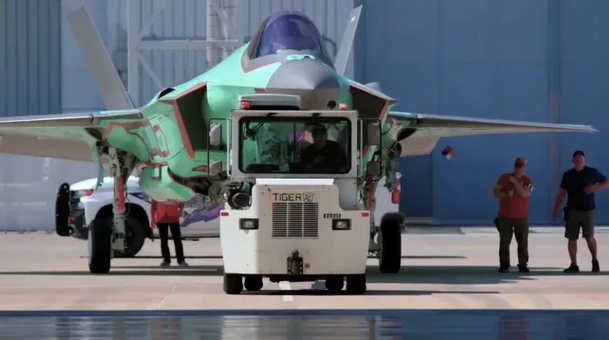
Image: from Global Defense Corp X @GlobalDefCorp
By Open Chronicle Defence
Germany’s transition to the F-35A Lightning II is moving closer to reality, with the country’s first aircraft approaching completion as final finishing work prepares the stealth fighter for delivery.
The milestone represents more than the arrival of another combat aircraft. Germany’s acquisition of the F-35 is a central element of the Bundeswehr’s modernisation and will eventually replace the ageing Tornado in one of the Luftwaffe’s most strategically important missions.
For Berlin, the programme combines technological modernisation, NATO integration and Germany’s continuing role in the Alliance’s nuclear sharing arrangements.
Lockheed Martin has reported that Germany’s first F-35A, designated MG-01, has completed final assembly and moved to the finishing stage, including application of its external coating. The aircraft is expected to be officially rolled out and make its first flight later this year… pic.twitter.com/boXEDsHEXS
— OSINTWarfare (@OSINTWarfare) August 18, 2026
Final work brings the first aircraft closer to delivery
Germany’s first F-35A is progressing through the final stages of production, bringing the aircraft closer to formal delivery.
At this point in fighter production, apparently small details matter. Finishing work forms part of the process that transforms an assembled airframe into an operationally representative aircraft ready for acceptance, testing and eventual service.
The approaching completion of the first German fighter provides a visible indication that a procurement decision taken as part of Germany’s post 2022 defence transformation is becoming an operational capability.
The first aircraft will also play an important role in preparing German pilots and maintainers for the transition to a completely different generation of combat aviation.
Germany ordered 35 F-35A fighters
Berlin selected the F 35A in 2022 and subsequently approved the acquisition of 35 aircraft.
The decision was closely connected to the replacement of Germany’s Tornado fleet.
The Panavia Tornado has served the Luftwaffe for decades, performing strike, reconnaissance and electronic warfare missions during its long operational career.
Maintaining the aircraft has become increasingly expensive and technically demanding as the fleet ages.
The F 35A provides Germany with a modern successor for the Tornado’s nuclear strike role while introducing capabilities associated with fifth generation combat aviation.
Nuclear sharing was central to the decision
Germany’s participation in NATO nuclear sharing was one of the most important considerations behind the F 35 selection.
Under the arrangement, certain NATO countries maintain aircraft capable of carrying American nuclear weapons stored in Europe, while the weapons themselves remain under US control.
Germany’s Tornado has traditionally fulfilled this role.
Replacing it therefore required an aircraft capable of continuing the mission.
The F 35A was particularly attractive because it was already being integrated into the United States and NATO nuclear architecture, including certification for the B61 12 gravity bomb.
That considerably reduced the risks associated with attempting to certify another aircraft for the mission.
A technological leap for the Luftwaffe
Moving from the Tornado to the F 35 represents a major generational transition.
The F 35 was designed around low observable characteristics, advanced sensors, electronic warfare capabilities and extensive battlefield networking.
Its importance lies not simply in how fast it flies or how many weapons it carries.
The aircraft is designed to collect enormous quantities of information from the battlespace and combine that information into a coherent tactical picture for the pilot.
Radar, electro optical sensors and electronic support systems can contribute to identifying aircraft, air defence systems and other threats.
That information can also be shared with other forces.
In this sense, an F 35 can function simultaneously as a strike aircraft, intelligence platform and networked sensor.
Stealth changes Germany’s strike capability
Survivability is another fundamental difference.
The Tornado was designed during the Cold War around high-speed penetration at very low altitude.
The F-35 belongs to a different philosophy.
Its airframe, materials, internal weapons carriage and electronic systems are designed to reduce the aircraft’s detectability, particularly by radar.
This does not make the fighter invisible.
Instead, reduced observability complicates an adversary’s ability to detect, identify and engage the aircraft at useful distances.
Against increasingly sophisticated integrated air defence networks, that capability has become particularly important.
The F-35 is becoming a European NATO standard
Germany is joining an expanding European community of F-35 operators.
Britain, Italy, the Netherlands, Norway, Denmark, Belgium, Poland and several other European NATO members have selected variants of the aircraft.
Finland and Switzerland have also chosen the platform.
This proliferation has significant implications for NATO.
Countries operating the same aircraft can increasingly share training, maintenance infrastructure, tactics, logistics and operational information.
During a major European crisis, interoperability could allow F-35 fleets from different countries to operate as elements of a much larger network rather than as isolated national forces.
Germany’s entry into that ecosystem therefore has consequences beyond the Luftwaffe itself.
Büchel will become the centre of German F 35 operations
The German aircraft are intended to operate primarily from Büchel Air Base in Rhineland-Palatinate.
Büchel has long been associated with Germany’s Tornado force and NATO nuclear sharing mission.
The transition requires substantial infrastructure work.
Operating the F 35 involves specialised maintenance facilities, secure information systems, mission planning infrastructure and other support capabilities associated with a modern stealth aircraft.
Consequently, acquiring the fighters is only one part of the programme.
Germany must simultaneously create the physical and digital environment necessary to operate them effectively.
Training will be crucial
The first German aircraft will contribute to another essential element of the transition: training.
Introducing a fifth-generation fighter requires much more than teaching experienced pilots how to fly a different aircraft.
Maintenance personnel must learn new procedures.
Mission planners must understand the aircraft’s sensor and information capabilities.
Commanders must develop tactics that exploit its ability to operate within a networked battlespace.
Cybersecurity and information management become increasingly important because modern combat aircraft depend heavily on software and digital mission systems.
Germany will therefore need to develop an entire F 35 ecosystem before the fleet reaches its full operational potential.
The programme reflects Germany’s defence transformation
The arrival of the F 35 also carries broader political significance.
Russia’s full scale invasion of Ukraine in February 2022 forced Germany to reconsider decades of assumptions about European security.
Then Chancellor Olaf Scholz described the transformation as a Zeitenwende, a turning point.
Germany subsequently announced major investments intended to rebuild Bundeswehr readiness and modernise equipment.
Progress has sometimes been complicated by procurement delays, infrastructure limitations and the enormous scale of rebuilding required after decades of comparatively restrained defence spending.
The F 35 programme has nevertheless become one of the most visible symbols of that transformation.
Unlike many defence investments whose effects remain largely invisible to the public, the arrival of an entirely new generation of fighter aircraft provides a tangible demonstration of military modernisation.
F 35 and Eurofighter will serve different purposes
Germany’s acquisition of the F-35 does not mean the end of the Eurofighter Typhoon.
Instead, the Luftwaffe is moving toward a complementary force.
The Eurofighter will remain central to Germany’s air defence and conventional combat capability while continuing to receive upgrades.
The F 35 will provide capabilities particularly valuable for penetrating heavily defended environments, conducting precision strikes and fulfilling the nuclear sharing mission.
Germany is also developing future electronic warfare capabilities around the Eurofighter.
The result will be a more diverse combat aviation force than a simple replacement of one aircraft by another might suggest.
From production line to operational capability
Completing the first German F-35 will be an important milestone, but it will not mark the end of the programme.
Aircraft must be delivered.
Pilots and technicians must complete training.
Infrastructure must become operational.
Weapons and mission systems must be integrated into German procedures.
The Luftwaffe must then demonstrate that it can deploy, sustain and fight with the aircraft.
Only after those elements come together will Germany possess a mature F-35 capability.
But the significance of seeing the first aircraft nearing completion should not be underestimated.
For decades, the Tornado represented Germany’s principal deep strike aircraft and an important component of NATO’s Cold War and post Cold War air power.
Its successor is now taking physical form.
The final finishing work on Germany’s first F-35 therefore represents something larger than the completion of another fighter jet.
It marks the beginning of a new chapter for German combat aviation and another step in Europe’s accelerating effort to rebuild credible air power for an increasingly uncertain security environment.