
By Open Chronicle Defence
For more than a century, submarine warfare has been a contest of concealment and detection.
Submarines survive by disappearing into one of the most complex environments on Earth. Navies hunting them must interpret faint acoustic signatures hidden among waves, marine life, commercial shipping, geological activity and countless other sources of underwater noise.
Artificial intelligence is beginning to change that contest.
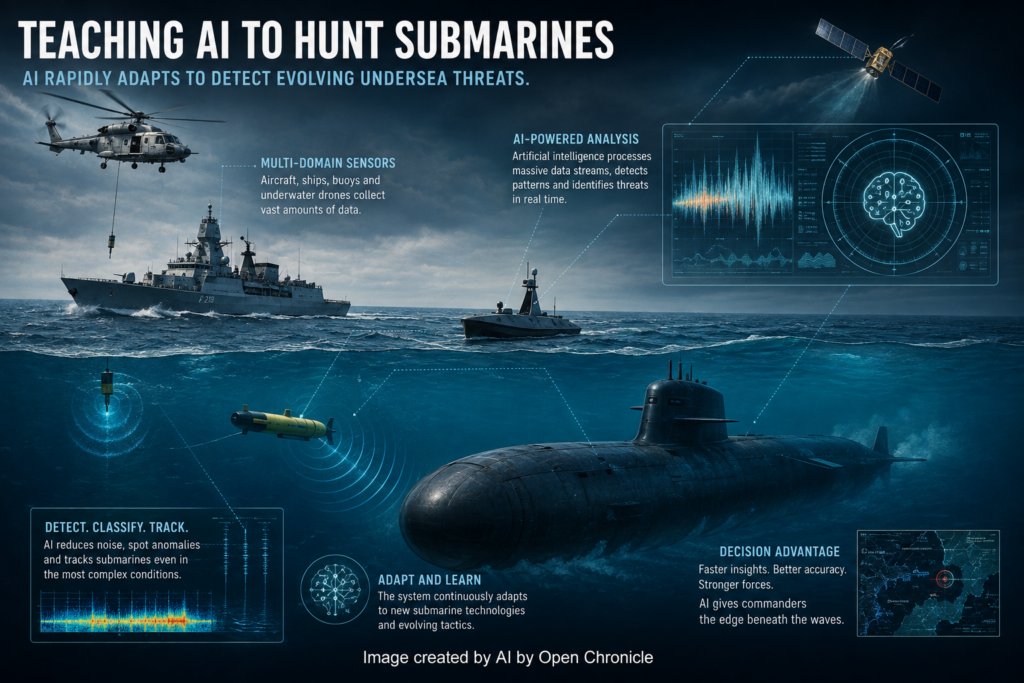
Modern machine learning systems can analyse enormous volumes of sensor information, identify patterns that human operators might overlook and adapt more rapidly as submarine technologies and tactics evolve. The objective is not simply to automate sonar analysis, but to create increasingly intelligent networks capable of detecting, classifying and tracking elusive underwater threats.
If successful, AI could transform anti-submarine warfare, one of the most demanding disciplines in modern military operations.
The ocean remains one of warfare’s greatest hiding places
Submarines are difficult to find for a fundamental reason: the ocean is enormous.
Water also behaves very differently from air.
Temperature, pressure, salinity, and depth affect how sound travels. Acoustic signals can bend, reflect, and disappear across different layers of water.
Weather and sea conditions introduce additional complexity.
Commercial vessels generate enormous amounts of background noise. Whales and other marine animals produce their own acoustic signatures. Underwater geological activity can further complicate the picture.
A submarine operating carefully within this environment can become extremely difficult to distinguish from the surrounding acoustic landscape.
This is why anti-submarine warfare has traditionally required highly trained specialists capable of interpreting incomplete and sometimes ambiguous information.
AI offers another set of eyes and ears.
Teaching machines what submarines sound like
Machine learning is particularly well suited to pattern recognition.
Instead of programming a computer with a rigid instruction saying that a particular sound always represents a submarine, researchers can train algorithms using large collections of acoustic data.
The system learns patterns associated with different sources.
A merchant vessel produces one type of signature.
Marine life produces another.
Environmental noise has its own characteristics.
A submarine’s machinery, propulsion system, and movement through water can create still others.
The challenge is identifying meaningful differences when those signals are weak, distorted or deliberately concealed.
This is where AI potentially becomes valuable.
Algorithms can process far more acoustic information simultaneously than a human operator and continuously compare incoming signals against previously learned patterns.
The target does not remain the same
There is another problem.
Submarines evolve.
New propulsion systems can make them quieter. Machinery changes. Hull designs improve. Crews alter operating procedures.
A detection system trained exclusively against yesterday’s submarine could gradually become less effective.
Modern AI research therefore increasingly focuses on systems capable of adapting when the underlying threat changes.
Rather than treating classification as a fixed problem, machine learning can potentially identify subtle changes in acoustic behaviour and adjust its models accordingly.
That ability could significantly reduce the time required to respond to new submarine classes or modified adversary tactics.
In undersea warfare, adaptation speed can be as important as raw detection performance.
From sonar operator to AI-assisted analyst
Artificial intelligence is unlikely to eliminate the human sonar operator.
Its more immediate role is to reduce the enormous analytical burden placed on crews.
Imagine an anti-submarine aircraft receiving information from dozens of sensors.
Sonobuoys are listening across a large section of ocean.
The aircraft’s own systems are gathering additional information.
Surface ships contribute sonar data.
Uncrewed underwater vehicles may be searching elsewhere.
Satellites and intelligence systems add further clues.
A human team must somehow turn all of that into an answer to one question:
Where is the submarine?
AI can help organise the problem.
Instead of forcing operators to examine every signal individually, algorithms can highlight anomalies, rank possible contacts and identify patterns worthy of human attention.
The operator then concentrates on the most significant information.
Finding a submarine is a data fusion problem
Future anti-submarine warfare will increasingly depend on combining different types of sensors.
Passive sonar listens without transmitting.
Active sonar sends acoustic energy into the water and analyses returning echoes.
Magnetic anomaly detectors can identify disturbances associated with large metallic objects.
Radar and electro-optical sensors can detect submarines when they expose masts or operate near the surface.
Satellites may contribute environmental and intelligence information.
Uncrewed systems can extend surveillance into areas where deploying crewed ships or aircraft would be expensive or dangerous.
Each sensor provides only part of the picture.
AI can potentially combine them.
A weak acoustic contact might mean little by itself.
But combine that contact with unusual movement detected elsewhere, environmental conditions favourable to submarine operations and intelligence indicating that an adversary submarine recently left port, and the probability becomes more significant.
The power of AI may therefore lie less in any individual sensor than in its ability to connect information across an entire network.
Uncrewed systems could become persistent submarine hunters
One of the most important developments is the convergence of artificial intelligence and autonomous vehicles.
Traditional anti-submarine warfare is expensive.
Destroyers, frigates, helicopters and maritime patrol aircraft require large crews, sophisticated equipment and considerable logistical support.
Uncrewed systems could alter that equation.
Autonomous underwater vehicles can potentially remain at sea for extended periods while searching designated areas.
Uncrewed surface vessels can carry sonar arrays.
Aircraft and drones can deploy sensors across large areas.
Networks of these platforms could create persistent surveillance zones.
AI would help coordinate them, determine where additional sensing is required, and identify patterns emerging across the network.
Instead of sending one expensive warship to search an enormous area, a navy could eventually distribute dozens or hundreds of relatively inexpensive sensors.
The submarine would be fighting a network
This represents a potentially profound shift.
Historically, a submarine might attempt to evade an individual frigate, aircraft, or sonar barrier.
In the future, it may need to evade an interconnected surveillance architecture.
A passive sensor detects something unusual.
An autonomous surface vessel moves closer.
Another sensor confirms the contact.
A maritime patrol aircraft is directed toward the area.
Sonobuoys narrow the search.
A helicopter eventually establishes a firing solution.
AI could help manage the process connecting those individual events.
The submarine is therefore no longer simply hiding from a ship.
It is hiding from a distributed information system.
Quiet submarines remain extraordinarily difficult targets
Artificial intelligence does not eliminate the fundamental physics of submarine detection.
A machine learning system cannot analyse a signal that a sensor never receives.
Modern nuclear-powered submarines are increasingly quiet.
Advanced conventional submarines using air-independent propulsion or sophisticated battery technology can also operate with extremely low acoustic signatures.
Commanders can exploit oceanographic conditions to conceal their vessels.
Submarines can reduce speed, minimise machinery use and choose routes that complicate detection.
AI therefore does not make the oceans transparent.
Instead, it potentially improves the probability of extracting useful information from extremely difficult conditions.
That distinction matters.
False positives could become dangerous
AI also introduces risks.
A classification system might identify an acoustic signature as hostile when it actually belongs to a civilian vessel, marine animal, or environmental phenomenon.
During peacetime, that may waste resources.
During a military crisis, it could have much more serious consequences.
Anti-submarine warfare frequently involves uncertainty.
An algorithm providing a 92 percent probability that a contact represents an enemy submarine still leaves an 8 percent possibility that it does not.
Military commanders must decide how much confidence is sufficient before acting.
Human oversight therefore remains essential, particularly when weapons could be employed.
Adversaries will try to deceive the algorithms
Once AI becomes important to submarine detection, navies will inevitably attempt to manipulate it.
Future submarines may carry acoustic decoys designed specifically to confuse machine learning classifiers.
Electronic systems could generate misleading patterns.
Uncrewed vehicles might imitate submarine signatures.
An adversary could deliberately expose false information to influence the data used for training.
This introduces the problem of adversarial AI.
The contest would no longer involve simply making a submarine quieter.
Engineers might ask an entirely new question:
How do we make the enemy’s algorithm misunderstand what it hears?
That could create a continuous technological competition between detection systems and deception systems.
Training data becomes a strategic resource
Effective AI requires high-quality data.
For anti-submarine warfare, that creates an obvious difficulty.
Navies do not possess unlimited recordings of every adversary submarine operating under every possible condition.
Some of the most valuable acoustic intelligence is also highly classified.
The precise sound characteristics of submarines have long been treated as sensitive military information.
AI increases the value of those libraries.
Recordings gathered during exercises, surveillance operations and intelligence missions could become essential for training future detection systems.
Synthetic data and advanced simulation may help fill gaps, allowing algorithms to experience thousands of hypothetical encounters.
But simulated information must still accurately represent the physical world.
Poor training data can produce confident but unreliable systems.
AI could accelerate the detection cycle
Speed may ultimately be one of the greatest advantages.
Traditional anti-submarine warfare involves a sequence:
Detection.
Classification.
Localisation.
Tracking.
Identification.
Engagement.
Every stage consumes time.
And submarines move while the process unfolds.
AI could potentially compress that cycle.
Algorithms can continuously analyse sensor information while predicting where a contact is likely to move next.
Autonomous systems could reposition themselves before human operators have completed every analytical step.
A network might therefore maintain contact more effectively once a submarine has been detected.
That could make recovering from an initial detection increasingly difficult for the submarine commander.
Strategic submarines raise the stakes dramatically
The implications become particularly serious when ballistic missile submarines are considered.
Nuclear-powered ballistic missile submarines form one of the foundations of nuclear deterrence for the United States, Russia, China, Britain and France.
Their survivability depends heavily on remaining hidden.
An adversary cannot easily destroy a nuclear deterrent if it does not know where the submarines carrying those weapons are located.
If AI, autonomous sensors and other technologies eventually make strategic submarines significantly easier to track, the consequences could extend far beyond conventional naval warfare.
Nuclear stability itself could be affected.
A government that feared its ballistic missile submarines were becoming vulnerable might alter deployment patterns, increase alert levels or invest heavily in countermeasures.
The submarine detection revolution therefore has strategic implications well beyond the ocean.
China, Russia and NATO are watching the same technological race
Every major naval power has reasons to invest in these technologies.
The United States and its NATO allies face increasingly capable Russian submarines operating in the North Atlantic, Arctic and surrounding waters.
Russia must consider the enormous Western anti-submarine warfare network.
China is rapidly expanding its submarine fleet while simultaneously developing technologies to detect American submarines operating throughout the Indo-Pacific.
The United States must preserve the survivability of its own attack and ballistic missile submarines while improving its ability to find Chinese and Russian vessels.
The result is a technological competition in which advances in detection immediately create incentives for advances in concealment.
The ocean may never become transparent
Predictions that new technology will make submarines obsolete have appeared repeatedly throughout naval history.
Radar did not eliminate submarines.
Sonar did not eliminate them.
Satellites did not eliminate them.
Advanced maritime patrol aircraft did not eliminate them.
Artificial intelligence probably will not either.
The ocean remains simply too large, dynamic, and physically complicated.
But AI does not need to make submarines impossible to hide to transform warfare.
Even a significant improvement in detection probability could change naval planning.
If a submarine that previously had a 10 percent probability of detection in a particular environment suddenly faced a substantially greater risk, commanders would need to reconsider routes, tactics and missions.
Small improvements accumulated across enormous sensor networks can produce strategic consequences.
A new contest beneath the waves
The future of submarine warfare may therefore become a contest between two increasingly intelligent systems.
One side will attempt to disappear.
Quieter propulsion, improved hulls, sophisticated coatings, decoys, environmental exploitation and deceptive tactics will make submarines harder to locate.
The other will attempt to see through that concealment.
Artificial intelligence, autonomous vehicles, distributed sonar networks, satellites and massive sensor fusion systems will search continuously for patterns revealing where submarines are hiding.
Neither side is likely to achieve permanent dominance.
Every detection breakthrough will encourage another concealment technology.
Every quieter submarine will create demand for more sensitive sensors and better algorithms.
The result could be one of the most sophisticated technological competitions in modern warfare.
For decades, anti-submarine warfare depended on extraordinarily skilled sailors and aviators listening carefully for faint clues in an immense ocean.
Those specialists are not disappearing.
But increasingly, something will be listening alongside them.
Artificial intelligence is learning the ocean.
And one of the things it is being taught to find is the submarine trying desperately not to be heard.