
By Open Chronicle History Desk
On August 25, 1944, after more than four years of German occupation, Paris was liberated.
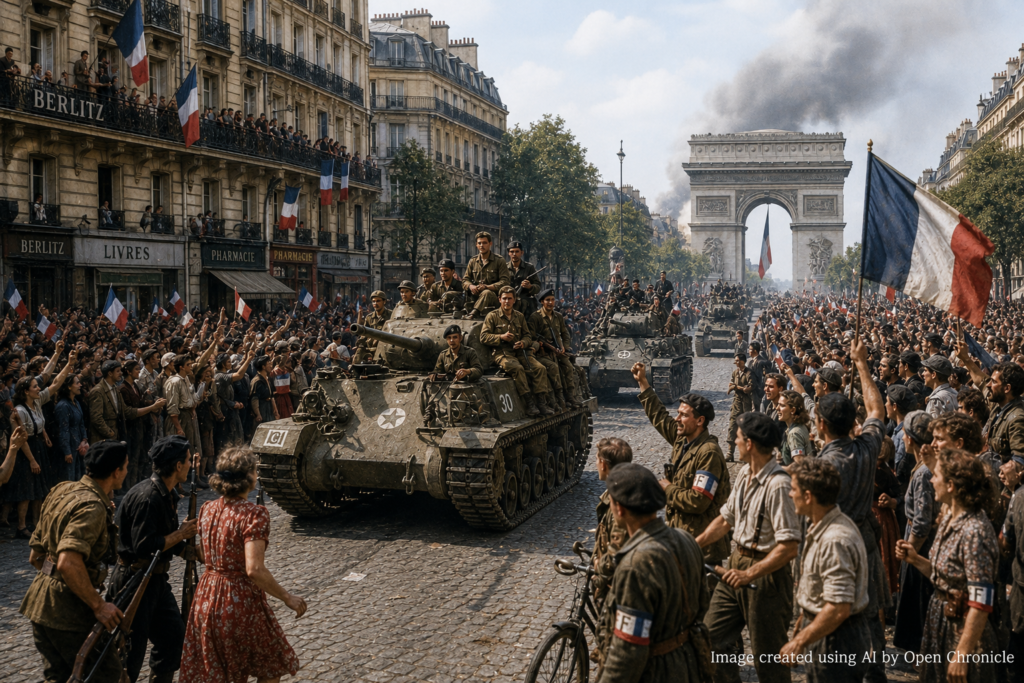
French and Allied troops moved through streets filled with crowds. Tricolour flags appeared from windows and balconies. Bells rang across the capital. Members of the French Resistance emerged openly after years of clandestine struggle. German positions surrendered one after another.
At the Hôtel Meurice, the German military governor of Paris, General Dietrich von Choltitz, was captured and taken to the headquarters of the French Resistance.
Later that day, at the Hôtel de Ville, General Charles de Gaulle delivered words that would become inseparable from the memory of liberation:
“Paris! Paris outraged! Paris broken! Paris martyred! But Paris liberated!”
The moment was more than a military victory.
Paris was the political, cultural and symbolic heart of France. Its liberation represented the collapse of German authority over the capital, the resurgence of French sovereignty and the beginning of the end of four years of occupation, collaboration, persecution and resistance.
Yet the liberation had not been inevitable.
Only days earlier, Adolf Hitler had demanded that Paris be defended. Bridges and strategic installations had been prepared for destruction. Fighting had broken out between German troops and French resistance forces. Allied commanders initially intended to bypass the city.
Instead, an uprising inside Paris transformed the strategic situation.
French civilians, police officers, resistance fighters, soldiers and Allied forces converged upon the capital.
By August 25, Nazi rule over Paris was finished.
The Fall of France
To understand the emotion of August 1944, it is necessary to return to the catastrophe of 1940.
On May 10, Nazi Germany launched its offensive against France, Belgium, Luxembourg and the Netherlands.
French and British military planners expected the main German attack to come through Belgium, as it had during the First World War.
German forces instead achieved a decisive breakthrough through the Ardennes.
Armoured formations crossed the Meuse near Sedan and drove rapidly toward the English Channel.
The Allied armies were divided.
British forces evacuated from Dunkirk.
The French military position collapsed with extraordinary speed.
Paris was declared an open city in an effort to prevent its destruction.
On June 14, 1940, German troops entered the French capital.
For Parisians, the sight was almost unimaginable.
The swastika flew over public buildings.
German soldiers marched along the Champs Élysées.
France, one of Europe’s great military and political powers, had been defeated in six weeks.
Paris Under Occupation
German occupation transformed everyday life.
Paris remained visually magnificent, but the city existed under foreign military authority.
German officers occupied hotels and public buildings.
Signs appeared in German.
Military vehicles travelled through familiar streets.
Curfews restricted movement.
Food shortages became increasingly severe.
Fuel was scarce.
Electricity could be limited.
Rationing shaped daily existence.
The black market flourished.
German propaganda appeared throughout the city.
For some Parisians, survival required compromise.
For others, occupation became an opportunity for collaboration.
For still others, resistance became a moral and political necessity.
Paris during the occupation was therefore not a simple story of occupiers and resisters.
It was a city filled with fear, adaptation, compromise, opportunism, courage and betrayal.
Vichy France
France itself had been divided by the armistice of June 1940.
Northern and western regions were occupied by Germany.
A French government headquartered at Vichy controlled the unoccupied zone until Germany occupied the remainder of the country in November 1942.
Marshal Philippe Pétain, the celebrated First World War commander of Verdun, became head of the Vichy regime.
Vichy pursued a policy of collaboration with Nazi Germany.
It also implemented its own authoritarian political programme known as the National Revolution.
Democratic institutions were dismantled.
Political opponents were persecuted.
Antisemitic legislation excluded Jews from many areas of public and professional life.
French authorities participated in the persecution and deportation of Jews.
This history would become one of the darkest aspects of occupied France.
The Persecution of the Jews
Paris had possessed a large and diverse Jewish population before the war.
Under German occupation and Vichy legislation, Jewish residents faced escalating persecution.
They were required to register.
Businesses were confiscated.
Restrictions multiplied.
From June 1942, Jews in the occupied zone were ordered to wear the yellow star.
Then came mass arrests.
On July 16 and 17, 1942, French police arrested more than 13,000 Jews in the Vel d’Hiv Roundup.
Thousands, including children, were confined in terrible conditions at the Vélodrome d’Hiver before being transferred to camps.
Many were eventually deported to Auschwitz.
Few returned.
The liberation of Paris in 1944 therefore came after years in which state institutions and occupying forces had participated in systematic persecution.
For many families, liberation came too late.
The Birth of Free France
Not all French leaders accepted defeat.
On June 18, 1940, from London, the relatively little known Brigadier General Charles de Gaulle broadcast an appeal urging French people to continue the struggle.
De Gaulle rejected the idea that France’s defeat was final.
The war, he argued, was global.
France could fight from its empire and alongside Britain.
His movement became known as Free France.
Initially, de Gaulle possessed limited forces and uncertain political legitimacy.
But over the following years his position strengthened.
Free French forces fought in Africa, the Middle East, Italy and elsewhere.
By 1944, de Gaulle had become the dominant political figure representing a France that claimed continuity with the Republic rather than with Vichy.
That distinction would become crucial when Paris was liberated.
Resistance
Inside occupied France, resistance developed gradually.
There was no single Resistance.
Different organisations emerged from diverse political traditions.
Gaullists.
Communists.
Socialists.
Conservatives.
Christians.
Trade unionists.
Foreign immigrants.
Jewish resistance groups.
Former soldiers.
Ordinary citizens.
Their activities varied enormously.
Some distributed underground newspapers.
Others gathered intelligence.
Railway workers sabotaged transportation.
Networks helped Allied airmen escape.
Resistance groups attacked German forces and collaborators.
Weapons were hidden.
Information was transmitted to London.
The risks were enormous.
Arrest could mean torture, imprisonment, deportation or execution.
Families could also suffer reprisals.
Yet the movement grew.
Jean Moulin and Resistance Unity
One of the most important figures in unifying the Resistance was Jean Moulin.
A former prefect, Moulin was sent to France by de Gaulle to coordinate the fragmented resistance organisations.
His work helped create the National Council of the Resistance in 1943.
The achievement was politically important.
De Gaulle needed more than military resistance.
He needed evidence that his movement represented a broad national coalition capable of governing liberated France.
Moulin did not live to see liberation.
He was arrested by the Gestapo in June 1943.
He was tortured and died while being transported toward Germany.
By 1944, however, the organisational foundations he had helped construct were playing an important role in the struggle for France.
D Day Changes Everything
On June 6, 1944, Allied forces landed in Normandy.
Operation Overlord opened the long awaited Western Front.
American, British, Canadian and other Allied forces established beachheads and began fighting their way through Normandy.
Progress was initially slow.
The bocage countryside favoured defenders.
German resistance was fierce.
Then, in late July, American forces broke through during Operation Cobra.
The German position in Normandy began collapsing.
Allied armies advanced rapidly.
German forces suffered devastating losses in the Falaise Pocket.
The road toward the Seine and Paris opened.
For Parisians, liberation suddenly seemed possible.
Should the Allies Liberate Paris?
Despite its enormous symbolic importance, Paris was not initially the principal Allied military objective.
General Dwight D. Eisenhower, Supreme Allied Commander, was focused on destroying German forces and advancing toward Germany.
Paris presented logistical problems.
A city containing millions of inhabitants would require enormous quantities of food and fuel.
Urban fighting could also cause catastrophic destruction and delay the Allied advance.
Military planners therefore considered bypassing Paris.
The capital could be isolated while Allied armies continued eastward.
From a strictly operational perspective, the argument had logic.
Politically, however, Paris could not easily be treated as just another city.
And events inside the capital were about to make bypassing it much more difficult.
Resistance Prepares for Insurrection
As German armies retreated across France, resistance activity intensified.
In Paris, tension grew throughout August.
Different resistance factions disagreed about timing.
Some feared that a premature uprising could lead to a massacre similar to what was unfolding in Warsaw, where Polish resistance fighters had risen against German occupation on August 1 without sufficient outside military support.
Others believed the moment had arrived.
The political dimension was also important.
Whoever controlled Paris during liberation would possess enormous influence over post occupation France.
Communist resistance organisations were powerful.
Gaullist representatives wanted to ensure that legitimate French republican authority emerged immediately.
The liberation of Paris would therefore be both a military and political contest.
The Paris Police Revolt
On August 15, Paris police began striking.
Postal workers and other public employees also joined strikes.
The machinery of occupation was beginning to fracture.
On August 19, resistance fighters and police seized important government buildings and police headquarters.
Barricades appeared across the city.
The imagery evoked earlier Parisian revolutions.
Cobblestones were torn from streets.
Vehicles were overturned.
Furniture and other materials were piled into defensive positions.
French flags appeared.
Resistance fighters attacked German patrols and installations.
German forces responded.
Paris was in revolt.
Henri Rol Tanguy
A central military figure in the uprising was Henri Rol Tanguy, the Communist commander of the French Forces of the Interior in the Paris region.
Rol Tanguy had fought in the Spanish Civil War before becoming active in the French Resistance.
From an underground command post beneath Paris, he helped coordinate the insurrection.
His forces possessed enthusiasm but limited heavy weaponry.
The danger was obvious.
If German forces launched a full scale counterattack, resistance fighters could be overwhelmed.
Paris needed Allied troops.
Raoul Nordling and the Truce
During the uprising, Swedish consul general Raoul Nordling played an important intermediary role.
Nordling negotiated with German authorities, including Dietrich von Choltitz.
A temporary truce was arranged.
The ceasefire was imperfect and controversial.
Some resistance groups regarded it as necessary to gain time.
Others wanted the fighting to continue.
The negotiations nevertheless helped create breathing space while the military situation outside Paris developed.
But the uprising could not remain suspended indefinitely.
Hitler’s Orders
Adolf Hitler understood the symbolic importance of Paris.
He did not want the city simply handed to the Allies.
German preparations included plans to destroy bridges and strategic infrastructure.
Hitler issued demands that Paris be defended.
The story of the liberation later became inseparable from the famous question attributed to Hitler:
“Is Paris burning?”
The precise details of Hitler’s orders and the degree to which the destruction of the entire city was technically prepared have been debated.
What is clear is that significant demolition plans existed and that Hitler expected resistance rather than an orderly surrender.
Paris contained bridges, transport infrastructure, government buildings and monuments of enormous strategic and symbolic value.
Had major demolitions been carried out, the consequences could have been devastating.
Dietrich von Choltitz
The man responsible for German forces in Paris was General Dietrich von Choltitz.
He had been appointed military governor shortly before the liberation crisis.
Choltitz would later portray himself as the man who saved Paris by refusing Hitler’s destruction orders.
That image became enormously influential, particularly after the publication of his memoirs and the book and film Is Paris Burning?
Modern historians treat the claim more cautiously.
Choltitz was not a humanitarian opponent of Nazi warfare.
Earlier in the war he had participated in destructive operations and served Hitler’s military system.
His ability to destroy Paris completely has also sometimes been exaggerated.
Nevertheless, he ultimately did not carry out large scale destruction of the capital’s bridges and monuments.
Whether motivated by military realism, recognition that Germany had lost control, concern for Paris, self preservation or a combination of factors, the result was historically significant.
Paris survived.
Leclerc Wants Paris
One French commander was determined that French soldiers should participate directly in liberating the capital.
General Philippe Leclerc, commander of the French 2nd Armored Division, had fought for Free France since the early years of the war.
His division had landed in Normandy and fought alongside American forces.
Leclerc understood the political importance of Paris.
So did de Gaulle.
France could not appear merely to be liberated by foreign armies.
French forces needed to enter their own capital.
As reports of the uprising became increasingly urgent, pressure grew to redirect Allied troops toward Paris.
Eisenhower agreed.
The 2nd Armored Division Moves
Leclerc’s division was ordered toward Paris.
The advance was not easy.
German forces still resisted.
Roads were crowded.
Military traffic created delays.
But the destination was clear.
Paris was waiting.
Among the soldiers advancing toward the city were men with remarkable personal histories.
One unit would acquire particular symbolic importance.
La Nueve
The 9th Company of the Régiment de marche du Tchad was known as La Nueve, the Ninth.
Many of its soldiers were Spanish Republicans who had fled Spain after Francisco Franco’s victory in the Spanish Civil War.
They had already fought fascism once.
Now they served in Free French forces.
Their armoured vehicles carried names recalling battles and political memories from Spain, including Guadalajara, Teruel and Ebro.
On the evening of August 24, elements of La Nueve entered central Paris.
They were among the first Allied troops to reach the Hôtel de Ville.
The symbolism is extraordinary.
Men driven from Spain by Franco’s victory became some of the first soldiers of the Allied liberation to enter the heart of Paris.
For decades, their role received relatively limited public attention.
Today, their contribution is increasingly recognised.
August 24: Allied Troops Enter Paris
News spread rapidly.
French armoured vehicles were entering the city.
Crowds poured into streets despite continuing danger.
Church bells began ringing.
Notre Dame’s great bell joined the celebration.
After four years of occupation, the sound carried extraordinary emotional meaning.
But Paris was not yet completely secure.
German positions remained.
Snipers fired.
Street fighting continued.
The full weight of Leclerc’s division would arrive the following day.
August 25: The Battle for the Capital
On August 25, the French 2nd Armored Division entered Paris in force.
American troops of the 4th Infantry Division also moved into the capital.
French tanks and infantry advanced against remaining German positions.
Fighting occurred around key sites.
German strongpoints were reduced.
Resistance fighters assisted the advancing troops.
The occupation was collapsing street by street.
Leclerc established his command at the Montparnasse railway station.
The decisive moment approached.
The German Surrender
Dietrich von Choltitz was captured at the Hôtel Meurice, which had served as his headquarters.
He was taken to the Paris police headquarters and later to Montparnasse.
There, surrender documents were signed.
The German garrison of Paris was ordered to lay down its arms.
Henri Rol Tanguy’s participation in the surrender process became symbolically important because it recognised the contribution of the internal Resistance.
The city was liberated.
But the political battle over what liberation meant had already begun.
De Gaulle Enters Paris
Charles de Gaulle arrived in Paris on August 25.
His objective extended far beyond celebration.
He intended to demonstrate immediately that France possessed its own legitimate government.
The Allies had previously considered administering liberated French territory through the Allied Military Government of Occupied Territories.
De Gaulle strongly opposed such a possibility.
France, he insisted, was not an enemy country being occupied.
The French Republic had never legitimately ceased to exist.
Vichy was illegitimate.
The provisional government he led therefore represented French sovereignty.
Paris offered the perfect stage on which to establish that claim.
“Paris Liberated!”
At the Hôtel de Ville, de Gaulle delivered one of the most famous speeches in modern French history.
He spoke of Paris as outraged, broken and martyred, but liberated.
His language deliberately emphasised French agency.
Paris had been liberated by itself, by its people, with the assistance of the armies of France and the support of the Allies.
This interpretation simplified reality.
American military power had been indispensable.
British and Commonwealth efforts had been indispensable to the wider campaign.
The Soviet Union was simultaneously destroying enormous German forces in the east.
France itself had experienced collaboration as well as resistance.
Yet de Gaulle was not delivering a detached historical analysis.
He was rebuilding national authority.
France needed a story capable of restoring political continuity after the trauma of 1940.
August 26: The Champs Élysées
The following day produced the defining visual image of liberation.
De Gaulle walked down the Champs Élysées toward Notre Dame.
Hundreds of thousands of people filled the avenue and surrounding streets.
The Arc de Triomphe stood behind the procession.
French flags covered buildings.
Crowds pressed forward.
De Gaulle’s enormous physical stature made him visible above many of those around him.
The procession demonstrated something politically fundamental.
There would be no power vacuum.
De Gaulle was presenting himself as the embodiment of restored French state authority.
Gunfire was heard near Notre Dame, creating panic and confusion.
The exact origins of some shooting remain uncertain.
De Gaulle continued.
His refusal to seek cover reinforced the image of confidence and authority that he wanted France to see.
Liberation Was Not the End of the War
Paris was free.
France was not yet completely liberated.
And the war in Europe was far from over.
German forces continued occupying parts of France.
Allied armies pushed toward Belgium, the Netherlands and Germany.
Operation Market Garden would fail in September.
The Battle of the Bulge would erupt in December.
The fighting would continue until Germany surrendered in May 1945.
French troops themselves would participate in the final campaigns into Germany.
Paris was therefore not the end.
But psychologically, it felt like the recovery of France.
The Épuration
Liberation also brought vengeance and reckoning.
People accused of collaborating with German authorities were arrested.
Some were executed without formal trials during the period known as the épuration sauvage, the wild purge.
Women accused of relationships with German soldiers were publicly humiliated.
Many had their heads shaved before crowds.
These scenes became among the most disturbing images of liberation.
Later, the French state attempted to bring the process under legal control through formal trials and judicial proceedings.
Philippe Pétain was convicted of treason and sentenced to death, although de Gaulle commuted the sentence to life imprisonment.
Pierre Laval, a leading Vichy politician, was executed.
The challenge was enormous.
How could France punish collaboration while rebuilding a functioning society in which millions had lived under occupation?
The Myth of a Nation of Resisters
After the war, French national memory often emphasised resistance.
De Gaulle had strong political reasons to promote the idea of a France that had collectively resisted occupation.
The French Communist Party also developed its own powerful resistance narrative.
This helped rebuild national unity.
But it obscured uncomfortable realities.
Not everyone resisted.
Some collaborated actively.
Many attempted simply to survive.
French institutions participated in persecution.
The Holocaust in France could not be understood solely as something imposed by Germans.
Over subsequent decades, historians increasingly examined these complexities.
The liberation remained a moment of genuine national joy.
But understanding occupation required moving beyond comforting myths.
The Jews Who Did Not Return
Celebrations in August 1944 were accompanied by absence.
Thousands of Jewish families had been torn apart.
Approximately 76,000 Jews were deported from France during the Holocaust.
Most were murdered.
When survivors returned from camps, they often discovered that relatives were dead, homes occupied and possessions gone.
For them, liberation could not restore the world that had existed before occupation.
This is essential to remembering August 1944.
Liberation ended German rule.
It could not undo what occupation had done.
The Survival of Paris
One of the remarkable aspects of the liberation is what did not happen.
Paris did not become another Stalingrad.
It did not become another Warsaw.
It was not reduced to ruins through prolonged urban combat.
Major monuments survived.
The Eiffel Tower remained standing.
Notre Dame survived.
The Louvre survived.
The bridges across the Seine remained largely intact.
The city’s architectural heritage escaped the destruction experienced by so many European cities.
This was partly the result of the rapid military collapse of the German position.
It was partly the result of decisions made by German commanders.
It was partly the result of Allied strategy and French action.
Whatever combination of causes one emphasises, the result was extraordinary.
The capital survived its liberation.
Paris and Warsaw
The contrast with Warsaw is especially haunting.
The Warsaw Uprising had begun on August 1, 1944.
The Polish Home Army attempted to liberate its capital from German occupation as Soviet forces approached.
The Germans responded with extraordinary brutality.
Entire districts were destroyed.
Civilians were massacred.
The uprising was eventually crushed.
Afterward, German forces systematically demolished much of Warsaw.
Paris rose only weeks later.
Its uprising ended very differently.
Allied armies were close enough and able to intervene.
The German military situation in France was collapsing.
The political circumstances were different.
One European capital was liberated.
Another was destroyed.
The comparison demonstrates how narrow the distance between triumph and catastrophe could be in 1944.
The Political Victory of Charles de Gaulle
For de Gaulle, liberation was also an extraordinary political victory.
In 1940 he had been a relatively obscure general speaking from London.
The Vichy regime condemned him.
Many Allied leaders found him difficult.
Franklin D. Roosevelt in particular remained suspicious of his ambitions and political legitimacy.
Yet in August 1944, de Gaulle walked through Paris at the head of a restored French political authority.
There was no Allied military government.
France would govern itself.
The provisional government moved quickly to restore republican institutions.
Women received the right to vote, a reform enacted earlier in 1944 and first exercised nationally in 1945.
Major economic and social reforms followed.
The postwar French state began emerging from the ruins of occupation.
The Return of the Republic
De Gaulle rejected the idea that a new republic needed to be proclaimed in Paris.
From his perspective, the Republic had never ceased to exist.
Vichy had been an illegal interruption.
This constitutional interpretation carried enormous symbolic power.
France had been defeated.
Its territory had been occupied.
Its government had collaborated.
But republican legitimacy, de Gaulle argued, had survived through Free France and the Resistance.
The liberation therefore represented restoration rather than creation.
That narrative became central to postwar French political identity.
Women and the Liberation
Women played important roles throughout the Resistance.
They carried messages.
Hid fugitives.
Gathered intelligence.
Printed underground newspapers.
Transported weapons.
Served as liaison officers.
Some participated directly in armed resistance.
Yet their contributions were often underrepresented in postwar commemorations.
The liberation period also exposed sharp gendered inequalities.
Women accused of intimate relationships with German soldiers were subjected to highly visible public humiliation, while many male forms of economic and political collaboration were treated differently.
The contrast reveals how national anger could be directed through existing social assumptions about gender, honour and sexuality.
Modern scholarship has increasingly recovered the complex experiences of women during occupation and liberation.
Foreign Fighters in the Liberation
The liberation of Paris is often presented as a French national event, understandably so.
But the forces involved were international.
American troops entered the city.
Spanish Republicans served in Leclerc’s division.
Soldiers from France’s colonial empire had played major roles in Free French and Allied campaigns.
North African troops had fought across Italy and France.
African soldiers had contributed to the liberation struggle, even though political decisions about which units would enter Paris reflected racial and imperial considerations.
The wider liberation of France depended upon armies drawn from across continents.
Remembering that diversity provides a fuller picture of the Allied victory.
Paris Becomes a Symbol
Images of the liberation travelled around the world.
Crowds celebrating beneath the Arc de Triomphe.
French flags hanging from windows.
Resistance fighters carrying weapons.
American soldiers surrounded by civilians.
De Gaulle walking down the Champs Élysées.
These photographs became visual shorthand for the liberation of Western Europe.
Paris carried cultural weight unlike almost any other city.
It was associated internationally with art, literature, fashion, revolution and political thought.
Its liberation therefore possessed symbolic power far beyond France.
A city that had embodied the humiliation of 1940 now embodied the reversal of Nazi conquest.
Memory and Reality
The liberation of Paris has been repeatedly reconstructed through memoirs, photographs, documentaries, novels and films.
The story naturally lends itself to drama.
An occupied capital rises.
Barricades appear.
Hitler demands destruction.
French tanks race toward the city.
Resistance fighters emerge.
Church bells ring.
The German commander surrenders.
De Gaulle enters.
The tricolour returns.
All of these elements are real.
But history becomes richer when the triumphant narrative is placed alongside complexity.
The Resistance was politically divided.
The Allies debated whether to enter Paris.
Choltitz’s motives remain disputed.
Collaboration did not disappear when flags changed.
Jewish families remained devastated.
Political factions competed to shape the meaning of liberation.
Victory was genuine.
So were the contradictions.
Why August 25 Matters
August 25, 1944, was one of the great symbolic days of the Second World War.
Four years earlier, German soldiers had marched through a defeated Paris.
Now German troops were surrendering inside the same city.
The French flag returned.
Resistance fighters emerged from hiding.
French armoured vehicles moved through streets that had lived beneath the swastika.
American soldiers entered alongside them.
Church bells announced what millions had waited years to hear.
Paris was free.
But the significance of the moment reached beyond the capital.
The liberation demonstrated the collapse of German power in France.
It restored a centre of French political authority.
It strengthened Charles de Gaulle’s claim to lead the country.
It allowed France to present itself not merely as a liberated territory but as an Allied nation recovering its sovereignty.
The occupation had lasted 1,526 days.
During those years, Paris had known shortages, censorship, repression, collaboration, deportation and resistance.
Some had accommodated themselves to occupation.
Some had profited from it.
Some had fought it.
Some had been murdered by it.
Liberation could not erase those histories.
But it changed what came next.
On August 25, de Gaulle stood before a city that had endured defeat and occupation and declared that Paris had been liberated.
The following day he walked through enormous crowds on the Champs Élysées.
Behind him lay the humiliation of 1940.
Ahead lay the reconstruction of France.
Around him stood hundreds of thousands of people celebrating something that, only weeks earlier, had still seemed uncertain.
The German occupation of Paris was over.
The Republic had returned.
And one of Europe’s greatest cities had survived the war without suffering the destruction Hitler had demanded.