
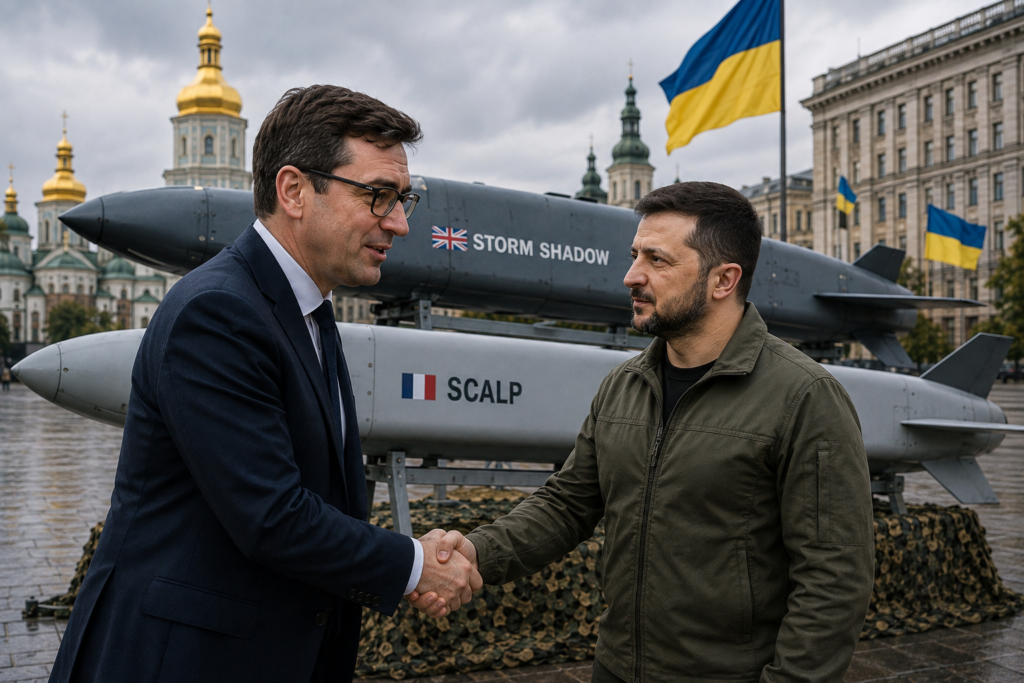
Image Credits: UK to Share Classified Storm Shadow Technology as Ukraine Moves Toward Domestic Long Range Missile Production. AI-generated illustration created by Open Chronicle using ChatGPT (OpenAI). August 2026. This image is illustrative and does not depict a real-world scene.
By Open Chronicle Defence with agencies
The United Kingdom will provide Ukraine with classified technical information related to British components used in the Storm Shadow and SCALP cruise missile family, helping Kyiv develop the ability to assemble its own long-range precision strike weapons.
British Prime Minister Andy Burnham announced the initiative during a visit to Kyiv for Ukraine’s Independence Day, saying European missile manufacturer MBDA would release technical details concerning British made components incorporated into the SCALP missile.
The initiative represents another significant step in the transformation of Western military assistance to Ukraine. Rather than simply supplying finished weapons from existing European inventories, Britain and France are increasingly helping Ukraine develop the industrial and technical capacity to manufacture sophisticated weapons itself.
The immediate battlefield impact, however, is expected to be limited. Defence specialists caution that Ukrainian assembled missiles are unlikely to become operational before 2027 at the earliest and will not solve Kyiv’s urgent shortage of air defence interceptors as Russia intensifies ballistic missile attacks.
Britain opens access to sensitive missile technology
The British decision involves technology associated with one of Europe’s most capable conventional long-range strike weapons.
SCALP is the French version of Britain’s Storm Shadow cruise missile. Both weapons emerged from a joint British and French development programme and share substantial technology.
MBDA will provide Ukraine with information concerning British components necessary for Ukrainian assembly of the weapon.
Transferring such information is fundamentally different from delivering missiles.
Advanced cruise missiles incorporate technologies involving navigation, propulsion, guidance, survivability and warhead integration that governments normally protect closely.
Sharing technical information therefore represents a deeper level of defence cooperation between Britain and Ukraine.
It could also reduce Kyiv’s long-term dependence on limited stocks of finished Western missiles.
What is Storm Shadow and SCALP?
Storm Shadow and SCALP are air-launched precision cruise missiles designed to attack valuable fixed targets at considerable distance.
The weapon is approximately 5.1 metres long and has a range exceeding 250 kilometres.
Its low observable characteristics and flight profile make detection and interception difficult, while an advanced navigation system allows the missile to strike targets with considerable precision.
Unlike many of the relatively inexpensive long-range drones now used extensively by Ukraine, Storm Shadow was specifically designed to destroy heavily protected military targets.
Potential targets include command facilities, ammunition storage sites, airbases and hardened infrastructure.
The missile’s warhead is particularly important.
It is designed to penetrate hardened structures before detonating, giving Storm Shadow capabilities that comparatively lightweight drone warheads cannot easily reproduce.
Ukraine already discussing production with France
Britain’s decision complements a separate initiative involving France.
Kyiv has been discussing plans with Paris to establish missile assembly infrastructure inside Ukraine, potentially allowing the country to manufacture a Ukrainian version of SCALP.
How advanced those preparations have become remains unclear.
There is also no confirmed date for the first operational missile assembled under the programme.
Douglas Barrie, a senior fellow at the International Institute for Strategic Studies, cautioned that the military significance of the programme will depend heavily on how rapidly Ukrainian assembled SCALP missiles can actually enter service.
That could take considerable time.
Missile manufacturing requires specialised components, quality control, testing facilities, trained personnel and reliable supply chains.
Establishing those capabilities during an active war presents an additional challenge because production facilities themselves could become Russian targets.
No immediate solution for Ukraine’s winter air defence problem
The announcement is strategically important, but it does not address Ukraine’s most immediate military requirement.
Arun Dawson, a researcher at King’s College London’s Freeman Air and Space Institute, cautioned that domestic SCALP production is unlikely to help Ukraine through the coming winter.
Its impact may not become visible until next year at the earliest.
“What Ukraine needs is protection from Russian ballistic missile attacks,” Dawson said.
That distinction is important.
SCALP is an offensive weapon.
Patriot is defensive.
Ukraine urgently needs both, but they solve different problems.
President Volodymyr Zelenskyy has warned that Ukraine is receiving substantially fewer Patriot air defence systems and interceptors even as Russia increases its use of ballistic missiles.
Production limitations in the United States and Europe have complicated efforts to replace the missiles Ukraine consumes defending its cities.
Long-range missiles could attack the source of Russian strikes
Although SCALP cannot intercept Russian ballistic missiles, it could potentially contribute to Ukraine’s defence in another way.
Long-range precision weapons allow Ukrainian forces to attack the infrastructure supporting Russian missile operations.
“You can use it to take out the Russian sites from which they are launching these ballistic missiles,” Dawson said.
Depending on intelligence, range and operational circumstances, deep strike weapons could threaten airbases, ammunition storage facilities, command centres and other infrastructure supporting Russian attacks.
This represents the offensive component of Ukraine’s increasingly layered approach to air defence.
Rather than relying exclusively on intercepting weapons after they have been launched, Kyiv wants the ability to disrupt the military infrastructure that launches them.
Cruise missiles provide capabilities drones cannot
Ukraine has developed an enormous long-range drone industry during the war.
These weapons have demonstrated the ability to reach targets hundreds and sometimes more than a thousand kilometres from Ukrainian territory.
They are relatively inexpensive and can be produced in substantial numbers.
But drones have limitations.
Many are comparatively slow.
They can be detected by radar or visual observation.
Electronic warfare can interfere with their navigation.
Their warheads are generally smaller than those carried by sophisticated cruise missiles.
Matthew Savill, director of military sciences at the Royal United Services Institute, said Ukrainian development of ballistic and cruise missiles would therefore complement rather than replace its drone arsenal.
A weapon such as SCALP carries a sophisticated warhead and strikes at a velocity allowing it to penetrate hardened structures and destroy buried targets in ways slower drones currently cannot easily replicate.
That creates an important combination.
Ukraine could potentially use large numbers of inexpensive drones to overwhelm or distract Russian air defences while reserving more sophisticated cruise missiles for particularly valuable or hardened targets.
Britain has supplied Storm Shadow since 2023
The United Kingdom has played an important role in developing Ukraine’s deep strike capabilities since the earlier stages of the war.
Britain became the first country to provide Ukraine with longer-range Western cruise missiles when it began supplying Storm Shadow in 2023.
The missiles significantly expanded the range of targets Ukrainian forces could attack.
Ukraine subsequently employed the weapon against Russian military facilities and targets in Russian-occupied Crimea.
Storm Shadow provided a capability that Kyiv’s forces initially lacked: a relatively stealthy, precision weapon capable of penetrating defended airspace and striking valuable infrastructure far behind the frontline.
France subsequently supplied SCALP missiles, while other Western weapons further expanded Ukraine’s precision strike arsenal.
The problem has always been numbers.
European inventories were built for the requirements of peacetime national armed forces rather than the consumption rates of a prolonged industrial war.
Domestic Ukrainian production could eventually change that equation.
From weapons donations to industrial cooperation
The British announcement reflects an important evolution in Western assistance.
During the early stages of the war, Ukraine depended heavily on weapons transferred directly from NATO inventories.
That model has inherent limitations.
Every missile sent to Ukraine leaves an allied stockpile.
Replacing sophisticated weapons can take months or years.
Production lines cannot always expand rapidly enough to match battlefield consumption.
Technology transfer offers another model.
Rather than continually supplying finished systems, Western governments can help Ukraine develop manufacturing capacity of its own.
That approach could make Ukrainian military production more sustainable while simultaneously expanding Europe’s overall defence industrial base.
It also creates deeper technological integration between Ukraine and European defence companies.
Britain developing another 500 kilometre strike weapon
The United Kingdom is simultaneously cooperating with defence companies on a different long-range strike project intended for Ukraine.
British officials have been working with industry to test a relatively inexpensive ground-launched weapon capable of striking targets more than 500 kilometres away.
The system is expected to carry a warhead weighing approximately 225 kilograms.
If successfully developed and manufactured at scale, such a weapon could occupy an important position between Ukraine’s inexpensive long-range drones and much more sophisticated cruise and ballistic missiles.
Cost is crucial.
A missile can possess impressive performance characteristics but have limited strategic effect if only a handful can be produced.
Ukraine’s wartime experience has repeatedly demonstrated the value of weapons that combine adequate capability with mass production.
Russia condemns the British decision
Moscow reacted angrily to Burnham’s announcement.
Kremlin spokesman Dmitry Peskov accused Britain of “fanning the flame” of the war by helping Ukraine expand its missile capabilities.
Burnham rejected the accusation.
“Who started the fire?” the British prime minister responded when questioned by reporters in Kyiv.
Russia has repeatedly warned Western governments against supplying Ukraine with increasingly capable long-range weapons.
Moscow argues that such assistance escalates Western involvement in the conflict.
Britain maintains that Ukraine has the right to defend itself against Russia’s invasion and that supporting Ukrainian defence does not make the UK a direct participant in the war.
The transfer of classified missile technology nevertheless represents another expansion in the depth of Western-Ukrainian military cooperation.
Domestic production changes Russia’s strategic problem
If Ukraine succeeds in producing SCALP type weapons domestically, Russia could eventually face a different strategic challenge.
Western governments have sometimes placed political or operational restrictions on how donated weapons can be employed.
Weapons manufactured by Ukraine itself give Kyiv greater control over targeting decisions.
Domestic production can also make it harder for Moscow to calculate how many weapons Ukraine possesses.
When missiles come exclusively from foreign stockpiles, Russian intelligence can attempt to estimate deliveries and remaining inventories.
A functioning domestic production line makes that calculation considerably more difficult.
Production capacity itself then becomes a strategic variable.
Manufacturing sites will become targets
That advantage creates another problem.
Russia will have powerful incentives to locate and destroy Ukrainian missile manufacturing infrastructure.
Factories assembling long-range weapons would become high-priority targets for Russian intelligence and strike forces.
Ukraine may therefore need to disperse production across multiple facilities, conceal sensitive manufacturing stages and construct hardened infrastructure.
Some components could potentially be manufactured abroad before final assembly in Ukraine.
Others may require highly protected domestic production.
The missile programme therefore becomes not simply an engineering challenge, but a counterintelligence and industrial security operation.
Ukraine is building an increasingly independent strike arsenal
The SCALP initiative fits within a much greater Ukrainian effort.
Kyiv is developing domestic cruise missiles, ballistic weapons and increasingly sophisticated long-range drones.
The objective is gradually becoming clear.
Ukraine wants an arsenal capable of threatening Russian military infrastructure at operational and strategic depth without depending entirely on decisions made in Washington, London, Paris or other allied capitals.
Western technology can accelerate that transformation.
Ukraine contributes something equally important: more than four years of experience developing and using strike systems under actual wartime conditions.
That combination could have implications extending beyond the current conflict.
A significant move, but not an immediate battlefield revolution
The British announcement should therefore be understood in two different timeframes.
In the short term, it will not solve Ukraine’s most pressing defensive problem.
Kyiv needs additional Patriot interceptors and other air defence weapons now, particularly as Russia intensifies ballistic missile attacks against Ukrainian cities and infrastructure.
Ukrainian-assembled SCALP missiles will not arrive quickly enough to change that situation this winter.
Over the longer term, however, the significance could be substantial.
Britain and France are helping Ukraine move from being primarily a recipient of European long-range missiles toward becoming a producer.
If that transition succeeds, Ukraine could eventually possess a domestically controlled arsenal combining mass-produced drones, cruise missiles and ballistic weapons.
That would fundamentally change Kyiv’s ability to conduct deep strike operations.
Britain’s decision to share classified technology is therefore about more than another weapons package.
It represents an investment in what Ukraine’s military could become after the next winter, after the next production cycle, and potentially long after the current war ends.