
By Open Chronicle with agencies
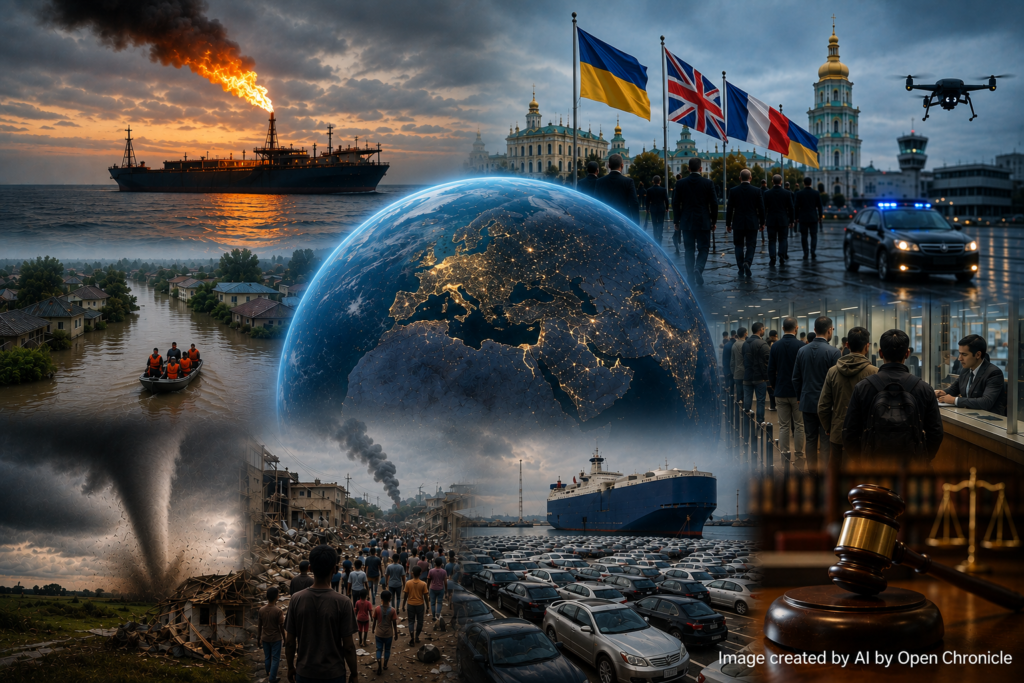
The international agenda on August 25 is being dominated by a renewed confrontation between Washington and Tehran, mounting concerns over global energy security, continuing instability from Ukraine to Haiti, and an increasingly aggressive economic and immigration agenda in the United States.
Six months into the Iran war, the consequences are spreading well beyond the battlefield. Almost half of global oil supplies are now moving through regions affected by conflict, while the United States is widening economic pressure on Tehran and warning countries that continue doing business with Iran.
Elsewhere, severe flooding has forced tens of thousands from their homes in southern China, a tornado has caused extensive damage in France, investigators in Germany are examining an apparent attempted drone attack on an airport, and another Ukrainian drone strike has hit Russian energy infrastructure.
Here are the major stories shaping the world today.
Iran vows retaliation as Washington widens sanctions
Iran has promised to respond after the United States expanded sanctions designed to further restrict Tehran’s access to international trade and revenue.
The measures form part of Washington’s attempt to tighten economic pressure on Iran six months into the conflict.
American officials are also increasing pressure on governments and companies maintaining commercial relationships with Tehran. Washington has warned countries conducting business with Iran about the possibility of secondary sanctions, although it has so far stopped short of immediately imposing penalties on all of them.
Iran, however, is signalling that it believes important trading partners will resist American pressure.
The confrontation is increasingly becoming an economic struggle alongside the military conflict, with Washington attempting to restrict the financial resources available to Tehran while Iran searches for alternative trading networks.
Almost half of global oil now flows from conflict zones
The Iran war is also reshaping global energy security.
Six months into the conflict, almost half of the world’s oil supply is moving through areas directly or indirectly exposed to military instability.
That concentration of energy flows in vulnerable regions has increased concerns about supply disruptions, shipping security and sudden price shocks.
The Persian Gulf remains one of the world’s most strategically important energy corridors, meaning any sustained disruption could rapidly affect economies far beyond the Middle East.
The consequences would be particularly serious for countries heavily dependent on imported energy.
Energy markets are therefore increasingly reacting not simply to conventional supply and demand calculations, but to military developments, shipping risks and political decisions surrounding Iran.
Pakistan and Iran report progress in talks
Diplomatic efforts surrounding the conflict continue alongside military and economic pressure.
Pakistan and Iran have reported significant progress following talks aimed at addressing the regional crisis.
Pakistan occupies an important position because of its geographical proximity to Iran and its relationships across the Islamic world.
Islamabad has an obvious interest in preventing the conflict from spreading further across the region, particularly as instability could affect trade, border security and domestic politics.
Any diplomatic channel capable of maintaining communication with Tehran could become increasingly important if the confrontation continues.
Ukraine marks Independence Day with renewed European support
Britain and France have pledged stronger support for Ukraine as the country marked the 35th anniversary of its declaration of independence from the Soviet Union.
President Volodymyr Zelenskyy thanked international leaders who travelled to Kyiv for Independence Day, presenting their presence as a demonstration of continued international solidarity.
The diplomatic symbolism comes as Ukraine continues facing Russian missile and drone attacks while simultaneously expanding its own long range strike capabilities.
Britain has also announced deeper technological cooperation with Kyiv involving long range weapons, while European governments continue examining how to maintain military assistance as their own weapons inventories come under pressure.
The war remains one of Europe’s defining security challenges more than four years after Russia’s full scale invasion.
Drone attack sets Russian oil refinery ablaze
The war also reached deeper into Russian territory on Tuesday.
A Ukrainian drone attack struck the Afipsky oil refinery in Russia, triggering a fire and killing two people, according to regional authorities.
Energy facilities have become increasingly important targets in Ukraine’s long range campaign.
Kyiv has sought to disrupt Russian refining capacity, logistics and the infrastructure supporting Moscow’s war economy.
Russia, meanwhile, continues extensive missile and drone attacks against Ukrainian cities, energy facilities and military targets.
The increasingly frequent exchange of long range strikes demonstrates how the geographical boundaries of the war have expanded far beyond the immediate frontline.
Germany investigates apparent attempted drone attack on airport
German investigators have reportedly recovered a third drone and explosives following an apparent failed attack involving Leipzig/Halle Airport.
The discovery adds to growing European concern about drones being used against civilian infrastructure.
Airports are particularly vulnerable because even relatively small unmanned aircraft can force authorities to suspend operations.
The investigation comes as European governments increasingly confront unidentified drones around military facilities, energy installations and transport infrastructure.
Authorities will now seek to determine who operated the aircraft and whether the incident formed part of a broader operation.
Philippines plans major expansion of military drone capabilities
The Philippines intends to significantly expand its unmanned military capabilities as Manila continues modernising its armed forces.
The country’s defence leadership said the strategy would involve both acquiring drones and developing domestic capabilities.
The announcement comes amid persistent tensions in the South China Sea and a wider military modernisation effort across the Indo Pacific.
Drones are becoming particularly attractive to countries seeking comparatively affordable surveillance and strike capabilities.
For the Philippines, unmanned aircraft could provide improved maritime surveillance across the country’s extensive territorial waters and disputed areas.
The move also reflects a wider transformation of military technology, accelerated dramatically by lessons from Ukraine and other recent conflicts.
China battles worsening floods in the south
Severe flooding is intensifying across southern China, submerging homes and forcing tens of thousands of people to relocate.
Authorities are responding as heavy rainfall continues to affect vulnerable regions.
The situation is developing while East Asia also monitors Typhoon Saudel and potentially dangerous weather conditions affecting areas around Japan and Taiwan.
Extreme rainfall events have repeatedly tested infrastructure across Asia in recent years.
Large urban populations, mountainous terrain and densely developed river systems can amplify the consequences when exceptionally heavy rain falls over short periods.
Emergency services are now focused on evacuations, flood control and preventing additional casualties.
Tornado damages more than 300 homes in France
France is dealing with its own severe weather emergency after a tornado struck the southwestern part of the country.
More than 300 homes were damaged and dozens of people were injured.
The tornado moved through the Aude region, producing extensive structural damage.
Such powerful tornadoes are considerably less common in France than in parts of the United States, making the scale of destruction particularly notable.
Authorities are assessing damaged buildings while emergency crews assist affected communities.
Haiti gang attack leaves 47 dead
Haiti’s security crisis has produced another devastating episode.
At least 47 people were killed and 22 injured when armed gang members attacked a community overlooking Port au Prince, according to the United Nations.
The killings have intensified anger among residents who say authorities have failed to provide adequate protection against repeated attacks.
Haiti continues to face a profound breakdown in state security, with armed groups controlling or contesting significant territory.
International efforts to stabilise the country have struggled to restore effective government control.
The latest massacre illustrates the enormous challenge facing Haitian authorities and international security partners.
Trump escalates trade confrontation with Canada
US President Donald Trump has threatened to impose 50 percent tariffs on all cars, trucks and automotive components imported from Canada beginning January 1, 2027.
The threat represents another escalation in the rapidly deteriorating trade relationship between Washington and Ottawa.
Canada has already announced retaliatory tariffs following the collapse of negotiations with the Trump administration.
The automotive sector is particularly sensitive because manufacturing networks in Canada and the United States are deeply integrated.
Components frequently cross the border several times during vehicle production.
A 50 percent tariff could therefore have consequences for manufacturers and consumers on both sides of the border.
The confrontation is also raising increasingly serious questions about the future of the USMCA continental trade framework.
Trump administration plans mass visa revocations
The Trump administration is preparing another major tightening of US immigration policy.
Washington plans to revoke business and tourism visas held by foreigners who subsequently sought asylum in the United States, potentially affecting as many as 200,000 people.
The proposal would target holders of B1 and B2 visas and could become the largest mass visa revocation operation in American history.
The administration argues that some people obtained temporary visitor visas while intending to remain permanently through asylum claims.
Critics are expected to challenge any assumption that applying for asylum automatically proves an applicant misrepresented their original intentions.
Legal challenges are therefore likely if the programme proceeds on the proposed scale.
Washington moves toward $100,000 H 1B visa fee
The administration is also moving to impose a fee exceeding $100,000 for some H 1B worker visas.
Such a dramatic increase could have major consequences for American companies that depend on highly skilled foreign workers, particularly in technology and engineering.
The H 1B programme has long been politically controversial.
Supporters argue that it allows American businesses to recruit specialised workers unavailable domestically.
Critics contend that some companies use the programme to reduce labour costs or replace American employees.
The proposed fee would significantly alter the economics of recruiting foreign professionals through the system.
Supreme Court gives Trump victory over mail voting restrictions
The US Supreme Court has removed a judicial obstacle affecting the Trump administration’s efforts to restrict mail in voting.
The decision represents an important legal victory for the administration ahead of future elections.
Mail voting has become one of the most politically contested aspects of American election administration.
Republicans have generally pushed for tighter restrictions, arguing that stronger controls improve election security.
Democrats and voting rights organisations contend that limiting postal ballots can disproportionately affect voters who rely on remote voting.
The legal battle is likely to continue as states prepare for upcoming elections.
Trump’s approval remains at record low
The president is simultaneously facing difficult domestic polling.
A Reuters/Ipsos survey indicates Trump’s approval remains at a record low while American public support for the Iran war has declined.
The figures come at a politically sensitive moment.
Republicans are preparing for a major midterm convention in Dallas as party leaders attempt to rebuild momentum ahead of congressional elections.
Economic concerns, the Iran conflict and increasingly contentious domestic policies are emerging as important electoral issues.
The political consequences of the war may therefore become increasingly significant for the White House.
US removes Syria from state sponsors of terrorism list
Washington has formally removed Syria from its list of state sponsors of terrorism.
The decision eliminates one of the largest remaining obstacles to international investment in the country and marks another significant shift in US relations with Syria’s new government.
Damascus has argued that the designation severely restricted economic reconstruction by discouraging international banks, investors and companies from entering the Syrian market.
Removing it could open the door to greater international economic engagement.
The decision also demonstrates how rapidly Syria’s geopolitical position has changed since the fall of Bashar al Assad’s government.
Washington is increasingly engaging with the new Syrian authorities even as major security questions remain unresolved.
South Korea and US reaffirm cooperation on North Korea
Seoul and Washington have pledged continued coordination over North Korea’s nuclear programme.
South Korean Foreign Minister Cho Hyun and US Secretary of State Marco Rubio agreed to maintain close communication following renewed tensions on the Korean Peninsula.
North Korea recently launched approximately 10 short range ballistic missiles despite Washington reducing the scale of joint US South Korean military exercises.
Pyongyang has indicated that the reduction is insufficient to fundamentally change its position.
The episode demonstrates the difficulty facing Washington as it attempts to explore renewed diplomacy with Kim Jong Un while maintaining military deterrence.
Lockerbie bombing trial postponed
A US federal judge has postponed the trial of the man accused of building the bomb used to destroy Pan Am Flight 103 over Lockerbie, Scotland, in 1988.
The attack killed 270 people and remains one of the deadliest terrorist incidents involving a civilian aircraft.
The postponement came only days before proceedings were expected to begin.
The case continues to carry enormous historical and emotional significance for families of the victims in Britain, the United States and other countries.
Hungary investigates $964 million pandemic ventilator deals
Hungary’s Foreign Ministry has submitted a report to prosecutors concerning suspected fraud and other potential crimes related to ventilator purchases made during the COVID 19 pandemic.
The transactions were valued at approximately $964 million.
The investigation concerns procurement undertaken in 2020, when governments across Europe competed intensely for medical equipment during the early stages of the pandemic.
Emergency purchasing programmes frequently involved unusually rapid contracts and reduced procurement procedures.
Hungarian authorities will now examine whether criminal activity occurred in connection with those purchases.
A world defined by overlapping crises
The global picture on August 25 illustrates how increasingly interconnected the world’s major crises have become.
The Iran war is affecting energy markets, sanctions policy, American domestic politics and relationships across the Middle East and Asia.
The Russia Ukraine war continues generating attacks far beyond the frontline while accelerating military investment in drones and long range weapons.
Washington is simultaneously reshaping immigration and trade policy, creating new tensions with allies and international businesses.
Climate and weather emergencies are producing destruction from southern China to France and the western United States.
Meanwhile, countries including Syria, Haiti and Myanmar remain caught in difficult political and security transitions.
No single event defines today’s international agenda.
Instead, August 25 is being shaped by the convergence of military conflict, economic confrontation, political uncertainty, technological change and extreme weather.
That combination increasingly defines the international environment of 2026, one in which events in the Persian Gulf can influence energy prices in Europe, trade decisions in Washington can disrupt factories in Canada, and technologies developed on one battlefield rapidly reshape military planning thousands of kilometres away.