
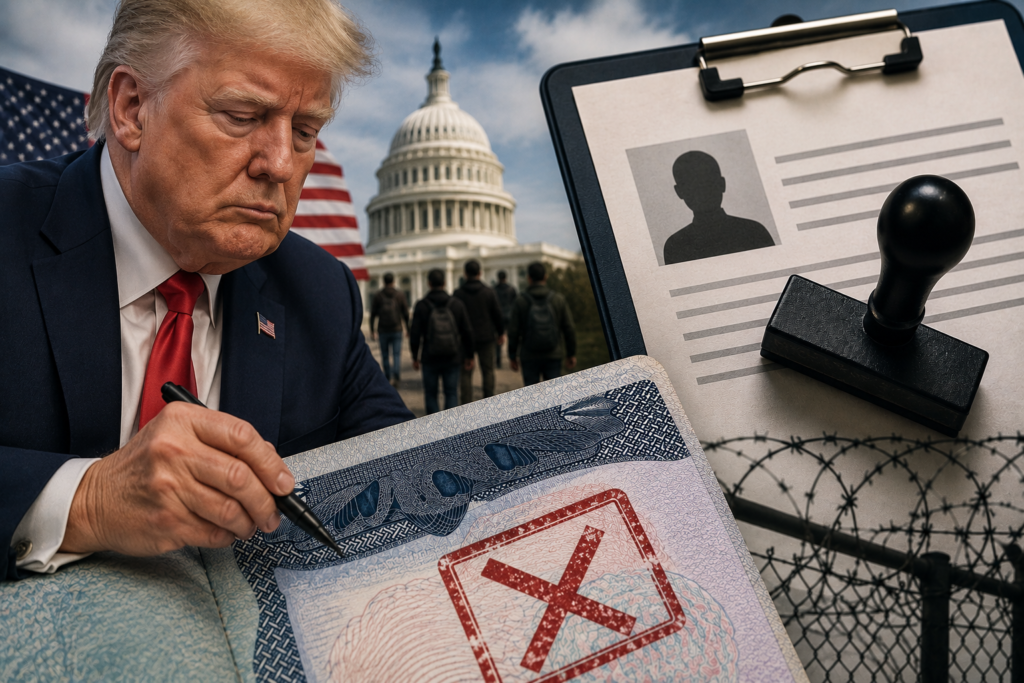
Image Credits: Trump Administration Plans Mass Visa Revocation Targeting Up to 200,000 Asylum Seekers. AI-generated illustration created by Open Chronicle using ChatGPT (OpenAI). August 2026. This image is illustrative and does not depict a real-world scene.
By Open Chronicle with agencies
The Trump administration is preparing to revoke business and tourism visas held by as many as 200,000 foreign nationals who have applied for asylum in the United States, in what could become the largest single mass visa revocation in US history.
The planned measure would target holders of B1 and B2 nonimmigrant visas issued between 2016 and 2026 who subsequently sought asylum or currently have asylum applications pending in the United States.
According to State Department documents obtained by The Associated Press and accounts from two US officials, the department is expected to begin implementing the policy in coordination with the Department of Homeland Security.
The administration argues that people who entered the United States after presenting themselves as temporary visitors and subsequently sought permanent protection through the asylum system may have misrepresented their original intentions.
The proposal is likely to become another major legal and political battleground over President Donald Trump’s increasingly restrictive immigration policies.
Up to 200,000 visas could be affected
The precise number of people who would ultimately lose their visas remains uncertain.
State Department spokesperson Tommy Pigott confirmed that the department was working with Homeland Security to identify affected individuals but declined to provide a final figure.
“We are coordinating with DHS to identify and revoke the nonimmigrant visas of foreigners who have come to the United States claiming to be short term visitors, but then file for asylum to stay here permanently,” Pigott said.
He described the process as ongoing and said revocations would occur on a rolling basis.
If the number approaches 200,000, however, the operation would represent an extraordinary use of the federal government’s authority to revoke nonimmigrant visas.
Revocation would not mean immediate deportation
Losing a B1 or B2 visa would not necessarily mean that an asylum seeker could immediately be removed from the United States.
According to officials familiar with the proposal, many people with pending asylum claims would instead be reclassified under their existing immigration proceedings.
They would lose their status as business or tourist travellers, but their asylum applications would not automatically disappear simply because the underlying visa had been revoked.
This distinction is likely to become important if the policy is challenged in federal court.
Visa status and asylum eligibility operate under different sections of US immigration law.
An individual can therefore lose the immigration status under which they originally entered the country while continuing to pursue another form of legal protection.
Administration says asylum is being used as a loophole
The policy reflects the administration’s broader argument that some foreign nationals are using temporary visas as an entry mechanism before attempting to remain permanently through the asylum system.
Deputy Secretary of State Christopher Landau made that argument publicly on Monday.
“People in the US and all over the world are fed up with bogus asylum claims,” Landau wrote on X.
“Asylum isn’t supposed to be a loophole to circumvent immigration law.”
Landau cited the example of a Colombian national who entered the United States on a tourist visa in 2015 and later applied for asylum.
The administration sees such cases as evidence that some applicants obtain temporary visas while already intending to seek permanent residence in the United States.
Critics are likely to challenge the assumption that applying for asylum after arriving as a visitor necessarily proves that an applicant misrepresented their intentions.
Circumstances in a person’s home country can change, while an individual may also decide to seek protection after entering the United States.
That distinction could become central to future litigation.
What are B1 and B2 visas?
B1 and B2 visas are among the most common categories of temporary US visas.
A B1 visa is generally intended for short term business activities, including meetings, negotiations and conferences.
B2 visas are primarily used for tourism, visiting relatives and receiving medical treatment.
Applicants are normally required to demonstrate that their stay will be temporary and that they maintain sufficient ties to their home country to return after their visit.
Current B1 and B2 applicants are also required to affirm that they do not intend to use the visa to seek asylum in the United States.
The administration appears to be using that requirement as the basis for examining whether some previous visa recipients entered under false pretences.
Screening reportedly covers a decade of visas
According to the documents, the review potentially encompasses visas issued over a ten year period, from 2016 through 2026.
The State Department reportedly began screening existing B1 and B2 visa holders after receiving information concerning asylum applications from US Citizenship and Immigration Services.
Cross referencing the two sets of records would allow officials to identify individuals who received temporary visitor visas and subsequently entered the asylum system.
The scale of the proposed review makes the operation unusual.
Rather than assessing visa holders only when specific concerns arise, the government would effectively examine an entire category of people based on their subsequent immigration activity.
Trump’s second term has brought increasingly restrictive visa policies
The planned revocations form part of a much broader tightening of US immigration and visa policy since Trump returned to the White House.
The administration has expanded scrutiny of visa applicants, including their online activities and social media histories.
Some applicants have been subjected to additional financial requirements, including expensive visa bonds.
Washington has also restricted or prohibited visa issuance to citizens of certain countries.
Together, the measures reflect an effort to extend immigration enforcement beyond the southern border and into the legal visa system.
The administration argues that greater scrutiny is necessary to prevent fraud, protect national security and ensure that temporary visas are used for their intended purposes.
State Department has already revoked around 175,000 visas
The proposed asylum related action follows an unusually active period of visa revocations.
During the past 18 months, the State Department has revoked approximately 175,000 visas, according to the information provided.
Those actions involved individuals convicted of or accused of offences ranging from drunken driving to robbery and rape.
The government has also revoked visas in cases involving political speech and public opposition to US policies, particularly concerning the Middle East.
Those actions have generated separate debates about the extent of the executive branch’s authority over foreign nationals and whether immigration powers can be used in ways that implicate freedom of expression.
Adding potentially 200,000 asylum related cases would dramatically expand the scale of the administration’s visa enforcement programme.
Legal challenges appear likely
Any mass revocation programme affecting such a large population is likely to face litigation.
Potential challenges could focus on whether the administration is treating an asylum application itself as sufficient evidence that a visitor originally lied about their intentions.
The timing of an individual’s decision to seek asylum could become particularly important.
Someone who entered the United States with a genuine intention to return home but later experienced a change in circumstances would present a different case from someone who allegedly planned to seek asylum before applying for a tourist visa.
Applying a broad policy to both groups could raise questions about due process and individual assessment.
The government’s ability to revoke visas is extensive, however, and courts have historically granted the executive branch substantial authority over immigration and admission decisions.
The legal battle would therefore involve both presidential immigration powers and the statutory protections surrounding asylum.
Asylum remains legally distinct from ordinary immigration
Asylum occupies an unusual position within the immigration system because it exists primarily as a form of protection.
Applicants generally argue that they face persecution or a credible threat if returned to their country of origin.
That means asylum cases cannot necessarily be treated in the same manner as ordinary applications to immigrate permanently.
The government can challenge the credibility of an asylum application and immigration judges can reject claims that do not meet legal requirements.
But simply applying for asylum does not establish that a claim is fraudulent.
The administration’s use of the phrase “bogus asylum claims” therefore goes to the centre of a larger political disagreement over how the American asylum system should operate.
Birth tourism also remains a target
The administration is simultaneously pursuing other measures intended to prevent temporary visas from being used to obtain longer term immigration advantages.
One area of particular focus has been so called birth tourism.
The administration argues that some pregnant foreign nationals enter the United States primarily so their children will acquire American citizenship at birth.
Trump has repeatedly sought to restrict birthright citizenship itself.
Those attempts have faced significant legal obstacles, including adverse court rulings.
The controversy illustrates the wider constitutional constraints surrounding the administration’s effort to reshape immigration policy.
The policy could affect future visa applications worldwide
The significance of the planned revocations extends beyond the people directly affected.
Future B1 and B2 applicants may face even more intensive scrutiny concerning their reasons for travelling to the United States.
Consular officials could demand stronger evidence of employment, family relationships, property ownership or other ties demonstrating that an applicant intends to return home.
Applicants from countries experiencing political instability or high levels of asylum applications could potentially face particularly close examination.
That could have consequences for legitimate tourism and business travel as well.
The United States receives millions of international visitors each year, making temporary visas an important component of tourism, commerce and international relationships.
A major expansion of Trump’s immigration strategy
The potential revocation of up to 200,000 visas demonstrates how the administration’s immigration agenda is expanding beyond conventional border enforcement.
Trump’s first term was defined partly by disputes over border walls, travel restrictions and asylum seekers arriving at the US Mexico border.
His second administration is increasingly focusing on the infrastructure of legal migration itself.
Visa applications, existing visa holders, social media screening, asylum applications and citizenship rules are all becoming parts of a broader enforcement strategy.
The central principle behind that strategy is that the government should exercise much greater control over not only who enters the United States, but also whether visitors subsequently attempt to change their immigration status.
The scale would be unprecedented
The final policy has not yet been formally announced, and the number of affected people could change.
But if the administration proceeds with anything close to 200,000 revocations, the measure would establish a new benchmark for mass visa enforcement.
The immediate consequences would vary considerably between individuals.
Some would remain legally present while their asylum cases proceed.
Others could face more complicated immigration proceedings.
Future visa applications could become considerably more difficult.
And the courts would almost certainly be asked to determine how far the executive branch can go in treating asylum applications as evidence that temporary visitor visas were improperly obtained.
The administration describes the initiative as an attempt to close an immigration loophole.
Its opponents are likely to describe it as an effort to penalise people for exercising their legal right to seek protection.
That fundamental disagreement means the battle over B1 and B2 visas could quickly become something much larger: another major test of the boundaries of presidential power over the American immigration system.